
He stressed on the need to give more attention to the industrial sector.

The output of eight core sectors grew 8.9 per cent in June, mainly due to a low base effect and uptick in production of natural gas, steel, coal and electricity, official data showed on Friday. The eight infrastructure sectors of coal, crude oil, natural gas, refinery products, fertilisers, steel, cement and electricity had contracted by 12.4 per cent in June 2020 due to the lockdown restrictions imposed to control the spread of coronavirus infections. In May this year, these key sectors had recorded a growth of 16.3 per cent, while it was 60.9 per cent in April.

Eight core sector industries recorded a growth of 5.5 per cent in February, the highest in 11 months, mainly due to healthy expansion in output of coal, refinery products and electricity, according to a government data released on Tuesday. The eight core sector industries -- coal, crude oil, natural gas, refinery products, fertiliser, steel, cement and electricity -- had expanded by 2.2 per cent in February last year.

The output of eight core infrastructure sectors contracted for the third month in a row by 1.3 per cent in December 2020, dragged down by poor show by crude oil, natural gas, refinery products, fertiliser, steel and cement sectors. The core sectors had expanded by 3.1 per cent in December 2019, according to the provisional data released by the Commerce and Industry Ministry on Friday. Barring coal and electricity, all sectors recorded negative growth in December 2020. During April-December 2020-21, the sectors' output declined by 10.1 per cent against a growth rate of 0.6 per cent in the same period of the previous year.
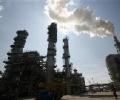
Industrial growth slowed to 3.6 per cent in February, 2011, compared to 15.1 per cent expansion in the year-ago period, dragged down by poor performance of manufacturing and mining sectors.
.jpg)
The marginal improvement in the index of industrial production was mainly on account of higher power generation and mining sector output, while manufacturing declined.

The IIP growth number of 5.6 per cent in May 2011 over May last year is the lowest in nine months. A downward trend in IIP has been seen since December 2010, with brief interludes of good news.
India's industrial output rose 6.2 per cent in October year-on-year, boosted by strong growth in the manufacturing and electricity sectors, official data released on Thursday showed.

There are glaring anomalies with Indian data and that could lead to wrong policy prescriptions.

'It is far too early to celebrate the numbers.' 'They are still fairly weak compared to the pre-pandemic level.'

The output of eight core sectors grew by 16.8 per cent in May, mainly due to a low base effect and uptick in production of natural gas, refinery products, steel, cement and electricity, official data released on Wednesday showed. The eight infrastructure sectors of coal, crude oil, natural gas, refinery products, fertilisers, steel, cement and electricity had contracted by 21.4 per cent in May 2020 due to the lockdown restrictions imposed to control the spread of the COVID-19 infections. In March this year, these key sectors had recorded a growth of 11.4 per cent, and 60.9 per cent in April.

IIP is expected to post a subdued volume growth in February 2017

The NCEAR has indicated some improvement in the fourth quarter of the current financial year.

According to the Central Statistical Organisation data, released earlier in the day, Index of Industrial Production grew by 16.7 per cent in January against just a per cent during the corresponding month in 2009.

Analysts polled by Reuters had expected an annual output growth of 3.5 per cent for the month.
IIP's contraction deals a severe blow to the Indian economy.
M&M was the top gainer in the Sensex pack, rallying around 6 per cent, followed by SBI, ITC, NTPC, Bharti Airtel and ONGC. On the other hand, Bajaj Finance, HDFC, Bajaj Finserv, Titan, Sun Pharma and Dr Reddy's were among the laggards. NSE Nifty inched up 1.40 points to its fresh closing record of 14,564.85.
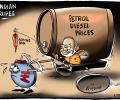
Retail inflation inches up to 3.77%; IIP growth dips to 3-month low
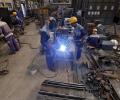
IIP down due to poor show by manufacturing, mining and power sectors

The previous low at 1.8 per cent was recorded in October 2017.

Manufacturing sector, which constitutes over 75 per cent of the index, grew at 5.5 per cent in November compared to a decline in output by 4.6 per cent earlier

Crude oil, fertiliser and cement recorded negative growth

'Everyone confuses GDP to be a measure of output, when it is actually a measure of income.'

The Sensex closed at 27,534 levels, down by 114 points or 0.4%.

The mismatch between PMI and core sector could also be due to the fact that while core sector is calculated year-on-year, PMI is calculated month-on-month.

RBI is likely to have reached broadly similar conclusions since it did cut rates, presumably to stimulate activity.
Industrial production is expected to dip marginally in the next 3 months due to rupee gaining strength against the dollar and declining non-food credit, even as petrol and diesel might become cheaper, the Institute of Economic Growth said.

Trading sentiment in the equity markets this week will be guided by global cues, Covid-19 trends and quarterly earnings by market heavyweight TCS, analysts said. Investors will also monitor movement of rupee and crude oil as well as progress of monsoon, they added.
India's index of industrial production rose by 6.4 per cent in February over the same period a year earlier, the government said on Thursday.

Month-on-month stats show industrial output shrank 4 times till Oct in 2011-12.

Output of the manufacturing sector, which constitutes over 75 per cent of the index, rose 8.5 per cent in January, compared to 8.1 per cent in the same month last year.

Industrial production grows at 2.1 per cent in March.


Leading indicators suggest economic activity has been disrupted after demonetisation.

n the broader market, BSE Midcap and Smallcap indices are trading higher by 0.3% each.

Key share indices ended over 1 per cent higher on Tuesday led by rate sensitive shares as the sluggish April IIP data re-inforced market expectations that the central bank could cut key policy rates and also lower the cash reserve ratio to boost growth.

Investments through participatory notes (P-notes) in the Indian capital market surged to a 27-month high of Rs 83,114 crore at November-end driven by continued liquidity and improvement in second quarter corporate earnings. P-notes are issued by registered foreign portfolio investors (FPIs) to overseas investors who wish to be part of the Indian stock market without registering themselves directly. They, however, need to go through a due diligence process. According to Securities and Exchange Board of India (Sebi) data, the value of P-note investments in Indian markets -- equity, debt and hybrid securities -- increased to Rs 83,114 crore at November-end from Rs 78,686 crore at October-end.
Industrial growth in the country revived moderately to 8.8 per cent in June this year on the back of a smart recovery in the manufacturing sector and better offtake of capital goods.

Industrial production growth slowed down to five-month low of 0.4 per cent in August mainly due contraction in manufacturing output and lower offtake of consumer goods.

What could be the reason for the successive downward revisions across the board? Some key indicators make it evident, reports Abhishek Waghmare.
