
The greatest disconnect lies in the estimates of industrial growth.

Despite near-term headwinds of rising input costs and the possibility of lower demand for products as Covid dented rural & urban India, and impacts both production & consumption, analysts remain bullish on stocks of fast moving consumer goods (FMCG) companies and expect the index to relatively outperform its peers in the second half of fiscal 2021-22 (FY22). In the past one year, prices of key commodities such as groundnut oil, mustard oil, Vanaspati, soya oil, sunflower oil and palm oil have shot up in the range of 20 per cent to 60 per cent, data show. The FMCG sector macros in this backdrop, according to analysts, have further deteriorated because of weakness in consumer demand and likely margin pressure due to elevated crude oil, palm oil and global food prices.

Says sugar miscalculation behind 'one-off aberration'; Feb reading weak at 4.1%

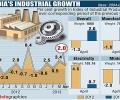
The manufacturing sector, which constitute more than 77 per cent of the index, recorded a growth of 5.2 per cent in April, up from 2.9 per cent in the year ago month.

"Within the broader index of industrial production, manufacturing has the largest of the weight. Having fallen off the cliff by 40.7 per cent during the April-June quarter, it is likely to witness a rebound when July IIP data is released. However, turnaround to positive growth trajectory could be some time away," Assocham said.

Investors are keenly awaiting the announcement of the macroeconomic data.

Industrial output maintained its double digit growth for the sixth consecutive month at 13.5 per cent in March, but was lower than expected.

IndusInd Bank, Bharti Airtel, HUL, M&M, Tata Steel, PowerGrid and Tech Mahindra too ended with gains on the BSE.

Propelled by a strong growth in manufacturing, the industrial production grew by 6.4 per cent in January over the same period of the previous year.

The output, as measured by the Index of Industrial Production, had contracted by 2.5 per cent in the same month of last year.

Trifacta's investors include Accel, Greylock Partners, Ignition and Cathay Innovation

The positive numbers raises hopes of recovery.
Vivek Mahajan (Head - Research) Aditya Birla Money, analysed the slow IIP growth.

According to the commerce and industry ministry data, during April-February 2018-19, the eight sectors recorded a flat growth rate of 4.3 per cent over the same period previous fiscal.

'While collections under the Income Disclosure Scheme explain it partly, indirect tax numbers not showing any effect of the withdrawal of high denomination currency notes was puzzling.'

Coal, crude oil, natural gas, cement, and electricity recorded a negative growth of 8.6 per cent, 5.4 per cent , 3.9 per cent, 4.9 per cent and 2.9 per cent, respectively, in August.

A rate cut could stimulate demand and help revive industrial activity, without much risk of sparking off inflation again.

The 30-share Sensex ended down 12 points at 25,610.
The fiscal 2008-09 began on somber note with industrial growth in April dropping to 7 per cent compared to 11.3 per cent in the same month a year ago, reflecting the impact of higher interest rates and rising input costs.The performance in April, however, was much better than the 3.9 per cent growth rate witnessed during March, the last month of the previous fiscal, according the Index of Industrial Production (IIP) data released on Thursday.
Industrial production growth rate has declined to 7.6%, due to dismal performance by manufacturing, mining and electricity sectors.

India's annual industrial output growth slowed to 4.2 per cent in July compared with an upwardly revised 4.4 per cent growth a month ago, government data showed on Friday.
Coal, crude oil, natural gas, refinery products, fertiliser, steel, cement and comprise 40.27 per cent of the weight of items included in the Index of Industrial Production.

An index value of 42 to 46 means moderate decline.
The Index of Industrial Production recorded an impressive growth of 11 per cent in February despite power sector registering dismal performance indicating unpleasant summers in the days ahead.

What came to the rescue of the IIP numbers in February were mining and electricity.

Though the ministry is considering 2017-18 as the new base year, no decision has been taken as the committees of experts are awaiting some more data before finalising their opinion.

Economists surveyed by Reuters had forecast a 0.5 per cent growth in output

Stock markets will remain closed on Tuesday

India's current account surplus moderated to $15.5 billion or 2.4 per cent of the GDP in the July-September quarter of the current fiscal, the RBI said on Wednesday. The same was at $19.2 billion or 3.8 per cent of the GDP in the preceding three-month period on account of a rise in the merchandise trade deficit, the RBI said in a statement on 'Developments in India's Balance of Payments during the Second Quarter (July-September) of 2020-21'. It is for the third consecutive quarter that India's current account remained in surplus. In the last quarter of 2019-20, the surplus was $0.6 billion. Current account deficit/surplus reflects the difference between the outflow and inflow of foreign exchange in a country's current account.

Lack of new investments may undermine higher consumption

The November IIP has been revised upwards to 3.9% from 3.8%.

Chief Economic Advisor Krishnamurthy Subramanian said China imports a lot of components, parts, assembles and integrates and then exports them.

Fertiliser production dropped sharply by 11.5 per cent, crude oil by 5 per cent and natural gas by 0.9 per cent in October over the year-ago month

The NSE Nifty settled the day 28.30 points, or 0.27 per cent, lower at 10,554.30.

'The economy is suffering (perhaps 'enjoying' is a better word) the lowest credit demand in decades; banks are struggling with stressed loans equivalent to near 10 per cent of GDP,' points out Devangshu Datta.

Changes the base year and included more sectors.

The broader NSE Nifty recaptured the key 10,000-mark and ended at 10,096.40

The NSE Nifty closed lower by 32.15 points, or 0.32 per cent, at 9,984.80.

Slow growth in key sectors would also have implications on the Index of Industrial Production number

India's industrial output grew a better-than-expected 6.4 per cent in August compared with a downwardly revised 4.1 per cent growth a month ago.
