
They feel reducing policy rates will help to boost production and revive the economy.

With retail inflation surprising on the upside, the six-member monetary policy committee (MPC) of the Reserve Bank of India (RBI) is expected to increase the repo rate by 35-50 basis points (bps) in the review scheduled for September 28-30. According to economists, the central bank will continue to focus on bringing inflation down even though economic growth has remained sluggish. Data released by the government on Monday showed that the consumer price index (CPI)-based inflation increased by 7 per cent year-on-year (YoY) in August, thus, staying above the upper tolerance limit of the central bank for all the eight months of 2022.
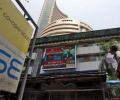
Analysts believe that investors should look at stocks that hit 52-week lows only if they have a dividend paying track record, are debt-free and have sound fundamentals.

The index of industrial production, which was negative in March, was positive in April - but just barely.

Several fiscal and monetary incentives since December 2008 helped the industry to recover into a growth trajectory. The 10 per cent plus growth in manufacturing, basic goods, mining, electricity has been buoyed by these measures, Confederation of Indian Industry said.
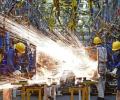
Capital goods output rose by a robust 20 per cent in the month under review as against a contraction of 2.4 per cent earlier.

Production of coal, crude oil, natural gas, refinery products, fertiliser, steel, cement and electricity contracted. The record contraction in the growth rate of eight core sectors will affect the Index of Industrial Production.

Markets end flat ahead as investors turned cautious and booked profits ahead of Jan IIP, Feb CPI data.

The NSE Nifty settled at 4,680, up 21 points. The market breadth was positive -- out of 2,867 stocks, 1,941 advanced and 853 declined on Wednesday.
The Reserve Bank on Thursday said the country's wholesale price-based inflation and industrial production data should be improved and employment data availed for effective monetary policy management.
Describing 6.8 per cent industrial growth in January as an indication of strong recovery, Finance Minister Pranab Mukherjee on Monday said efforts will have to be made for promoting mining, capital goods and consumer durables sectors.
According to the provisional figures, it could be the fourth month in a row and fifth month in the last fiscal that industrial growth may turn negative. However, after revision the provisional figures for October and January, which were negative, have turned positive.

These core industries comprise 40.27 per cent of the weight of items included in the Index of Industrial Production.
Short-circuited by the lacklusture performance of electricity sector, the industry recorded a marginal slowdown in growth at 6.2 per cent in May this year compared to 6.4 per cent recorded in the comparable month of 2003.

Domestic equity markets are likely to see volatility in a range-bound trade this week amid geopolitical worries and growing expectations of a sharp hike in interest rates, analysts said. Global trends, inflation data and the last batch of quarterly earnings will drive the markets this week, they said. Besides, the rupee movement, FII investment pattern and Brent crude trends would also be watched by investors.
Pointing out that loosening cycle of monetary policy by RBI began only in October, Moody's said, it might not have led to an immediate rebound in domestic consumption. However, the RBI on Thursday stated that monetary measures taken by it were 'appropriate'.
Driven by high growth in the manufacturing sector, the industrial production recorded a high 7.4 per cent growth in November 2003, compared to a mere 4.1 per cent in the same period previous year.

As many as seven of eight core industries saw a contraction in output in September.
The print media industry is on a roll, if Index of Industrial Production (IIP) data is to be believed without a pinch of salt.

Slow growth in the key sectors would have implications on the IIP number as these segments account for about 41 per cent of the total factory output.
India's leading infrastructure sector index grew by 4 per cent year-on-year in May, compared with growth of 5.6 per cent in the same period a year earlier, a government statement said on Tuesday.

The poor performance of capital goods - a bellwether for future growth - has alarmed most analysts

The task force was set up in July 2011. Although the industrial production during March improved to 2.5 per cent, the factory output during 2012-13 worked out to be only 1 per cent, down from 2.9 per cent in the previous fiscal.

Slow growth in key sectors would also have implications on the Index of Industrial Production (IIP) number as these segments account for about 41 per cent to the total factory output.

The 30-share Sensex is down 359 points at 26,378 and the Nifty has dropped 78 points to trade at 7,883
India's Index of Industrial Production -- which measures industrial growth -- plunged to a dismal 1.6 per cent in December 2010 from 18 per cent in the same period a year ago due to the poor performance of the manufacturing sector.

Large sectors such as metals, mining, machinery, and transportation have seen a decline.

The previous low was recorded at 3.8 per cent in May this year.

"Despite subdued growth in the world economy, India has maintained a GDP growth rate of 7.2 per cent in 2014-15, 7.6 per cent in 2015-16 and 7.1 per cent during April to September of 2016-17," the commerce and industry minister said in a written reply during Question Hour in the Lok Sabha.

Index of Industrial Production is expected to have grown by 1-2 per cent in April, D&B said in a research note, adding that the pace of improvement in consumption and investment demand is likely to take place as per the measures taken by the new government.

There are some companies in the sector that have seen a decline in revenues but their performance is not sufficient to cause such a decline in industrial production data.

The output of eight core sectors declined by 4.6 per cent in February, the steepest contraction in the last six months which experts said could drag the overall industrial production in the month into the negative territory. All the key segments, including coal, crude oil, natural gas, and refinery products, witnessed a decline in production, according to the official data released on Wednesday. The growth rate of the eight infrastructure sectors -- coal, crude oil, natural gas, refinery products, fertilisers, steel, cement and electricity -- stood at 6.4 per cent in February 2020. Last time in August 2020, the sectors had recorded a negative growth of 6.9 per cent.

Sluggish infrastructure sector growth would also have impact on IIP as these segments account for about 41 per cent of the total factory output.

India's industrial output rose by 10.3 per cent in October against 0.1 per cent in the same month last year.

Bajaj Finserv was the top loser in the Sensex pack, shedding around 3 per cent, followed by Bajaj Auto, Bajaj Finance, L&T, Asian Paints, Dr Reddy's, ICICI Bank, HDFC Bank and RIL. NSE Nifty finished 101.45 points down at 14,929.50.

Within IIP, the capital goods sub-index has contracted for seven continuous months, suggesting investment demand continues to be weak.

The overall market breadth was extremely positive as 1,868 stocks advanced while 951 declined.

In terms of industries, 10 out of 23 industry groups in the manufacturing sector showed positive growth during November 2018.
Pulled down by the mining and electricity sectors, the Index of Industrial Production stood at 8.8 per cent during April 2005 compared to 8.9 per cent in the same month last year.

RBI has been on a rate hike spree since March 2010.
