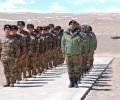
The Working Mechanism for Consultation and Coordination on India-China Border Affairs (WMCC) was established in 2012 as an institutional mechanism for consultation and coordination for the maintenance of peace and tranquillity in the border areas.

China on Tuesday announced that its Defence Minister General Li Shangfu will visit India this week to attend the meeting of SCO defence ministers from April 27 during which he is expected to hold talks with his Indian counterpart Rajnath Singh on ending the prolonged eastern Ladakh standoff which has severely strained bilateral ties.
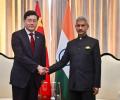
Qin's first in-person meeting with Jaishankar on Thursday came on the sidelines of the G20 foreign ministers conclave in New Delhi amid the over 34-month-long border row in eastern Ladakh.

The discussions took place on the sidelines of the G20 Foreign Ministers' Meeting.

After India firmly told China that its violation of the border pacts has "eroded" the entire basis of bilateral ties, China's defence ministry on Friday said the situation at the border is "generally stable" and both sides should put the boundary issue in an "appropriate position" and promote its transition to "normalised management".
The fresh round of Corps Commander talks are scheduled to start at 10:30 AM at Moldo border point on the Chinese side of the Line of Actual Control in eastern Ladakh, they added.

Prime Minister Narendra Modi's bilateral meetings on the sidelines of the BRICS summit in Johannesburg are being finalised, Foreign Secretary Vinay Kwatra said on Monday but did not give a direct reply on the possibility of a meeting between Modi and Chinese President Xi Jinping.

The Indian side is expected to seek disengagement as soon as possible in the remaining friction points besides pressing for resolution of issues in Depsang Bulge and Demchok.

The relations between India and China cannot be normal if peace and tranquillity in border areas are disturbed, External Affairs Minister S Jaishankar said on Friday.
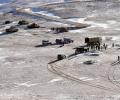
The Indian and Chinese troops are locked in an over three-year confrontation in certain friction points in eastern Ladakh even as the two sides completed disengagement from several areas following extensive diplomatic and military talks.

After having successfully disengaged with China in the Pangong lake area, Armies of India and China are likely to hold talks again this week to discuss further disengagement from Gogra heights and Depsang plains, said sources.

On Monday China said it has "effectively managed and controlled" frictions in certain border areas.

Jaishankar also said that there is a need to take the disengagement process forward.

Indian graziers were stopped by Chinese troops from moving ahead near the Line of Actual Control (LAC) in the Demchok region of eastern Ladakh over a week ago, people familiar with the development said on Monday.
India and China to hold the 11th round of corps commander-level talks at Chushul in eastern Ladakh at 10.30 am on Friday that is expected to focus on disengagement of troops in remaining friction points, sources within the Indian Army said.

Gen Pande also said that Indian troops are adequately deployed along the Line of Actual Control to deal with any situation and that guidance has been given to them to "remain firm and resolute" in their tasks.

The Shanghai Cooperation Organisation (SCO) will hold its first in-person summit in Samarkand in Uzbekistan on Thursday after two years, shaking off Covid fears and providing a rare opportunity for all its eight heads of state to meet on the sidelines of the event to have face-to-face talks on pressing global and regional issues of common concern.

Jaishankar said the last few years have been a "period of serious challenge", both for the relationship and for the prospects of Asia, noting that continuation of the current impasse will not benefit either India or China.

Chinese Foreign Minister Qin Gang reiterated that the situation at the India-China border is generally stable and both sides should consolidate the present achievements and strictly abide by the relevant agreements while pushing for further cooling and easing of the conditions for sustainable peace and tranquillity at the frontier.

The Army said it was also highlighted that completion of disengagement in other areas would pave the way for the two sides to consider de-escalation of forces and ensure full restoration of peace and tranquillity and enable progress in bilateral relations.
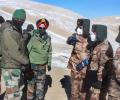
In the fresh round of talks, the Indian side is expected to press for disengagement of troops as soon as possible in all the remaining friction points besides seeking resolution of issues in Depsang Bulge and Demchok.

The Indian side is expected to seek disengagement as soon as possible in the remaining friction points besides pressing for resolution of issues in Depsang Bulge and Demchok.
The sources said the focus of the talks was to take forward the disengagement process in friction points like Hot Springs, Gogra and Depsang in eastern Ladakh.
India and China on Saturday held another round of military talks with a focus on taking forward the disengagement process in Hot Springs, Gogra and Depsang in eastern Ladakh and bring down the tensions in the region, official sources said.
The two countries have been engaged in a military standoff for almost a year but disengaged from the most contentious Pangong lake area last month after extensive talks at both military and political levels.

The 16th round of military talks between India and China on the lingering border standoff in eastern Ladakh will be held on July 17 on the Indian side of the Line of Actual Control (LAC) in the region, official sources said on Friday.
The 11th round of the Corps Commander-level talks began at around 10.30 am at the Chushul border point on the Indian side of the Line of Actual Control (LAC) in eastern Ladakh, they said.

The situation along the Line of Actual Control (LAC)in eastern Ladakh remained 'very fragile' and is 'quite dangerous' in military assessment because of close deployments of troops of both sides in some pockets though substantial progress has been made in the disengagement process in many areas, External Affairs Minister S Jaishankar said on Saturday.
'The two sides should support rather than undermine each other, strengthen cooperation rather than guard against each other, and enhance mutual trust rather than be suspicious of each other'

This is the first time that the defence ministry has admitted officially about the transgressions by the Chinese troops.
'China is in the middle of a substantial expansion of its nuclear weapon arsenal, which satellite images indicate includes the construction of over 300 new missile silos,' SIPRI's statement noted.
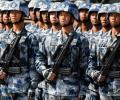
The international community must be clear that such a behaviour is unacceptable, a top US senator said.

At a media briefing in Beijing, Chinese Foreign Ministry spokesman Wang Wenbin said the two sides have maintained smooth communication on border-related issues through diplomatic and military channels.
Two days after the India-China military talks, the joint statement, issued in New Delhi by the Indian Army said both sides had a 'candid and in-depth exchange' relating to disengagement along the Line of Actual Control (LAC) in the Western Sector of India-China border areas.

In its annual threat assessment presented before the Senate Armed Services Committee during a Congressional hearing on Tuesday, the US intelligence community said the expanded military posture by both India and China along the disputed border elevates the risk of armed confrontation between the two nuclear powers that might involve direct threats to US persons and interests and calls for America's intervention.

The Indian Army's Shatrujeet brigade is conducting an airborne exercise along the northern borders in eastern Ladakh to validate its rapid response capabilities, sources said on Monday.
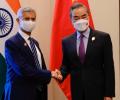
India and China are likely to hold the 16th round of high-level military talks on July 17 to resolve the issues in remaining friction points along the Line of Actual Control (LAC) in eastern Ladakh, people familiar with the development said on Wednesday.
India and China failed to make any breakthrough, but agreed to maintain dialogue to arrive at a mutually acceptable resolution at the earliest.

The people familiar with the development said the new bridge is being built in an area that is over 20 km from the Line of Actual Control (LAC).

The Indian Army has deployed a significant number of easily transportable M-777 ultra-light howitzers in mountainous regions along the Line of Actual Control (LAC) in Arunachal Pradesh, military officials said on Thursday.
