It is learnt that the India's top military brass is constantly monitoring the evolving situation even as the United States said the aggressive behaviour by Chinese troops was a reminder of the threat posed by China.
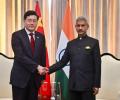
Qin's first in-person meeting with Jaishankar on Thursday came on the sidelines of the G20 foreign ministers conclave in New Delhi amid the over 34-month-long border row in eastern Ladakh.
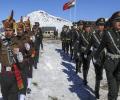
The two militaries are set to hold extensive talks on finalising modalities for restoring normalcy and bringing back peace and tranquillity in the region after the verification of the disengagement exercise is completed.

The discussions took place on the sidelines of the G20 Foreign Ministers' Meeting.

'The Chinese staying put in Pangong Tso, and creating a buffer zone on Indian territory in other areas,' a senior serving general tells Ajai Shukla.

'However, a lot of preparatory work would have to go in and China must be prepared to announce an end to the standoff by disengaging from the remaining areas along the LAC.'
Sources said the process of disengagement along the Line of Actual Control is "complex", and in such a context, speculative and unsubstantiated reports need to be avoided.
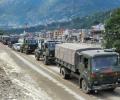
Indian Army planners find themselves contemplating the possibility of more Chinese intrusions along the contested 3,488-km border. That could lead to the army having to man a 'hardened LAC' round the year, like the LoC with Pakistan, reports Ajai Shukla.
'India will keep trying to avoid conflict.' 'This is the moment when we draw a line in the sand.'

China remains in firm control of an estimated 600-800 square kilometres of Indian territory.

The two sides held diplomatic talks through video conference on the border standoff in midst of fresh details emerging that China has strengthened its position in several areas in eastern Ladakh including Galwan Valley where a violent clash on June 15 left 20 Indian soldiers dead.
Chinese military has also deployed a sizeable number of its troops in Galwan Valley, the site of the violent clashes on June 15 that left 20 Indian soldiers dead.

India has repeatedly called on Russia and Ukraine to return to the path of diplomacy and dialogue and end their ongoing conflict.
Defence Minister Rajnath Singh on Monday said India is a peace-loving nation that never resorts to any kind of aggression but is always prepared to give a befitting reply if provoked or threatened.

Last year, China held a meeting with some South Asian countries on COVID-19 vaccine cooperation without the participation of India.

By offering aid to China in its hour of need we will create an opening to Xi Jinping to rectify his policy towards India, argues Colonel Anil A Athale (retd).
The Indian side is expected to present specific proposals at the talks to deescalate tension in Pangong Tso, Galwan Valley and Demchok -- the three areas in eastern Ladakh where the two sides have been on a bitter standoff for last one month, the sources said.

'When armies start attacking with clubs and batons, then at some point this can take an escalatory spiral and spin out of control.'
The Chinese side has particularly bolstered its presence in the Galwan Valley, erecting around 100 tents in the last two weeks and bringing in heavy equipment for construction of bunkers, notwithstanding the stiff protest by Indian troops. There have been reports of multiple incidents of transgressions by Chinese troops in several areas in Eastern Ladakh.
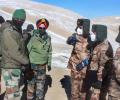
Sources said the Indian troops resolutely confronted the Chinese PLA soldiers.
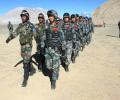
During the course of the intense and complex negotiations between senior commanders of the two armies that ended at 2 am on Wednesday, the Indian delegation also apprised the Chinese PLA about the "red lines" and conveyed that the onus was largely on China to improve the overall situation in the region, the sources said.
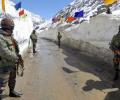
China on Thursday said Chinese and Indian troops have taken "effective measures" to disengage at the Galwan Valley and other areas along the Line of Actual Control in eastern Ladakh and the situation is "stable and improving," days after the two sides agreed on an expeditious withdrawal of soldiers from all the standoff points.
The sources said the mutual disengagement of troops at the two friction points is likely to be completed within two days, and that there has been 'substantial' withdrawal of forces by Chinese military from the areas.

Sibal asked Modi to stop doing the politics of "illusion and delusion" and showing "red eyes" to China, and protect Indian territory.

Gandhi's dig at the prime minister came in a tweet wherein he tagged an article in a foreign publication with the headline "India's appeasement policy toward China unravels".

Experts said attempts from China have increased in the last year, which further amplified after the Indian government banned Chinese applications post the Galwan clash.

Spokesperson in the MEA Anurag Srivastava said both sides have agreed to work for an early resolution to the issue in keeping with broader guidance provided by leaders of the two countries for ensuring peace and tranquillity along the border areas. He, however, did not respond to questions relating to reports of pulling back of troops by both India and China from certain friction points in the Galwan Valley and Hot Spring areas in eastern Ladakh in the last few days.

In the review meeting, Singh told the top military brass to continue to deal with the situation in eastern Ladakh and other areas with "firmness".
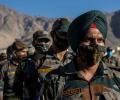
A joint statement released on Thursday said both sides exchanged views in an 'open and constructive' manner to resolve the 'relevant issues' and that it was agreed to maintain 'security and stability' on the ground in the region.
The talks came a day after the two armies began a limited disengagement in a few areas in Galwan Valley and Hot Spring in a demonstration of their intent to end the row peacefully.

Sources said the Indian delegation was warmly greeted by senior officials of the Chinese Army before the talks began.
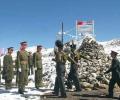
The two sides have already held at least 12 rounds of talks between local commanders and three rounds of talks between major general-rank officials but no positive outcome came out from the discussions, they said.

The village in Maharashtra has continuously sent soldiers to the Army since World War I. Every other person you meet is a soldier or a retired soldier or is aspiring to be a soldier.
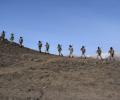
The enhancement of combat capability by the two armies in the region came even as both the countries continued their efforts to resolve the dispute through talks at military and diplomatic levels.
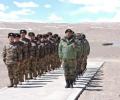
At present, the Chinese Army has diverted its troops carrying out a massive exercise on their side of the LAC and deployed them at short notice across the Line of Actual Control in the areas under the Indian Army's 81 and 114 Brigades deployed to counter the Chinese assertions from Daulat Beg Oldie and adjoining areas.

'The Galwan crisis involves the security of the nation, can't we spend eight hours on that?' 'Why are you scared? Why are you running away from that?

'Unless India ups the ante, Beijing will continue to believe its transgressions are cost free and will feel encouraged to do more of the same.'

This is Gen Pande's first visit to the sector after taking over as the chief of the Indian Army on April 30.

The puja is performed on the banks of river Sindhu (Indus).

The "eyeball to eyeball" deployment and the dynamic internal security situation in the JK make Northern Command the most unique theatre.
