
After the last Budget's announcement of a major tax relief for those earning an annual salary of less than Rs 12 lakh, there is not much that individuals can look forward to in the forthcoming Budget, points out A K Bhattacharya.

The idea of back-loading the target of fiscal consolidation is perhaps guided by the government's desire to be prepared for any adverse developments in the coming year, points out A K Bhattacharya.

'LIC will reduce but not fully exit its stake in IDBI Bank, which remains an important bancassurance partner,' says LIC of India' MD and CEO R Doraiswamy.

The government will have to get projects moving.
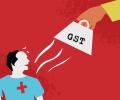
Reduction of GST on health insurance premium from 18% to 0% looks like a straight 18% reduction in what consumers pay. The truth, however, is...

Increase in tax exemption limit by Rs 50000 is positive for the FMCG sector, as it will leave more discretionary income in the hands of consumers.

India's electric two-wheeler (e2W) manufacturers have urged the government to extend subsidies under the PM E-Drive (Electric Drive Revolution in Innovative Vehicle Enhancement) scheme beyond March 2026, cautioning that a withdrawal could slow near-term demand even as confidence in long-term electric mobility adoption remains intact.

Simplifying GST rates, removing exemptions, easing disputes, and speeding up refunds can boost investment in India and offer the best reply to Trump's tariffs, observes V S Krishnan, former member, Central Board of Indirect Taxes and Customs.

Tier-II, Tier-III, and rural regions accounted for 62 per cent of all new health insurance policies sold by insurers so far in 2025-26 (FY26), according to a Policybazaar report. These regions are also witnessing a rise in the sum assured opted by customers.

Real GDP growth surprised on the upside in 2025, but weaker nominal growth, trade uncertainty, and soft demand signal a bumpier road ahead.

India, the world's fourth largest economy, is set to maintain the 'goldilocks' phase with tailwinds of good growth, low inflation and robust banking performance as well as reform initiatives poised to sustain the economic pace witnessed during 2025.

The proposed exemption in customs duty on import of lithium, cobalt and other rare minerals in the Union Budget 2024-25 is likely to lower the battery production cost and help in making electric vehicles more affordable for the buyers, auto industry leaders said on Tuesday.

'That is going to have an impact on literally every one, whether you buy a toothpaste, a safety pin, a car, shoes or medicines or you go to a diagnostic centre.'

Taking both direct and indirect taxes, the gross collection is expected to grow 10.45 per cent to Rs 33.61 trillion in 2023-2024.
Can this growth in GST collection be sustained in the coming years? asks A K Bhattacharya.

The rising goods and services tax (GST) and personal income-tax collections may bolster the Narendra Modi government's ability to announce new schemes or enhance existing ones.

While demand for sub Rs 50-lakh affordable housing prevails, market players cite increased land rates, escalated construction costs and low margins as key prohibiting factors.

Opposition MPs in India's Rajya Sabha raised concerns about US President Donald Trump's tariff threats, demanding the government clarify its response and engage in discussions with opposition parties. Leaders like P Chidambaram and Sagarika Ghose warned of potential economic repercussions, including depressed exports, lower FDI, and a significant tariff burden. The debate also touched on other issues such as the government's economic policies, demonetization, and the impact of GST on common citizens.

There is nothing specific announced for Chemicals Industry, however, reduction in customs duty

The government should bring natural gas under the Goods and Services Tax (GST) regime to realise Prime Minister Narendra Modi's vision for a gas-based economy and raising the share of the environment-friendly fuel in India's energy basket, an industry body that represents the likes of Reliance Industries as well as state-owned firms, has said. Natural gas is currently outside the ambit of GST, and existing legacy taxes -- central excise duty, state VAT, central sales tax -- continue to be applicable on the fuel. In its pre-Budget memorandum to the finance ministry, Federation of Indian Petroleum Industry (FIPI), which boasts of members from across the oil and gas spectrum, also demanded rationalisation of GST on transportation of natural gas through pipeline as well as on re-gasification of imported LNG to help bring down cost of the environment friendly fuel.

The govt has hiked customs duty for metallurgical coke.

'If because of El Nino, the monsoon is affected adversely in the current year, naturally it will affect income projections and consequently Budget numbers.'

The government should take measures to promote innovation and R&D while simplifying regulations for the sector in the upcoming Union Budget, as per pharmaceutical industry bodies. Outlining the wish list for the sector in the upcoming Union Budget, Indian Pharmaceutical Alliance (IPA) secretary general Sudarshan Jain said the domestic pharma industry is currently around $50 billion in size and aspires to grow to around $130 billion by 2030 and $450 billion by 2047. "To achieve this vision, the Union Budget 2023-2024 should help fuel innovation and R&D, which will set the pace for propelling the pharmaceutical industry forward," he told PTI.

Leading brokerages have revised their charges with the true-to-label norms by the Securities and Exchange Board of India (Sebi) kicking in from Tuesday.

Automobile dealers' body FADA said the Budget lacked immediate demand boosters for the automobile industry.
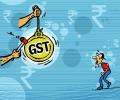
The broad trends of GST collections will make you wonder if indeed the biggest indirect tax reform in the country has led to a real improvement in revenues, notes A K Bhattacharya.

'There is a need for stimulus, as India is essentially a consumption economy.'
There is a need for stimulus, as India is essentially a consumption economy, argues Cargill India chairman Siraj Chaudhry
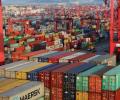
Exporters on Thursday demanded fiscal incentives, tweaking in customs duties on certain products and credit at affordable rates in the forthcoming Budget to boost exports and create jobs. In a pre-budget virtual meeting with Finance Minister Nirmala Sitharaman, the Federation of Indian Export Organisations (FIEO) said the depreciation of the rupee against the US dollar is affecting exports' competitiveness and the sector requires more support. "Creation of employment is the biggest challenge faced by the country...We would urge the government to provide fiscal support to units which provide additional employment in the export sector," the exporter's body said.


Insurance companies are seeking a separate deduction limit of Rs 1 lakh for insurance premium payment under Section 80C of the Income Tax Act in the upcoming Union Budget to bring in more people under the ambit of insurance. The insurers also want reduction in the goods and services tax (GST) rate of 18 per cent currently applied on health insurance products to 5 per cent to make such products more affordable to common people. Finance Minister Nirmala Sitharaman will present the Union Budget for 2022-23 on February 1.

Increasing the duties on auto parts and putting an additional cess on petrol and diesel could drive up costs of vehicles, specially where volumes are low and localisation is not viable.

'The private sector believes that some enablers in labour-intensive sectors like apparel, toys, tourism, and media retail, can unlock a lot of jobs.'

The duty reduction in feedstock would strengthen the domestic manufacturing in India making it more competitive leading to surge in exports of finished goods.

Going by the number of changes Mr Jaitley's next Budget is likely to see, he will go down in the history of Budget-making as the finance minister who ushered in the largest number of changes in a single Budget, says A K Bhattacharya.

GST will yield 'better value for money' for car buyers, increasing automobile industry demand, says Sandip Neogi.

The government expects indirect tax collection to be lower than the Budget Estimate (BE) of Rs 13.38 trillion this fiscal year, despite prospects of netting goods and services tax (GST) in large amounts, Revenue Secretary Tarun Bajaj has said. "Indirect tax collection may see lower realisation than budgeted on account of cuts in excise and customs duties. "We could see a shortfall of about Rs 1.5 trillion on account of those," he told Business Standard.

Here's everything you need to know about the Goods and Services Tax Bill.

The dates of general elections in 2019 and the presentation of the final Budget of the Modi government are so far removed from each other that Jaitley is not under any pressure to present a populist Budget. Instead, he could well unveil an array of schemes and proposals that he believes are necessary for the economy, even if a few of them could be unpopular, says A K Bhattacharya.

The move will primarily impact luxury car companies like Mercedes Benz, BMW, Audi and Volvo and bike brands like Triumph and Harley Davidson.
 © 2026 Rediff.com - Advertise with us - Disclaimer - Privacy Policy - Sitemap - Feedback - About us - Terms of use - Grievances