

Reduction of GST on health insurance premium from 18% to 0% looks like a straight 18% reduction in what consumers pay.
The truth, however, Arun Ramamurthy says, is...
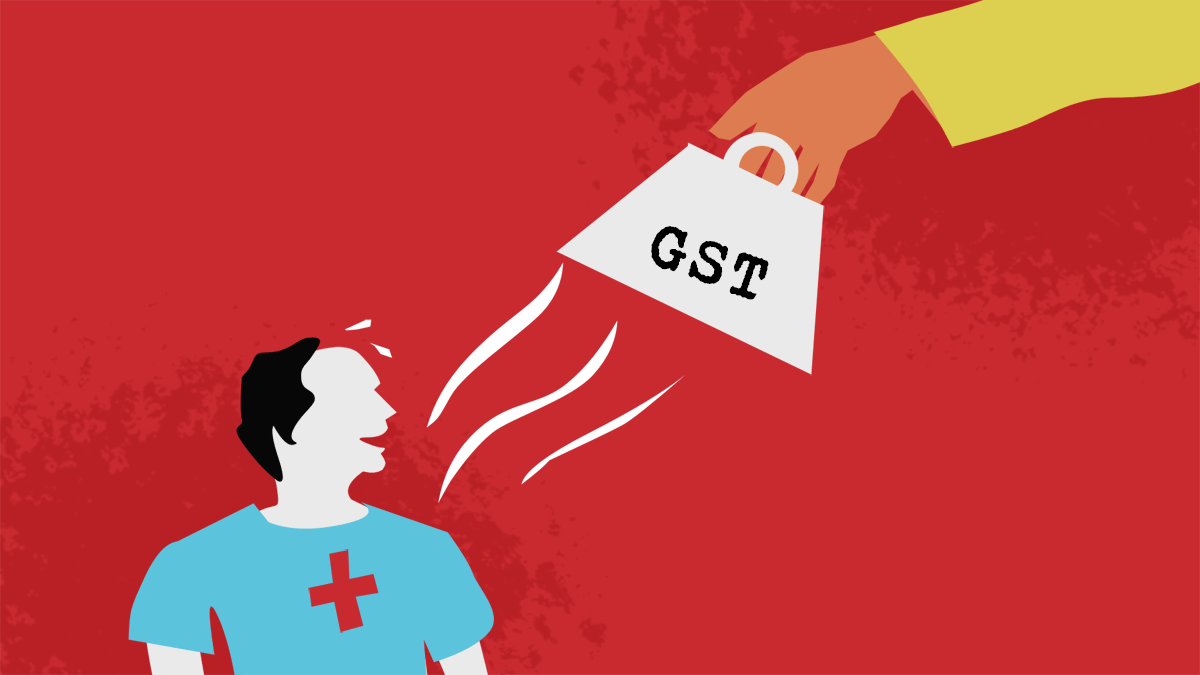
Illustration: Dominic Xavier/Rediff
The GST Council's decision to scrap tax on health insurance premiums has been one of the most widely discussed reforms in recent months.
For years, anyone buying a mediclaim plan paid not just the base premium but an extra 18% GST on top. That meant Rs 10,000 policy cost Rs 11,800 (Rs 10,000 base premium + GST of Rs 1180). Starting September 22, 2025, this burden disappears.
On paper, reduction of GST on health insurance premium from 18% to 0% looks like a straight 18% reduction in what consumers pay. The truth, however, is more complicated.
Premiums will drop, but the cut will likely settle in the range of 12% to 15% rather than the full 18%.
Why the gap?
The answer lies in the way insurers' balance sheets work.
The ITC Factor: A Silent Trade-Off
Until now, insurers had the cushion of Input Tax Credit (ITC is a mechanism allowing businesses to deduct the GST paid on their expenses from the GST they collect on sales). They would pay GST on a range of expenses -- commissions, marketing spends, technology contracts, office rentals -- and then claim credit to offset their liability.
The reduction of GST on health insurance premiums from 18% to 0% ends this mechanism of claiming ITC.
What's more, companies must reverse accumulated ITC from past years -- meaning additional paperwork, and financial adjustments.
In effect, insurers are being asked to charge customers less but run their businesses with higher internal costs.
So, insurers face three clear choices:
- Absorb the cost, which hits margins
- Pass some of it on, tweaking base premiums so the reduction isn't the full 18%
- Tighten operations, cutting inefficiencies, fraud, and administrative fat to neutralise the impact
Which path they walk will determine how much of the GST relief trickles down to you and me.
How Health Insurers Are Likely to Respond
The good news: Most health insurers appear calm. Unlike life insurance, which runs on long-term contracts and metrics like Embedded Value (a way of estimating how much profit an insurer is likely to make in the future from the policies it has already sold), health insurance is priced annually. That gives companies the flexibility to reprice products quickly and manage cost pressures more nimbly.
Insurers are already working on a mix of responses:
- Digitising claims to cut fraud and manual handling
- Tweaking product features such as room rent caps or sub-limits
- Absorbing part of the hit in high-volume flagship policies to preserve goodwill.
Analysts believe the ITC reversal will shave only a few percentage points off profitability. In other words, there's enough room for insurers to still deliver a double-digit premium reduction to customers.
What Will Policyholders Really Save?
Let's translate this into numbers.
A family paying Rs 40,000 a year for a comprehensive plan earlier paid another Rs 7,200 (18% of Rs 40,000) in GST. With the exemption, that extra charge vanishes.
After insurers account for their lost ITC, the actual saving could likely land between Rs 5,000 and Rs 6,000 and not Rs 7,200.
That may not sound dramatic, but in a country where medical inflation runs at 12-14% annually, this effectively buys households a year of breathing space.
In practical terms, the tax reform offsets one cycle of rising hospitalisation costs.
Why the Reform Matters Beyond Numbers
The psychological impact is arguably bigger than the arithmetic. By removing GST, the government has sent a clear message: Health insurance is a necessity, not a luxury good to be taxed.
This matters in a country where fewer than 35% of Indians carry adequate health cover. Too many still treat mediclaim as optional until a crisis forces their hand. Making it tax-free elevates it to the same category as essentials like food and education -- services that should not carry a consumption tax.
For fence-sitters, the reform lowers not just the price but also the perception barrier.
For existing policyholders, it reduces the risk of lapses at renewal by trimming the annual burden.
Conclusion
The GST exemption on health insurance premiums is more than a technical adjustment. It is a signal reform, one that directly reduces the financial burden on families while repositioning insurance as a social good.
Policyholders should expect premiums to fall by 12% to 15%, not the full 18%. Even so, the saving is meaningful -- it offsets a year's worth of medical inflation and puts real money back into household budgets.
The lasting impact, however, will be measured not in percentages but in penetration. If insurers pass on the benefit transparently and use the moment to rebuild trust, this reform could nudge millions more Indians into securing health cover.
Tax relief is the spark. What will keep the flame burning is efficiency, fairness, and a renewed commitment to making health protection truly affordable.
Arun Ramamurthy is co-founder, Staywell.Health.









 © 2026