
Analysts predict that crude oil prices and the ongoing US-Iran conflict will be the primary drivers of stock market movements, with investors also closely watching the Jackson Hole symposium for cues on interest rates.

How well is your country's healthcare system staffed? We compare the density of essential healthcare professionals across countries, based on figures from World Population Review.

A NITI Aayog report indicates that India's digital public infrastructure (DPI) initiatives could contribute 4 per cent of the GDP by 2030, a significant increase from the current 1 per cent.

'A balance had to be struck between the economic cost of taking action at this point against the need not to fall behind the curve in controlling inflation and anchoring inflation expectations.'

'Wages have not risen. Rural wages have stagnated. The growth was 0.7 per cent last year. For casual and irregular labour, the wage growth is negative.'

The Reserve Bank of India (RBI) has projected a 6.9 per cent GDP growth for the current financial year, citing concerns over commodity prices and supply chain disruptions stemming from the West Asia crisis.

The government maintained a strong pace of capital expenditure, which jumped nearly 24 per cent to Rs 3.40 trillion in April-June.

That means making it easier to invest, protecting investors through predictable rules, and avoiding policy reversals after investments have been made, notes Rajeswari Sengupta.

'... to see that young people are gainfully employed. After that, it will become very difficult as we will start ageing much more rapidly.' 'We have a huge proportion of Gen Z. After 2030, every year, we will start seeing a gradual shift towards a slightly older society.'
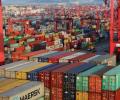
India's trade deficit reached a six-month high of $31.98 billion in July, driven by a sharp increase in imports, particularly crude oil, electronic goods, coal, and fertilisers. Both merchandise exports and imports recorded their second-highest levels during the same period.

A working paper by the Economic Advisory Council to the Prime Minister (EAC-PM) reveals a continuous decline in the rate at which foreign-owned firms invest in fixed assets in India since the FY20 peak, contrasting with a steady increase from Indian business groups.

Reserve Bank Deputy Governor S C Murmu has highlighted the "cash paradox" where currency in circulation continues to grow despite a significant increase in digital payments. This trend complicates the RBI's forecasting and planning for currency production and distribution, prompting the central bank to seek solutions and explore ways to extend banknote life and reduce the carbon footprint of the cash cycle.

Indian benchmark indices, Sensex and Nifty, saw early gains driven by lower crude oil prices and buying in Reliance Industries, even as the Reserve Bank of India maintained its benchmark policy rate for the fourth consecutive meeting, reinforcing confidence in the domestic economy.
The United Nations has revised downward India's economic growth forecast for 2026 to 6.4 per cent from an earlier 6.6 per cent, attributing the change to global uncertainties and economic shocks stemming from the ongoing West Asia crisis.

The Indian government has approved the introduction of one billion polymer banknotes in Rs 10 and Rs 20 denominations for field trials, aiming to enhance durability. This move comes as the Finance Minister also addressed Parliament on declining retail inflation, GST reforms, and other fiscal measures taken to support the economy and household consumption.

The challenge thrown by the youth movement creates the opportunity for a more consequential debate on India's economic trajectory because it must remain centered on India's youth as its driving impulse, asserts former foreign secretary Shyam Saran.

India's fiscal deficit is projected to reach 4.5 per cent of GDP for the current fiscal year, exceeding the budgeted target, as the government's policy responses to the West Asia conflict are expected to strain public finances, according to research firm BMI.

Fitch Ratings forecasts a 9 per cent aggregate revenue increase for rated Indian corporates in the current fiscal year (FY27), a stronger outlook compared to the 5 per cent estimated for FY26, which is expected to keep credit metrics stable despite potential global and domestic challenges.

Base revisions are technical exercises, but history shows they can significantly reshape the narrative around India's growth performance.

'Healthy double-digit returns are still possible, though a sharp rally is unlikely.'

India's digital economy is projected to constitute nearly 20 per cent of the nation's GDP by 2030, fuelled by a growth rate twice as fast as the overall economy, according to a senior government official.

Rashtriya Swayamsevak Sangh chief Mohan Bhagwat on Thursday said protest is a legitimate form of dialogue in a democracy and should be aimed at building consensus rather than creating divisions.

The Asian Development Bank (ADB) has revised down India's GDP growth forecast for fiscal year 2026-27 (FY27) to 6.6 per cent from an earlier 6.9 per cent, primarily attributing the change to elevated energy prices stemming from the Middle East conflict. Despite this moderation, India is still expected to remain the world's fastest-growing major economy.

India's services sector experienced its weakest growth in four-and-a-half years in July, as new business orders, both domestic and export, eased due to intense competition and declining demand. Despite a modest rebound in job creation and improved profit margins, overall business confidence slipped, reflecting a broader slowdown in the economy.

Natarajan Chandrasekaran, credited with stabilising Tata Sons after a boardroom coup and overseeing significant expansion, has announced his resignation as chairman, capping a nearly decade-long tenure marked by both successes and escalating tensions with the group's controlling charitable trusts.

Following the Supreme Court's clean chit in the coal block allocation case, Congress leader Sonia Gandhi has lauded former Prime Minister Manmohan Singh's integrity and accountability, drawing a sharp contrast with the Narendra Modi government's operational style and alleged misuse of investigative agencies.
Indian stock market indices closed on a mixed note, with the Sensex gaining 374 points driven by buying in Reliance Industries and ICICI Bank, while the Nifty remained flat. This divergence is attributed to a new Closing Auction Session (CAS) mechanism introduced by stock exchanges, impacting market liquidity and price discovery.

'It is not because of the war in West Asia, which began on February 28.' 'Petroleum product prices are already going through the roof. They are bound to have a serious inflationary impact.' 'A country's leadership is tested in trying times. It is here that the current leadership is failing.'

Indian benchmark equity indices closed higher on Thursday, with the Sensex gaining 273.55 points to 77,928.15 and the Nifty rising 66.95 points to 24,317.15, driven by bargain hunting and short-covering in IT and auto sectors.

The Reserve Bank of India (RBI) maintained its key policy rates for the fourth consecutive time, keeping the repo rate at 5.25 per cent, while the benchmark BSE Sensex closed 152 points higher in a volatile session, recovering from an intraday dip.

A new report suggests that prolonged conflict in the Middle East could significantly impact India's GDP growth and inflation.

The Reserve Bank of India (RBI) is widely expected to keep its benchmark repo rate unchanged in the August monetary policy review, with economists citing elevated inflation risks and the pending closure of the FCNR(B) deposit scheme as key factors. Most anticipate a 'Neutral' policy stance but with a hawkish tone due to geopolitical tensions, high crude oil prices, and an uneven monsoon.

A NITI Aayog report outlines India's potential to scale its bioeconomy to USD 691 billion by 2035 and USD 2.6 trillion by 2047, creating over 30 million high-value jobs. The report stresses the need for coordinated national execution, regulatory reforms, a strengthened talent pipeline, and a significant BioEconomy Growth Fund to achieve this vision, positioning India among the top biotechnology powers globally.

India is projected to attract between $80 and $85 billion through the Reserve Bank of India's (RBI) concessional swap facility, designed to boost foreign currency inflows, according to an SBI research report.

The OECD projects India's GDP to grow at 7.6% in the current fiscal year and 6.1% in 2026-27, despite global economic challenges stemming from the Middle East conflict and energy price volatility.

'We can integrate AI and tech into education, but that is just a means and not an end.' 'Ultimately, we need to control what happens in a classroom and we need to let teachers innovate their teaching style to suit the needs of Gen Z and beyond.'

'After that the burdens of an ageing population will be upon us, and the share of working age population will shrink.'
India's economy experienced a growth of 7.8 per cent during the October-December quarter of 2025-26, according to the new series of national accounts with 2022-23 as the base year.

Holding Home Minister Amit Shah responsible for alleged police brutalities on protesting students, Leader of the Opposition in the Rajya Sabha Mallikarjun Kharge on Thursday said that "Jan Shakti" (people's power) will "drag him out" one day to make him accountable.

Adani Properties has emerged as the largest value creator in the 2026 Grohe-Hurun India Real Estate 150, adding Rs 38,000 crore in valuation to become India's fourth-most valuable real estate company, with its valuation rising 72.5 per cent year-on-year to Rs 90,400 crore.
