

'Trump says India will buy over $500 billion of US goods.'
'At present, India's annual imports of goods and energy from the US are under $50 billion.'
'Reaching $500 billion would likely require more than 20 years, suggesting the figure refers to a long-term aspiration rather than a near-term commitment.'
Key Points
- 'The Truth Social post leaves major questions unanswered, like what products are covered, what the timelines are, and whether India has really agreed to zero tariffs and zero non-tariff barriers, especially in sensitive areas like agriculture and regulated imports.'
- 'Trump claims India will reduce tariffs and non-tariff barriers on US products to zero, but he does not specify how many products are covered under India's commitment.'
- 'India has previously resisted opening sensitive sectors such as food grains, genetically modified products, and other regulated imports.'
On Monday, February 2, night, United States President Donald John Trump announced a trade deal with India after a phone conversation with Prime Minister Narendra Modi.
"Until there is a joint statement, negotiated text, and clarity on enforcement, this should be seen as a political signal -- not a final deal. So, what is needed is caution, and not celebration," Ajay Srivastava, founder, Global Trade Research Initiative, a New Delhi-based think-tank, explains to Shobha Warrier/Rediff.
How do you react to Trump reducing the tariff against India to 18%?
Yes, US President Trump said on Truth Social that the United States had reached a trade deal with India after a call with Prime Minister Modi.
According to Trump, Modi agreed to stop buying Russian oil and increase purchases from the United States and Venezuela.
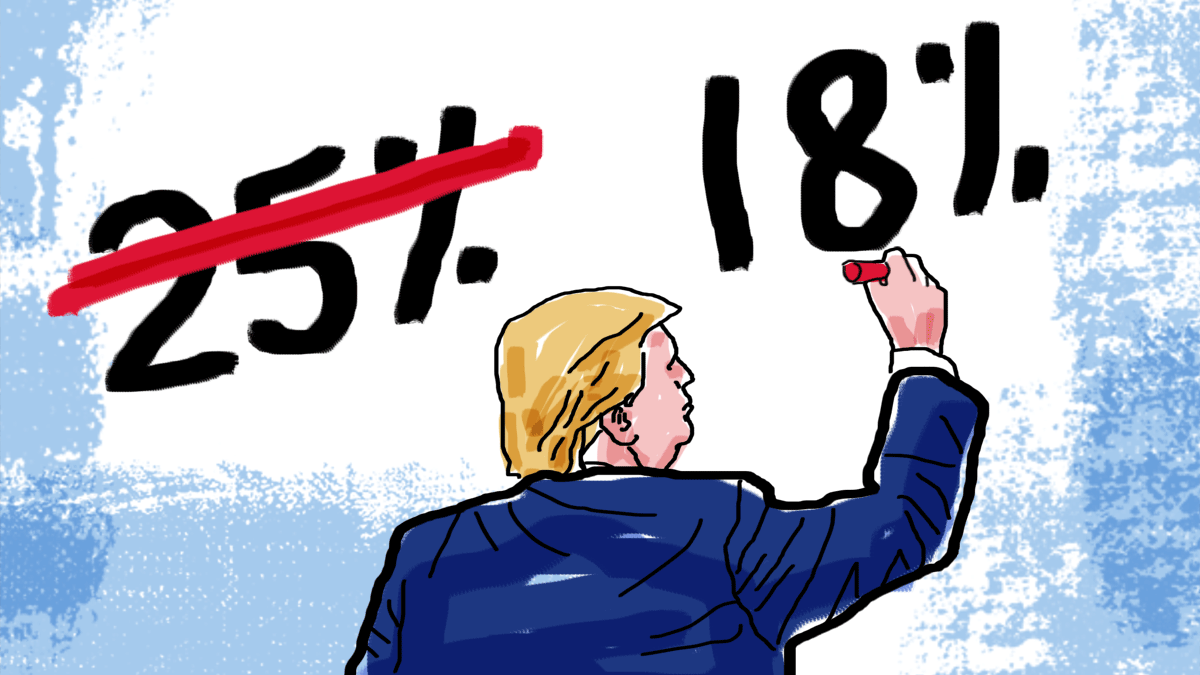
Trump said that, at Modi's request, the US had agreed to immediately reduce its 'reciprocal tariff' on Indian goods from 25% to 18%. In return, India would move to cut its tariffs and non-tariff barriers on US products to zero.
Trump also said Modi committed to Buy American at much higher levels, including purchases of more than $500 billion worth of US energy, technology, agricultural products, coal, and other goods.
Is the deal something to cheer about for India like the India-European Union deal?
Trump's Truth Social post leaves several key points unclear.
Trump said US tariffs would be reduced from 25% to 18%.
However, because the post also mentioned India stopping Russian oil purchases, earlier linked to punitive tariffs, it is unclear whether the cut is actually from 50% to 18%, or whether Trump misstated the original tariff level.
The US later clarified that tariffs are indeed being reduced from 50% to 18%.
The US has already offered reciprocal tariffs -- @10% to the UK, @15% to the EU and Japan, @19% to Indonesia and Malaysia and @20% to Bangladesh and Vietnam in respective trade deals that took place between May and October 2025.
These tariffs are over and above MFN (Most Favoured Nation) tariffs except for the EU.
For the EU, if a product's MFN tariff is up to 15%, the combined reciprocal + MFN tariff will be capped at 15%. But if a product's MFN tariff is above 15%, the existing MFN tariff will continue to apply.
Even after the trade deal, US Section 232 tariffs on steel, aluminium, copper etc will remain @50% and on few auto components @25%.
Also zero tariffs for pharmaceuticals, aircraft and parts, some mechanical and electronic components will continue.
Trump claims India will reduce tariffs and non-tariff barriers on US products to zero, but he does not specify how many products are covered under India's commitment.
India has previously resisted opening sensitive sectors such as food grains, genetically modified products, and other regulated imports.
Trump says India will buy over $500 billion of US goods. At present, India's annual imports of goods and energy from the US are under $50 billion. Reaching $500 billion would likely require more than 20 years, suggesting the figure refers to a long-term aspiration rather than a near-term commitment.
So, I feel India should not rush to celebrate President Trump's trade announcement.
So, a lot of questions remain unanswered...
Yes, the Truth Social post leaves major questions unanswered, like what products are covered, what the timelines are, and whether India has really agreed to zero tariffs and zero non-tariff barriers, especially in sensitive areas like agriculture and regulated imports.
The headline figure of $500 billion in US purchases is also unclear. India currently imports less than $50 billion a year from the US, suggesting this is more an aspiration than a firm commitment.
Until there is a joint statement, negotiated text, and clarity on enforcement, this should be seen as a political signal -- not a final deal.
So, what is needed is caution, and not celebration.

The EU-India trade deal is said to be the 'mother of all deals'. Is it really the mother of all deals, according to you?
The deal covers 23% of the world's GDP; $20 trillion of the EU and $4.2 trillion of India.
It covers 25% of the global population: India's 1.4 billion, EU's 450 million.
Of these 2 billion people, 1 billion are middle to high-end consumers.
So based on this statistics, we can say the deal is very big.
Next, our bilateral engagement with the EU is fairly high. We export and import $210 billion worth of goods and services.
So, it will not be a very difficult problem to take it from this space to a higher space.
That's why you can call it a significant deal.
I also would say that this is India's most ambitious deal.
India has given maximum concessions to the EU, and it has never allowed so many concessions to any other FTA (Free Trade Agreement) partner so far.
From India's point of view, which sectors will benefit most?
On market access, the EU will cut or eliminate tariffs on 98% of Indian goods.
India's main gains lie in labour-intensive sectors where tariffs are still high.
The biggest beneficiaries will be garments and footwear, along with marine products, gems and jewellery, handicrafts, chemicals and machinery.
You have to remember that the EU is a developed country and in developed countries, tariffs are generally low.
And on items from India, tariffs are high.
For example, on most labour intensive goods like textiles and garments, there is high tariff.
12% on leather and leather shoes and 8% to 18% on marine products. Because of these high tariffs, we were facing some problems.
Yes, we were exporting to the EU but we are facing stiff competition from other suppliers.
For example, because Vietnam has an FTA with EU, their goods can enter at zero tariff in the EU.
Bangladesh has a GSP (Generalised System of Preferences) arrangement with the EU. So, goods from Bangladesh can enter at zero tariff in the EU.
But Indian exporters are paying high tariffs.
Now, with this FTA, tariff will be zero once it's implemented.
So, the tariff disability compared to our competing countries like Vietnam or Bangladesh will disappear, and we can export much more.
It is said that after the US slapped high tariffs on India, textiles, leather, and marine products are very badly hit. So, you feel this deal will help the affected sectors?
Yes, these goods are badly hit because of the high tariffs imposed on India by the US.
With this FTA under the EU, they will recover.
But there is one small problem.
The problem is that our goods to the EU are being hit right now because of high tariffs.
The EU agreement will be implemented only after an year.
So, the goods which are hit by the US will get a push because of the EU trade deal.
But for that to happen, it will take one year.
Not from today.
Not from day one?
Day one will start after one year.
Now the documents will be legally tested, scrubbed and then the deal will be signed in 1 or 2 months' time.
After that, the deal will go to the parliaments of all 27 EU countries, the EU secretariat and India's Cabinet.
It may happen fast in India, but it takes a lot of time for the EU.
So I fear it will take at least one year for the deal to happen.
See, we have signed the agreement with the UK. It is still not rectified.
These trade deals take a lot of time to get implemented.
So, during this one year period, will it be very bad for the textile, leather sectors as they have almost lost the US market because of the tariffs?
I won't call it bad. They were exporting earlier also to the EU, and they will continue to export to the EU at high tariffs.
You spoke about Vietnam and Bangladesh. It is said that Chinese goods are going to Vietnam, and from there they are going to the rest of the world including the US...
Yes, Vietnam and EU have an FTA. That doesn't mean Vietnam can just import Chinese goods and export them to the EU, and gain the advantage.
Vietnam has to substantially process the Chinese imports into new goods, and then only it can be exported to the EU as Vietnam goods. Vietnam just cannot import from China and export to EU. That's not allowed.
Do you think the EU deal will negate the trade issues faced by India due to the high tariffs imposed by Trump? (This part of the interview was recorded before Trump's Monday announcement.)
Right now, we are facing a loss in exports because of the 50% tariff imposed by Trump
For example, between May and December 2025, our exports are down by 22%.
Like I said earlier, for the EU deal to get implemented, it will take at least one more year.
So, only after one year, the losses due to high tariffs by the US will be compensated.
The losses from the US are happening right now. But gains from the EU will happen only after one year. That's the issue.
Overall, how is the export situation in India right now?
Exports to the US were down by 22% between May and December 2025.
But exports to the rest of the world are up by 5.5%.
That means there is some diversification that is taking place, and it is good.
Let's hope we will sign a deal with the US very soon.
Yes, after one year, most of the negativities arising from the US loss will be wiped out because of the EU trade deal.
What kind of benefit will EU get from this deal?
India will cut or eliminate tariffs on about 97% of EU exports, with reductions phased in over 7 to 10 years.
Duties on wines will fall from 150% to 20% to 30%, spirits to 40%, beer from 110% to 50%, and cars from 100% to 125% to 10% for up to 250,000 vehicles.
India will also move to zero tariffs on a wide range of agri-food and consumer products such as sheep meat, fruit juices, bakery items, pasta, chocolate and pet food, and phase out duties on most processed foods, chemicals, machinery, electronics and aircraft.

As an expert on global expert, are you happy with the trade deal India has managed with EU?
I am very happy because India and the EU are at different stages of development.
India makes garments and textiles and shoes, but EU don't make it. So, more exports of these products from India can replace exports from other countries because of the deal.
Because of these exports from India, the local manufacturer in EU also will not be hurt.
Similarly, EU makes aircraft and high-end machinery which we don't make.
So, whatever EU exports to us, our industry will not be hurt.
The same is the case with most other products too.
So, this is a win-win for both EU and India.
Modi said this deal would boost the Make in India campaign. Do you think so?
See, if I am an exporter and my export grows because of the deal, then I will have to make more of those things.
When I make more, it will support the Make In India program.
So, more export means more production of goods.
With Trump threatening and imposing tariffs on many countries, how do you think the global trade situation is going to evolve over the next few months?
Globally, two countries are creating problems.
Most of the problem is created by the US because Trump is imposing illegal WTO inconsistent tariffs on most countries, the highest on India and Brazil.
Second aspect is, most of the countries have become dependent on China for their supplies. For example, China now produces 85% of world's laptops, and more than 80% of the world's smartphones.
If a COVID like situation arises again, and there is some disruption in China, then the laptop supplies, the smartphone supplies and many other supplies to the world will stop.
That's why there should be more than one manufacturing centre in the world.
That's why China plus another country is being talked about now. Most of the countries are realising it now.
Where do you think a substitution for China can happen?
For companies to move away from China, they need two factors.
One is, how much the country where they are moving to, can absorb their production.
India with its huge market is an obvious attraction.
But they fear moving to India because of India's high cost of doing business, which is 10% to 15% higher than China or Vietnam.
If we can address this, then India can be a great destination for shifting of production out of China.
As things stand, which region or which country can be another centre for manufacturing?
Southeast Asia is a great destination. A lot of companies are already shifting to countries like Vietnam, Thailand, Malaysia, Indonesia, etc. Mexico also is a destination.
Photographs curated by Anant Salvi/Rediff



 © 2026