
The Reserve Bank of India on Wednesday decided to keep the policy rate unchanged for the tenth time in a row but changed its stance to 'neutral' that may lead to a cut in the forthcoming policies. RBI maintained status quo despite the US Federal Reserve lowering the benchmark rates by 50 basis points last month.

India's economy grew by 1.6 per cent in the fourth quarter of 2020-21, restricting the full-year contraction to 7.3 per cent, official data showed on Monday. The fourth quarter growth was better than the 0.5 per cent expansion in the previous October-December quarter of 2020-21. The gross domestic product (GDP) had expanded by 3 per cent in the corresponding January-March period of 2019-20, according to data released by the National Statistical Office (NSO).

India's net oil import bill could widen to $101-104 billion in current fiscal from $96.1 billion in 2023-24 and any escalation in the Iran-Israel conflict could impart an upward pressure on the value of imports, ICRA said on Tuesday. The domestic rating agency said based on its analysis, lower value of Russian oil imports is estimated to have led to savings of $7.9 billion in 11 months (April-February) of 2023-24, up from $5.1 billion in 2022-23.

SBI economists on Tuesday sharply slashed their FY22 GDP growth estimates to 7.9 per cent - the lowest among all analysts - from the earlier projection of 10.4 per cent growth. The economists at the state-run lender seemed to attribute the impact of the second wave of COVID-19 infections as a key factor for the revision in the growth estimate, and pitched for faster vaccination. "... our analysis shows a disproportionately larger impact on the economy this time and given that rural is not as resilient as urban, the pick-up in pent-up demand is unlikely to make a large difference in FY22 GDP estimates, and hence it could only be a modest pick-up," they said.

'Healthcare is not an industry.' 'The government is only encouraging insurance as they are not able to provide healthcare to people.' 'Opening new medical colleges is not what is needed.' 'You have to invest in public sector hospitals.' 'You cannot hand over healthcare to the private industry.'

S&P Global Ratings on Friday said it will watch the fiscal numbers for the next 1-2 years, besides pro-growth policies of the new government, before deciding on India's sovereign rating upgrade. S&P, which earlier this week upgraded India's outlook to positive while retaining the sovereign rating at BBB-, expects the new government to continue with pro-growth policies, infrastructure investment and commitment to fiscal consolidation.

Prime Minister Narendra Modi's goal of making India a high-income economy by 2047 is unlikely to be achieved, but the country should become an upper middle-income nation by then, Financial Times chief economics commentator Martin Wolf said on Friday. Wolf further said that India would also become a superpower by 2047. "India wishes to become a high-income country by 2047.
Global forecasting firm Oxford Economics on Monday revised downwards its India GDP growth forecast for 2021 to 10.2 per cent from 11.8 per cent previously, citing the country's escalating health burden, faltering vaccination rate and lack of a convincing government strategy to contain the pandemic. Oxford Economics also said that notwithstanding the likelihood of further mobility restrictions, it expects India's targeted lockdown approach, less stringent restrictions, and resilient consumer and business behaviour to mitigate the economic impact of the second wave.

Dr Nagesh Kumar, one of the three new MPC members, wanted the MPC to reduce the repo rate by 25 basis points to 6.25%.

IT and interest rate-sensitive bank, realty, and auto stocks ended with sharp gains.

India's likely medium-term potential growth will almost certainly be markedly lower than that experienced in pre-pandemic years, warns Shankar Acharya, former chief economic advisor to the Government of India.

The bulk of the incremental profits will come from oil & gas and automobile sectors.

India's Gross Domestic Product (GDP) is expected to expand by 9.2 per cent in the current financial year, according to the Economic Survey 2021-22 tabled in the parliament on Monday. "Advance estimates suggest that the Indian economy is expected to witness real GDP expansion of 9.2 per cent in 2021-22 after contracting in 2020-21. "This implies that overall economic activity has recovered past the pre-pandemic levels," Economic Survey noted. Almost all indicators show that the economic impact of the "second wave" in Q1 was much smaller than that experienced during the full lockdown phase in 2020-21 even though the health impact was more severe, it said.

Hammad Albalawi, head of Saudi Arabia's 2034 World Cup bid unit, said his country welcomes all visitors, including LGBTQ people and their bid to host the 48-team showpiece event has nothing to do with 'sportswashing' their human rights record.

Growth rate in per capita income is projected to fall to the lowest in 21 years this financial year - except for the financial years 2019-20 (FY20) and 2020-21 (FY21) - according to the first advance estimates. During the last 21 years, the two periods - FY20 and FY21 - saw growth rates in per capita income lower than 7.9 per cent, seen during FY24. This was despite the real gross domestic product (GDP) being projected to grow by 7.3 per cent in the current financial year by the first advance estimates.

'A 10 to 15 per cent allocation to gold in portfolios reduces risk without compromising on potential returns.'

Citing faster-than-expected recovery, rising consumer confidence and the resultant spending spike, Swiss brokerage UBS Securities has revised upwards its growth forecast for the current fiscal to 9.5 per cent from 8.9 per cent in September. The brokerage also sees the economy clipping at 7.7 per cent in FY23 but moderating to 6 per cent in FY24, as it expects the benefit of the low-interest rate regime to end by the end of FY23, and it sees the central bank hiking policy rates by 50 bps in the second half of the next fiscal. The Reserve Bank also forecasts 9.5 per cent GDP growth this fiscal while the average projection ranges from 8.5 to 10 per cent.
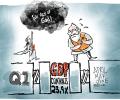
Dominic Xavier wonders whether the steep decline in GDP numbers should be considered as an act of God too.

>Bihar (18 days) has the most number of heatwave days in 2023, followed by Andhra Pradesh (15 days), Odisha (15 days), Jharkhand (13 days), West Bengal (8 days) and Tamil Nadu (6 days).

Indian companies are generating more cash than ever. The net cash flow from listed firms' operations hit a new high of Rs 11.1 trillion in financial year 2023-24 (FY24), crossing the Rs 10-trillion mark for the first time, according to the Centre for Monitoring Indian Economy (CMIE) data going back to 1990-91. The FY24 figure represents a 19.3 per cent jump over the previous year, even as quite a few companies are yet to release their numbers.

Online video platform YouTube's ecosystem has contributed over Rs 10,000 crore to India's GDP and supported more than 7.5 lakh full-time equivalent jobs in the country, according to a report. In India, over 4,500 channels had over 10 lakh subscribers and the number of YouTube channels in India making Rs 1 lakh or more in their annual revenue increased by over 60 per cent year-over-year in 2021, the YouTube Impact Report based on analysis by Oxford Economics said. "YouTube's creative ecosystem contributed over Rs 10,000 crore and supported more than 7,50,000 full-time equivalent jobs in the Indian economy in 2021. "That economic impact shows up in four ways, through direct, indirect, induced, and catalytic impacts," the report said.

'We have essentially tried to set out an agenda for the next five years and it, in essence, represents the political commitment to that agenda.'

'Whether I am optimistic or pessimistic is not the issue; I am just going by the evidence available.' 'The Indian economy and financial sector are now well-placed and very resilient in dealing with any kind of spillover coming from the external world.'

An average Indian couple spends around 2x on weddings versus education (pre-primary to graduation).

The US Fed interest rate decision, ongoing quarterly earnings, macroeconomic data and FII trading activity are the major triggers that will drive stock markets this week, analysts said. Investors would also track global market trends and the movement in global oil prices for further cues. "This week, the focus will shift to global cues, particularly the US markets," Santosh Meena, Head of Research, Swastika Investmart Ltd said.
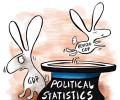
The GDP growth is estimated to come at the "deceptively high" level of 20 per cent for the April-June 2021 quarter but is far below the same in the pre-COVID times, rating agency Icra said on Wednesday. Icra said the low base of the last year, when the GDP had contracted by close to 24 per cent, "conceals" the impact of the second wave of COVID-19 infections. Economic activity is boosted by robust government capital expenditure, merchandise exports and demand from the farm sector, it said, estimating the GDP to grow by 20 per cent and the gross value added (GVA) will register a growth of 17 per cent for the June quarter.

The Budget should use the extra RBI surplus to better effect, suggests A K Bhattacharya.

Research and development (R&D) spending by BSE 100 companies has grown steadily, rising from 0.89 per cent of revenue in FY20 to 1.32 per cent in FY24, averaging around 1 per cent over the period in-between, according to data compiled from Bloomberg and company annual reports. Also, these companies more than doubled their R&D spending in absolute terms over these five years: From Rs 25,041 crore to Rs 63,072 crore. While this reflects a prioritisation of innovation, corporate R&D investment remains relatively conservative.
Global rating agency Moody's on Monday raised India's growth forecast for 2024 calendar year to 6.8 per cent, from 6.1 per cent estimated earlier, on the back of 'stronger-than-expected' economic data of 2023 and fading global economic headwinds. India's real GDP expanded 8.4 per cent year-over-year in the fourth quarter of calendar year 2023, resulting in a 7.7 per cent growth for full-year 2023. Capital spending by the government and strong manufacturing activity have meaningfully contributed to the robust growth outcomes in 2023, Moody's Investors Service said.

The outlook for India's financial sector appears bright, but it needs to brace for likely vulnerabilities, said Economic Survey 2023-24 tabled in Parliament on Monday. The Indian financial sector is at a "turnpike moment", it said, adding that the dominance of banking support to credit is being reduced, and the role of capital markets is rising. For a country that aspires to be a developed nation by 2047, this is a long-awaited and welcome development, it said.

India's foreign exchange reserves have jumped to an all-time high of $651.5 billion as of May 31, Reserve Bank Governor Shaktikanta Das said on Friday. This means the overall kitty has increased by $4.83 billion since the last reported number of $646.673 billion on May 24 this year.

Despite the wobble in the markets over the past few weeks, Indian equities remain expensive as measured by several yardsticks. India's market capitalisation-to-GDP ratio, for instance, has touched a multi-year high. The ratio is currently at 116 per cent, based on the FY22E gross domestic product (GDP) number, above its long-term average of 79 per cent.
Fitch Ratings has revised India's GDP growth estimate to 12.8 per cent for the fiscal year beginning April 1 from its previous estimate of 11 per cent, saying its recovery from the depths of the lockdown-induced recession has been swifter than expected. In its latest Global Economic Outlook (GEO), Fitch said revision is on the back of "a stronger carryover effect, a looser fiscal stance and better virus containment." "India's second half of 2020 rebound also took GDP back above its pre-pandemic level and we have revised up our 2021-2022 forecast to 12.8 per cent from 11.0 per cent," it said. "Nevertheless, we expect the level of Indian GDP to remain well below our pre-pandemic forecast trajectory."

Profits of India's top listed companies have been growing at a faster pace than those of their American peers, but when it comes to revenue growth, the order has reversed recently. The combined net profit of the S&P 500 companies was up 14.1 per cent year-on-year (Y-o-Y) during the trailing 12 months (TTM) ended December 2023, as against 17.4 per cent profit growth logged by the BSE 500 companies in the same period. This is the second consecutive year of faster profit growth for the BSE 500 companies.

India's first $1 trillion company by market capitalisation (mcap) is achievable by 2032 and HDFC Bank and Reliance Industries (RIL) are seen as lead contenders, ICICI Securities said in a note on Monday. To achieve this, the shares of both the firms will have to appreciate at least 20 per cent annually for the next decade. ICICI Securities believes this is possible if India's gross domestic product (GDP) growth accelerates to 9 per cent per annum and corporate profitability cycle peaks. "Our calculations suggest that India's first $1 trillion mcap stock could emerge by 2032.

Indian GDP will grow at 8.5 per cent in 2021-22, and the rate will accelerate further to 9.8 per cent in 2022-23, a foreign brokerage said on Tuesday. The GDP had contracted by 7.3 per cent in the pandemic-hit FY21, and is widely expected to grow at a faster pace due to the base effect in 2021-22. The Reserve Bank of India (RBI) expects a 9.5 per cent growth in 2021-22, and the same to slow down to 7.8 per cent as things normalise.

The government may relax the requirement of making payments to MSMEs within 45 days of buying goods and services to check large corporate from looking at other sourcing avenues, sources said. The announcement to this effect could be made in the Budget likely to be presented on July 23. The government is considering suggestions regarding changes to Section 43B(h) of the Income Tax Act made by MSMEs during pre-Budget consultations, sources said.

Among the 30 Sensex companies, Mahindra & Mahindra, Power Grid, Sun Pharma, Nestle, UltraTech Cement, NTPC, ITC, ICICI Bank, Titan, Bajaj Finserv, Bharti Airtel, and HDFC Bank were among the biggest gainers. IndusInd Bank, Adani Ports, Tata Steel, Reliance Industries, Axis Bank and Bajaj Finance were among the laggards.

A British brokerage on Tuesday cut India's FY22 GDP growth estimate by a sharp 0.80 per cent to 9.2 per cent, saying the economic impact of the second wave of infections has been deeper than initially expected. Barclays chief India economist Rahul Bajoria also mentioned the slow pace of vaccinations in the country and the rolling lockdowns across many states for the estimate. It can be noted that last month has seen a slew of similar forecasts from analysts, even as the RBI maintained its estimate of a 10.5 per cent growth in real GDP.

The size of Budget 2024-25 has increased 6.1 per cent to Rs 47.66 lakh crore because of the rise in expenditure and higher allocation for capital expenditure and social sector schemes.
 © 2026 Rediff.com - Advertise with us - Disclaimer - Privacy Policy - Sitemap - Feedback - About us - Terms of use - Grievances