
'India's output contraction in the previous year was among the worst in the world!'

The Reserve Bank on Friday retained GDP growth forecast of 7 per cent for 2024-25 financial year, lower than the 7.6 per cent expansion estimated for FY24. In its February monetary policy, the RBI had projected the GDP growth rate of 7 per cent for the financial year beginning April 1. Announcing the current fiscal's first bi-monthly monetary policy, RBI Governor Shaktikanta Das said the rural demand is gathering pace, and sustained growth in manufacturing sector should boost private investment.

Domestic ratings agency Icra on Monday forecast a 2 per cent GDP growth in the fourth quarter of 2020-21, and a 7.3 per cent contraction for the full fiscal year. From a GVA or gross value added perspective, the agency pegs Q4 growth at 3 per cent and the full year contraction at 6.3 per cent. According to the agency, the 2 per cent projected GDP growth will help the economy avoid a double-dip recession as indicated by the National Statistical Office (NSO) for Q4. Icra's projection is better than the 8 per cent contraction forecast by the NSO as it sees Q4 growth at only 1.1 per cent.

'A long-term investor with a 4 to 5 year horizon could invest in this theme via SIPs.'

'It's the second-largest market for us after the US, and should be the largest market at some point.'

Dominic Xavier asks if it is right to blame coronavirus and the lockdown for India's economic decline.

Foreign portfolio investors (FPIs) have net sold domestic shares worth over $10 billion so far this month amid a shift to China, which not only offers attractive valuations compared to India but has also announced several measures to support the economy and the stock market in recent weeks. If the trend doesn't reverse, this will be the first time that overseas funds will yank out more than $10 billion from Indian equity markets in a month.

Quarterly earnings of corporates, trading activity of foreign investors and inflation data are the key factors that are expected to drive the momentum in the equity markets this week, analysts said.

Road Transport and Highways Minister Nitin Gadkari on Tuesday favoured giving a majority 51 per cent stake to foreign partners in joint ventures for building tunnels and detailed project reports to improve work quality. Gadkari said providing a majority stake to a foreign partner in the joint venture is necessary to ensure that only serious and technically qualified players bid for tunnel projects.

New investors should gradually build a 5 to 10 per cent allocation to gold.

Union Finance Minister Nirmala Sitharaman on Tuesday said the fiscal deficit for 2024-25 is estimated at 4.9 per cent of GDP.

Chief Economic Advisor V Anantha Nageswaran on Thursday said the economy is expected to grow at 6.5 per cent in the current fiscal notwithstanding deficient rains in August. India recorded economic growth of 7.8 per cent in the April-June quarter of 2023-24 against 13.1 per cent in the year-ago period. India's economy in Q1 grew at the fastest pace in a year, on the shoulders of a boost in capital expenditure both at central and state levels, along with stronger consumption demand, especially in rural areas, and improved performance in the services sector, he said.

The country's gross domestic product (GDP) is expected to grow at around 18.5 per cent with an upward bias in the first quarter of the current financial year, according to SBI research report Ecowrap. This estimate is lower than the Reserve Bank of India's GDP growth projection of 21.4 per cent for the April-June quarter. "Based on our 'Nowcasting' model, the forecasted GDP growth for Q1 FY22 would be around 18.5 per cent (with upward bias)," the report said. Higher growth in Q1 FY22 is mainly on account of a low base.

India has already become the world's fifth largest economy in the 75th year of Independence and will reach the $3.5 trillion mark by end-March, said the Economic Survey tabled in Parliament on Tuesday. In real terms, the economy is expected to grow at 7 per cent for the year ending March 2023. This follows an 8.7 per cent growth in the previous financial year.

'Any finality in such matters requires political views. We will review it closer to the full Budget.'

Fitch Ratings has revised India's GDP forecast to minus 9.4 per cent in the current fiscal year from a previously projected contraction of 10.5 per cent after the economy staged a sharper rebound in the second quarter. In its Global Economic Outlook, Fitch said the coronavirus-induced recession inflicted severe economic scarring and the country needs to repair balance sheets and increase caution about long-term planning. "We now expect GDP to contract 9.4 per cent in the fiscal year to end March 2021 (plus 1.1 percentage point) followed by plus 11 per cent growth (unchanged) and plus 6.3 per cent growth in the following years," the rating agency said.

The Indian economy is likely to post better than anticipated growth in the second quarter (July-September) owing to robust urban consumption and expansion in services, a Business Standard analysis of high-frequency indicators showed. While gross domestic product growth in the September quarter is expected to come below the 7.8 per cent print in the June quarter due to a favourable base fading, analysts say the print will be much closer to 7 per cent than the 6.5 per cent anticipated earlier. While the Reserve Bank of India (RBI) had estimated 6.5 per cent growth for July-September, last month Governor Shaktikanta Das said the growth figure would surprise on the upside.

American brokerage firm Morgan Stanley on Thursday sharply cut its India FY23 real GDP growth estimate to 7.9 per cent, mainly due to the impact of the Russia-Ukraine conflict on oil prices. Analysts at the brokerage also raised their inflation forecast to 6 per cent - the upper end of the tolerance band for the RBI - and flagged stagflation risks because of the ongoing events. "We believe that the ongoing geopolitical tensions exacerbate external risks and impart a stagflationary impulse to the economy," they said. It can be noted that stagflation involves a stagnancy in output or growth, coupled with high inflation.

Fitch Ratings on Wednesday said India's high fiscal deficit would pose a challenge in lowering the debt to GDP ratio, which is expected to rise above 90 per cent in the next five years. It said India entered the pandemic with little fiscal headroom from a rating perspective. Its general government debt/GDP ratio stood at 72 per cent in 2019, against a median of 42 per cent for 'BBB' rated peers.

Fiscal deficit for 2020-21 was at 9.3 per cent of the gross domestic product (GDP), lower than 9.5 per cent estimated by the finance ministry in the revised Budget estimates, according to the CGA data. Unveiling the revenue-expenditure data of the Union government for 2020-21, the Controller General of Accounts (CGA) on Monday said that the revenue deficit at the end of the fiscal was 7.42 per cent.

With decline in number of fresh COVID-19 cases and easing of restrictions, the country's gross domestic product (GDP) will grow at 8.5 per cent in FY2021-22, according to credit rating agency Icra Ratings. It expects the gross value added (GVA) at basic prices (at constant 2011-12 prices) to grow at 7.3 per cent in FY2022. "The impact of the second wave of COVID-19 and the ensuing state-wise restrictions was seen across a variety of high frequency indicators in April-May 2021.
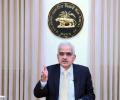
The challenge for the RBI in 2024 is likely to be less about containing elevated inflation and more about curbing excessive financial market exuberance and a 'problem of plenty', notes Sajjid Chinoy, Chief India Economist JP Morgan.

Moody's Investors Service on Thursday slashed India's economic growth projection for 2022 to 7.7 per cent, saying that rising interest rates, uneven monsoon, and slowing global growth will dampen economic momentum on a sequential basis.

Trading in the equity market will largely depend on two major events this week - general elections result and the RBI interest rate decision - analysts said, adding that the benchmark indices may rally on Monday on exit polls' prediction of a massive win for the BJP-led NDA and strong GDP data. Exit polls on Saturday predicted that Prime Minister Narendra Modi will retain power for a third straight term, with the NDA expected to win a big majority in the polls. Counting of votes will take place on June 4.

India's manufacturing sector growth moderated in August as output and sales rose at slowest rates since January, while competitive pressures and inflation concerns hampered business confidence, a monthly survey said on Monday. The seasonally adjusted HSBC India Manufacturing Purchasing Managers' Index (PMI) stood at 57.5 in August, below July's reading of 58.1 but above its long-run average of 54.0, signalling a substantial improvement in operating conditions.

Stock markets will be driven by domestic inflation data, ongoing quarterly earnings from corporates and global trends this week, analysts said. News flows around the general election would also be tracked by investors, market experts said.

Putin said that the Indian leader had "aptly" noted that it is "not an anti-western one but a non-western one".

India's economy contracted by 7.3 per cent in fiscal 2020-21. The pandemic, it said, will leave new economic scars and deepen pre-pandemic constraints.

Putin expressed concern over the situation in Gaza, and said Palestinian President Mahmoud Abbas has been invited to BRICS events.

India's GDP is estimated to grow at 7.4 per cent in the financial year 2022-23 with rising prices triggered by the Russia-Ukraine conflict posing as the biggest challenge to the global economic recovery, Ficci's Economic Outlook Survey released on Sunday said. According to the survey, the Reserve Bank of India (RBI) is likely to start a rate hike cycle in the second half of 2022, while a repo rate hike of 50-75 bps is expected by the end of the current fiscal. The RBI is expected to continue supporting the ongoing economic recovery by keeping the repo rate unchanged in its April policy review, the survey said.
'Given that the economy is going through a slowdown, further downward revisions of the 2019-2020 growth estimates cannot be ruled out,' notes A K Bhattacharya.

The Adani family, led by Chairman Gautam Adani, is the most valued first-generation family business at Rs 15.44 trillion.

Investors need to carefully assess country-specific risks. 'This is especially true of a market that is less transparent than the US.'

He said the transformation brought about by the fintech sector in India is not just limited to technology, but its social impact is far-reaching. He also stressed that fintech has dented the parallel economy and is bridging the gap between villages and cities on the financial services front. The prime minister also said that in the last 10 years, the fintech space has attracted investments of more than $31 billion and fintech startups have grown by 500 per cent.

India's services sector activity growth touched a five-month high in August on stronger rise in new work orders, while payroll numbers rose solidly as companies remained upbeat regarding the economic outlook, a monthly survey said on Wednesday. The seasonally adjusted HSBC India Services Business Activity Index rose from 60.3 in July to 60.9 in August, registering the fastest expansion since March and was largely supported by productivity gains and positive demand trends.

Indian food services sector is expected to grow at a CAGR (compounded annual growth rate) of 8.1 per cent between 2024 and 2028 on the back of rapid urbanisation, robust GDP growth, a rising younger population, and greater exposure among consumers, said a new report. The India Food Services Report-2024, brought out by the National Restaurants Association of India (NRAI), states that the sector contributes 1.9 per cent to India's GDP and is projected to grow to Rs 7.76 trillion by 2028 from Rs 5.69 trillion currently.

'Future market gains will likely depend primarily on earnings growth.'

The country's gross domestic product (GDP) is likely to grow more than 9.5 per cent in fiscal 2021-22, an SBI research report-Ecowrap said. The economy grew at 8.4 per cent in the second quarter of the current fiscal, according to data released by the National Statistical Office (NSO) on Tuesday. The growth in the April-June quarter of this fiscal stood at 20.1 per cent. In October's monetary policy review, the Reserve Bank of India had retained its projection for real GDP growth at 9.5 per cent in 2021-22, consisting of 7.9 per cent in Q2; 6.8 per cent in Q3; and 6.1 per cent in Q4 of 2021-22.

The government will provide Rs 11.11 lakh crore for capital expenditure for 2024-25 and introduce viability gap funding to spur private investment in infrastructure, Finance Minister Nirmala Sitharaman said on Tuesday. Presenting the Union Budget for FY2024-25, she said that the government will endeavour to maintain strong fiscal support for infrastructure over the next five years, in conjunction with imperatives of other priorities and fiscal consolidation.

All eyes will be on whether Sitharaman will deliver a populist budget leaving more money in hands of the common man or push the reform agenda by staying on the fiscal glide path to lower the fiscal deficit to 4.5 per cent of GDP by 2025-26.
 © 2026 Rediff.com - Advertise with us - Disclaimer - Privacy Policy - Sitemap - Feedback - About us - Terms of use - Grievances