
Updated new base years for national accounts and other macro-indicators are expected to come into effect from January-February 2026, coinciding with the first and second advance estimates of national income for FY26, senior official sources aware of the development told Business Standard. "The statistics ministry set up the Advisory Committee on National Accounts Statistics (ACNAS) earlier this week. "It will advise on the base year for GDP (gross domestic product) and its alignment with other macro-indicators.

India is poised to be the third largest global economy by 2030 but rising population presents mounting challenges in basic service coverage and growing investment needs to maintain productivity, S&P Global Ratings said on Thursday. It said emerging economies have high ambitions for the next decade and beyond with India aiming to become a $30 trillion economy by 2047, from the current $3.6 trillion. India is currently the fifth largest economy.

'As we enter 2025, it must be acknowledged that there is a convergence of capital, influential people (from business and politics) and technology deciding the destiny of others in the name of pride, patriotism, nationalism, nation building, all of it thinly veiled disguises for personal profit and glory,' asserts Shyam G Menon.

The central government's fiscal deficit during 2023-24 at 5.6 per cent of the GDP was better than previous estimates of 5.8 per cent on account of higher revenue realisation and lower expenditure, according to official data released on Friday. In actual terms, the fiscal deficit -- or gap between expenditure and revenue -- was Rs 16.53 lakh crore, or 5.63 per cent of the GDP, which grew 8.2 per cent in 2023-24.

The first wave of COVID-19 last year impacted households as their financial savings moderated to 8.2 per cent of GDP in December quarter from 10.4 per cent in the previous three-month period, revealed an RBI data released on Wednesday. The preliminary estimate of household financial savings is placed at 8.2 per cent of GDP in October-December 2020-21, exhibiting a sequential moderation for the second consecutive quarter after having spiked in the pandemic-hit June quarter, RBI said in a release. "The moderation was driven by a significant weakening in the flow of household financial assets, which more than offset the moderation in the flow of household financial liabilities," it said.
Reserve Bank on Thursday retained the growth and inflation projection at 7.2 per cent and 4.5 per cent respectively for the current fiscal amid expectations of a normal monsoon. In its last bi-monthly monetary policy review in June, RBI had projected real GDP growth and retail inflation at the same.

The three day MPC meeting began on Monday and the decision will be announced on Wednesday by RBI Governor Shaktikanta Das.

Prime Minister Narendra Modi urged CEOs of US majors to take advantage of India's growth story as the country is making all efforts to become the third largest economy of the world in his third term. India is currently the fifth largest economy of the world after the US, China, Germany and Japan with a GDP of around $3.9 trillion. India has been the fastest growing large economies of the world with GDP growth rate of over 7 per cent for the last three consecutive years.
China on Saturday lowered its GDP target to 5.5 per cent for this year bringing it down from last year's 6.1 per cent. The new target for the second-largest economy was announced by Premier Li Keqiang in his work report presented to the National People's Congress (NPC), the country's Parliament which opened its annual session in Beijing on Saturday. In 2021, China's economy grew by 8.1 per cent 2021 to about $18 trillion stated to be the best in a decade.

Whether she will pare the fiscal deficit target of 5.1 per cent of GDP, using the record dividend received from the RBI, or expand flagship government programmes will be keenly watched.

Large investors track high-frequency data that is immediately available today. That data has been bullish, points out Debashis Basu.

The country's GDP is likely to grow at 1.3 per cent in the fourth quarter of 2020-21 and may see a contraction of around 7.3 per cent for the full financial year, according to an SBI research report 'Ecowrap'. The e-National Statistical Office (NSO) will release the GDP estimates for the March 2021 quarter and provisional annual estimates for the year 2020-21 on May 31. "Based on our 'nowcasting model', the forecasted GDP growth for Q4 would be around 1.3 per cent (with downward bias) as against NSO (National Statistical Office) projection of a negative (-)1 per cent," the research report said.

Warning that the new year will be riskier than the previous two in terms of growth, inflation and the perils of monetary policy normalisation on consumption demand in particular, along with other external risks, a Wall Street brokerage has pencilled in an 8.2 per cent GDP growth next fiscal, with more downside risks to the projection. The biggest risk to the projection is a derailed consumption demand that has been the main growth driver in the past many years, said the Bank of America Securities India house economists who still believe that consumption demand will remain the key driver of growth next fiscal as well.

United States President-elect Donald Trump on Tuesday said that he understands the Russian feeling with NATO (North Atlantic Treaty Organisation) being on their doorstep.

'Generating employment requires a shift in policy.' 'If not, the country will face economic, social and political challenges in the coming years.'
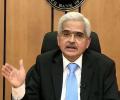
The Reserve Bank is unlikely to cut the benchmark interest rate in its forthcoming bi-monthly monetary policy review later in the week as retail inflation is still a cause of concern, and there is a possibility of the Middle East crisis deteriorating further, impacting crude oil and commodity prices, say experts.

India's services sector activity fell to a 10-month low in September as new businesses, international sales and output growth moderated, a monthly survey said on Friday. The seasonally adjusted HSBC India Services Business Activity Index fell from 60.9 in August to 57.7 in September, indicating that though the output registered an increase, the pace of growth was the slowest since November 2023. In the Purchasing Managers' Index (PMI) parlance, a print above 50 means expansion, while a score below 50 denotes contraction.

Equity investors will track the trading activity of foreign investors, global trends and ongoing earnings results for further cues, and benchmark indices may continue to witness consolidation in a holiday-shortened week amid the monthly derivatives expiry, analysts said. Markets fell sharply last week amid massive foreign capital outflows and dismal Q2 earnings so far. Weakness in the markets might continue in the near term amid cautiousness among investors ahead of the US presidential election early next month, an expert said.

Global brokerage firm CLSA has reversed its early tactical shift from Indian equities to Chinese stocks, and has decided to raise India allocation while cutting exposure to China. In its report titled 'Pouncing Tiger, Prevaricating Dragon', CLSA cited challenges facing Chinese markets in the aftermath of Donald Trump's victory in the US elections as the reason for the move. "Misfortune can happen in threes. So it has played out for Chinese equities over the past week.

The 16th Brics Summit beginning Tuesday in Kazan, Russia, is expected to see more focus on creating a sharper energy policy for Brics that ensures closer partnership among members in both energy security and energy transition, official sources said. The same is expected to be a part of the Kazan declaration, currently being negotiated, they added.

Citing the massive surge in Omicron infections and the resultant impact on overall economic activities in the March quarter, Swiss brokerage UBS Securities has revised downwards its India's growth forecast for the current financial year to 9.1 per cent from 9.5 per cent earlier. However, UBS Securities does not see the third wave impact extending to the next financial year as it has revised upwards its real GDP forecast to 8.2 per cent, up from 7.7 per cent earlier, expecting the real GDP growth to remain well above the historical average. The World Bank pegs it at 8.3 per cent, unchanged from its June assessment, saying the recovery is not broad-based yet.

The ties between India and the Maldives came under severe strain since Muizzu, known for his pro-China leanings, took charge of the top office in November.

'Maharashtra is virtually in a debt trap.'

Fiscal deficit for 2021-22 worked out to be 6.71 per cent of the gross domestic product (GDP), lower than 6.9 per cent projected by the Finance Ministry in the revised Budget Estimates, according to government data released on Tuesday. Unveiling the revenue-expenditure data of the Union government for 2020-21, the Controller General of Accounts (CGA) said that the fiscal deficit in the absolute terms was be Rs 15,86,537 crore (provisional).

It's always been a struggle for economists and statisticians to forecast India's gross domestic product (GDP) correctly, and say where the economy is headed before the official numbers come out. If estimating the GDP is tough, forecasting it in real time is complicated. It involves looking at tens of indicators, such as industrial production, electricity consumption and exports, to arrive at a number.

The Reserve Bank of India's (RBI's) interest rate decision, West Asia conflict and trading activity of foreign investors are the key factors that will dictate investors' sentiment in the market this week, analysts said. Moreover, quarterly earnings from IT bellwether TCS, domestic macroeconomic data and movement in global oil benchmark Brent crude would also guide trends in the market. Worsening tensions in the Middle East and foreign fund outflows were the major culprits behind the equity markets sharp fall last week.
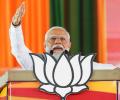
The BJP-led National Democratic Alliance's (NDA) slim majority in Lok Sabha may delay more far-reaching economic and fiscal reforms that could impede progress on fiscal consolidation, Moody's Ratings said on Wednesday. NDA securing a majority in the general elections will give a historic third term for Narendra Modi as Prime Minister of India. "We expect policy continuity, especially with regards to budgetary emphasis on infrastructure spending and boosting domestic manufacturing, to support robust economic growth.

'It does not understand economics. The entire focus of this government is skewed.'
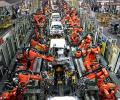
India's economy grew 6.1 per cent in the fourth quarter of 2022-23, pushing up the annual growth rate to 7.2 per cent, official data showed on Wednesday.

The RBI is fully aware that the high-cost loans and high indebtedness of the borrowers could pose financial stability risks, if not addressed by these NBFCs. Governor Shaktikanta Das has issued a stern warning, saying the RBI is closely monitoring these areas and will not hesitate to take appropriate action, if necessary, if the culprits don't opt for self-correction. Watch out for some action, soon, notes Tamal Bandyopadhyay.
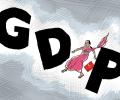
India's gross domestic product (GDP) growth slowed to 4.1 per cent in January-March 2022 period, while for the full year 2021-22 the growth stood at 8.7 per cent, according to the government data released on Tuesday. GDP at constant (2011-12) prices in Q4 2021-22 is estimated at Rs 40.78 lakh crore, as against Rs 39.18 lakh crore in Q4 2020-21, showing a growth of 4.1 per cent, as per the National Statistical Office (NSO) data. India's GDP growth has slowed for the third straight quarter.

However, the SBI report said it will take almost seven-quarters from Q4 FY21 to reach the pre-pandemic level in nominal terms and there will be a permanent output loss of around 9 per cent of GDP.

India's current account slipped into a deficit of $9.6 billion or 1.3 per cent of GDP in the September quarter, the Reserve Bank said on Friday. The current account, which records the value of exports and imports of both goods and services along with international transfers of capital, was in a surplus mode both in the quarter-ago and year-ago periods. India's current account surplus had stood at $6.6 billion or 0.9 per cent of GDP in the April-June 2021 quarter, while in the year-ago period (Q2FY22), the surplus had stood at $15.3 billion or 2.4 per cent of the GDP, the data said.

China's GDP grew by 4.9 per cent in the third quarter, down from 7.9 per cent in the second, confirming the slowdown of the world's second-largest economy which was under pressure from the crisis-hit property sector, curbs on energy and tardy recovery from the Covid-19 pandemic.

The Asian Development Bank (ADB) on Wednesday slashed India's GDP growth forecast for FY23 to 7 per cent from the earlier estimate of 7.2 per cent mainly on account of higher inflation and a tight monetary policy. India's economy grew 13.5 per cent year-on-year in the first quarter of 2022-23, reflecting strong growth in services, ADB said in its second supplement to Asian Development Outlook Report 2022 (ADO 2022). "However, GDP growth is revised down from ADO 2022's forecasts to 7 per cent for FY2022 (ending March 2023) and 7.2 per cent for FY2023 (ending March 2024) as price pressures are expected to adversely impact domestic consumption, and sluggish global demand and elevated oil prices will likely be a drag on net exports," ADB said.
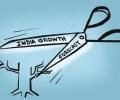
The International Monetary Fund (IMF), in its latest World Economic Outlook report, has slashed its forecast for India's FY23 gross domestic product growth to 8.2 per cent from 9 per cent, saying that higher commodity prices will weigh on private consumption and investment. This was one of the steepest cuts for emerging economies compared to the IMF's January WEO forecasts. Saying that global economic prospects have worsened significantly due to commodity price volatility and disruption of supply chains caused by the war in Europe, IMF cut its global growth outlook for calendar year 2022 to 3.6 per cent from 4.4 per cent, and said both Russia and Ukraine could experience large GDP contractions.

The Reserve Bank on Friday retained GDP growth forecast of 7 per cent for 2024-25 financial year, lower than the 7.6 per cent expansion estimated for FY24. In its February monetary policy, the RBI had projected the GDP growth rate of 7 per cent for the financial year beginning April 1. Announcing the current fiscal's first bi-monthly monetary policy, RBI Governor Shaktikanta Das said the rural demand is gathering pace, and sustained growth in manufacturing sector should boost private investment.
The country's gross domestic product (GDP) is likely to grow at 5.8 per cent in the third quarter of fiscal 2022, according to an SBI's research report- Ecowrap. The country's economy expanded by 8.4 per cent in the second quarter of 2021-22, to cross pre-pandemic levels. However, the GDP growth in July-September period was slower than the 20.1 per cent expansion in the previous quarter.

The pre-budget Economic Survey, which is tabled in Parliament ahead of the Union Budget to present the state of the economy and suggest policy prescriptions, quite often misses on the GDP forecast, sometimes by a significant margin. This time, Finance Minister Nirmala Sitharaman will table the Economic Survey for 2021-22 in the Lok Sabha on Monday soon after the President's address to both Houses of Parliament. She will present the Union Budget for the next financial year beginning April 1, 2022, on Tuesday.

'India's output contraction in the previous year was among the worst in the world!'
 © 2026 Rediff.com - Advertise with us - Disclaimer - Privacy Policy - Sitemap - Feedback - About us - Terms of use - Grievances