
Private sector banks reported the maximum number of frauds in 2022-2023.

Monthly systematic investment plan (SIP) flows into India have held steady above Rs 13,000 crore in 2022-23 (FY23) in the face of markets delivering muted returns in 18 months. However, it is not a rose-tinted view when it comes to viewing new SIP registrations and the cessation of existing ones. The ratio of SIPs stopped as a percentage of fresh SIPs registered (called SIP stoppage or closure ratio in industry parlance) stood at 56 per cent in the first 11 months of FY23, compared with 41 per cent during the same period of 2021-22 (FY22).

In the longer-term, analysts expect IHCL to see revenue CAGR of 15 per cent between FY23 to FY25 and Ebitda CAGR of 20 per cent in the same period. Analysts are seeing targets of around Rs 375-Rs 380 for the stock, which is a significant upside from the current Rs 313.

FSN E-Commerce Ventures, the parent of Nykaa, has had a roller-coaster ride since listing last November. The initial public offering (IPO) was priced at Rs 1,125 apiece, and the stock listed at a 96 per cent premium, closing the first day at Rs 2,205 apiece. It subsequently hit a high of Rs 2,573 in late November, but has seen steady selling since, hitting a low of Rs 1,208 in May.

India's top listed companies reported their best-ever quarterly net profit of Rs 2.39 trillion in the September quarter of FY22, up 46.4 per cent year-on-year. The earnings were driven by a big surge in the profitability of banks, non-banking financial companies & insurance (BFSI), oil & gas, and metal & mining firms. The combined net profit of these three cyclical sectors were up 87 per cent YoY to a record high of Rs 1.53 trillion, up from Rs 82,000 crore a year ago and Rs 1.08 trillion in Q1FY22.

The states will forego around Rs 44,000 crore of tax revenue after they reduced VAT on petrol and diesel in the reminder of the fiscal but higher central tax devolution of Rs 60,000 crore will offset the losses, according to a report. After months of calls for lowering the taxes on the fuels, the Centre on November 4 cut excise duty on diesel by Rs 10 a litre and by Rs 5 on petrol. Following this, as many as 25 states and Union territories have lowered value-added tax (VAT) on these fuels.

For Tata Consultancy Services (TCS) - India's largest and the world's second-largest IT services provider - the attrition rate touched an all-time high of 17.4 per cent in Q4FY22. The management, following the announcement of the Q4 results, has warned that the attrition situation could become even worse before any improvement. According to analysts, the short term, the attrition rate at TCS could even touch 20 per cent.

Byju Raveendran, CEO and founder of the eponymous edtech giant, has told shareholders that the company will set up a board advisory committee (BAC). This was part of a discussion on July 4 with shareholders at an emergency general meeting (EGM). Raveendran also said that in the next EGM in three weeks will give details about BAC's members and composition.

House economists at the nation's largest lender State Bank of India (SBI) have urged the government to budget for nursing the pandemic-ravaged economy and not to focus too much on fiscal consolidation as there is a need for more stabilisation measures to sustain the fledgling recovery. And one of the best way to begin the new fiscal is to complete the share sale of LIC this fiscal. This can go a long way in repairing the overstretched balance sheet which in turn will bring down fiscal deficit to a much lower 6.3 per cent in FY23 as the public coffers will be left with a cash surplus of at least Rs 3 lakh crore to begin the new fiscal, SBI chief economist Soumya Kanti Ghosh said in a pre-Budget note on Wednesday.

In a bid to enhance its equity exposure and earn higher returns for its nearly 65 million subscribers, the Employees' Provident Fund Organisation (EPFO) is considering reinvesting 50 per cent of its exchange-traded funds (ETFs) redemption proceeds back into equity. Sources close to the development said a proposal regarding this was discussed in the investment committee (IC) meeting in October last year, and the recommendation has been sent to the Central Board of Trustees (CBT), the apex decision-making body of the EPFO for its approval. The next CBT meeting is scheduled to be held on Saturday.

'The local support from our MP is nil. He never comes to see our farms.'

Maruti Suzuki's contribution to the sales revenue of its Japanese parent, Suzuki Motor Corporation (SMC), has touched the highest-ever figure during April-December of FY23. According to SMC's results declared on Tuesday, Maruti's share in its global revenues jumped from 33.42 per cent in April-December of FY22 to 40.93 per cent in the corresponding period of FY23.

Public sector banks (PSBs) have delivered significant outperformance over the past three years and the sector has been re-rated. Given the growth and profitability expectations of an 18 per cent return on equity (RoE) over FY24-26, there is still a case for buying at the current levels. While the net interest margins or NIMs may remain range-bound or have a downward bias, there's optimism about possibly better opex ratios and lower non-performing assets (NPAs), plus scope for further credit cost reduction, and healthy treasury performances as interest rates trend down.

The country's gross domestic product (GDP) is expected to grow at around 18.5 per cent with an upward bias in the first quarter of the current financial year, according to SBI research report Ecowrap. This estimate is lower than the Reserve Bank of India's GDP growth projection of 21.4 per cent for the April-June quarter. "Based on our 'Nowcasting' model, the forecasted GDP growth for Q1 FY22 would be around 18.5 per cent (with upward bias)," the report said. Higher growth in Q1 FY22 is mainly on account of a low base.

Mahindra & Mahindra (M&M) reported very strong results for the January-March quarter of the last financial year (Q4FY24), beating consensus comfortably. The margins of the automobile business improved 170 basis points (bps) year-on-year (Y-o-Y) to 8.8 per cent, while FES (Farm Equipment Sector) margins improved to 15.8 per cent (up 60 bps Y-o-Y), despite a decline in volumes due to cost optimisation and lower raw material costs.

Instead, 2019-20 could be the base from which the Budget estimates for next year are calculated.

The country's current account deficit is likely to hit a three-year high of 1.8 per cent or $43.81 billion in FY22, as against a surplus of 0.9 per cent or $23.91 billion in FY21, a report said on Thursday. According to an assessment by India Ratings, the Current Account Deficit (CAD) has moderated to $17.3 billion or 1.96 per cent of GDP in the fourth quarter of FY22 as against $8.2 billion or 1.03 per cent in the year-ago period, and massively down from $23.02 billion or 2.74 per cent in Q3, which was a 13-quarter high. The improvement in the key numbers are due to the remarkable improvement in merchandise exports in FY22, when it grew 42.4 per cent as against a negative 7.5 per cent in the pandemic-hit FY121.

Larsen & Toubro (L&T) disappointed the Street with its results for the January-March quarter of the 2022-23 financial year (Q4FY23) due to weaker core engineering & construction (E&C) segment performance by the engineering giant.' Although core E&C order inflows for FY23 rose 19 per cent year-on-year (YoY), with orders from railways, metals and water sectors, margins in the infrastructure segment crashed to all-time low. Revenue at Rs 58,300 crore was up 10 per cent YoY but somewhat below expectations.

The resolution seeking his reappointment as chairman and managing director of the diversified conglomerate will be put to vote at the company's annual general meeting to be held on August 11, 2023, according to a notice sent to the shareholders on Tuesday. The company under Puri drove the 'ITC Next' strategy in the last four years encompassing digital acceleration, cost optimisation, investing in new growth vectors and ensuring supply chain agility, its officials said.
The Centre has completed asset monetisation worth Rs 96,000 crore during FY22, surpassing the target of Rs 88,000 crore. For FY23, it has set itself a goal of Rs 1.62 trillion, and already has a pipeline of assets worth Rs 1.6 trillion under advanced stages of implementation, an official said. Union Finance Minister Nirmala Sitharaman on Tuesday reviewed the progress made by several ministries and nudged departments to achieve the targets set for them, the official added.

The unclaimed funds within the life insurance sector are higher from policies sold by agents as against other channels like bancassurance or a digital platform, said analysts and officials from insurance companies. Unclaimed life insurance funds refer to the proceeds of insurance policies including death or survival benefits not claimed by the beneficiary or the policyholder. Bancassurance means selling an insurance product through banks.

IT services firms' revenue growth in the fourth quarter will be affected by macro-driven headwinds, lower working-days, and the fact of the three-month period being low season. Analysts are expecting FY24 growth to be muted. Revenue growth will decline 600-700 basis points to 10-12 per cent for FY24, said a CRISIL Ratings report. The 10-12 per cent growth rate is a fall from the 18-20 per cent expected in FY23 and around 19 per cent growth in FY22, the highest in eight years, said the CRISIL Ratings report.

'We're putting a lot of focus on GenAI developers and people who can really do all the architecture and programming.'

An increased brand fee paid by India-listed Vedanta, apart from record dividend, has helped Vedanta Resources (VRL) - the London-based holding company of Vedanta Group - to repay part of its debt. Vedanta paid a brand fee of Rs 2,632 crore ($325 million) for 2022-23 (FY23), according to Nomura report. This was after the Anil Agarwal-owned holding company raised the brand fee to 2 per cent of the turnover for its Indian businesses in 2021.

Accenture's Q1 FY22 results have sent a wave of cheer among analysts, as the company raised its revenue guidance and said it expects double-digit growth in outsourcing, up from single digit to low double-digit growth expected earlier. Accenture's financial year ends on August 31. The company raised its revenue outlook for FY22 to 19-22 per cent in local currency, up from 12-15 per cent earlier.

Walmart group firm Flipkart continues to dominate the e-commerce segment with 48 per cent market share while Softbank-backed Meesho has emerged as the fastest growing e-commerce platform in terms of user base in India, a latest report by AllianceBernstein said. According to the report, Flipkart's user base grew 21 per cent year-on-year (YoY), Meesho accelerated at 32 per cent while Amazon lagged at 13 per cent user growth primarily due to relative premium offerings as compared to peers. "As of FY23, Flipkart was the market leader, with a 48 per cent share in India eCommerce.

The Organization of the Petroleum Exporting Countries (Opec) and its partners, such as Russia, collectively termed Opec+, have decided to cut crude oil production by 100,000 barrels per day (bpd) from October onwards, at a meeting on Monday. In a step that may increase prices in India, the group has decided to reduce output quotas for October, after a fall in global oil demand outlook. The cut in output is equal to 0.1 per cent of global supply.

The central government is on track to meet its fiscal deficit target of 6.4 per cent of the GDP for 2022-23 on the back of strong growth in revenue collections, the World Bank said in its India Development Update on Tuesday. High nominal GDP growth in the first quarter supported strong growth in revenue collection, especially Goods and Services Tax (GST), despite tax cuts on fuel. Notwithstanding an increase in spending due to expanded fertilizer subsidies and food subsidies for vulnerable households in response to the commodity price shock, the government is on track to meet its FY22/23 fiscal deficit target of 6.4 per cent of GDP and the general government deficit is projected to decline to 9.6 per cent from 10.3 per cent in FY21/22 and 13.3 per cent in FY20/21.
The earnings of India Inc hit a record high in the 2022-23 (FY23) January-March quarter (fourth quarter, or Q4), compared with their poor showing in the previous two quarters of the financial year. The rise in earnings, however, is exclusively led by banking, financial services, and insurance (BFSI) companies. A better-than-expected showing by banks and non-bank lenders in Q4FY23 more than compensated for the earnings contraction in the non-BFSI space.
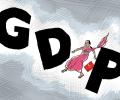
Citing a weak manufacturing sector coupled with the steep margin compression, SBI Research has pencilled in the country's GDP growth for the second quarter at 5.8 per cent, down 30 basis points from average estimates. The government will release the official numbers on November 30. In a report on Monday, SBI Research headed by Soumya Kanti Ghosh said corporate results, operating profit of companies, excluding banking and financial sector, degrew by 14 per cent in Q2FY23 as against 35 per cent growth in Q2FY22, though the top line continued to grow at a healthier pace.

India's total value of defence production breached Rs 1 trillion-mark in the fiscal year 2022-23 (FY23), up 12 per cent year-on-year (YoY). At the bourses, this has been well reflected in related-stocks from the sector as they gained considerable ground during this period. Shares of Hindustan Aeronautics (HAL), Mazagon Dock Shipbuilders, MTAR Technologies, Bharat Electronics (BEL), and Bharat Dynamics (BDL) have skyrocketed up to 160 per cent in a year, as against a 14 per cent jump in the S&P BSE Sensex.

RBI's exercise will take into account standards of governance, the viability of the payment bank (PB) business model, and changes, if any, if needed.

TVS Motor Company, on Wednesday, overtook Hero MotoCorp in terms of market value to become the sixth-largest automobile company on market capitalisation. he former's m-cap now stands at Rs 51,681 crore to the latter's Rs 50,951 crore. Bajaj Auto, with Rs 104,872 crore, is the only two-wheeler manufacturer in the top five. Shares of TVS have rallied 73 per cent this year while shares of Bajaj and Hero have risen only 3 per cent and 10 per cent, respectively. While sales, net profit and market share of TVS are lower than that of Bajaj and Hero, there are multiple triggers for the company.

Margins for the oil refining and retailing sector have moved off their peaks, and the average integrated margins (refining plus marketing) for oil marketing companies (OMCs) have normalised. The ascent in crude oil prices, combined with static retail prices, has depressed marketing margins for diesel and petrol. However, the fall in marketing margins has been offset by increased gross refining margins (GRMs).

A consortium of shareholders with over 30 per cent stake in cash-strapped Byju's might approach the National Company Law Tribunal (NCLT) seeking a management change, if the extraordinary general meeting (EGM) scheduled for Friday failed to yield an 'amicable settlement' or faced further delays, sources said. Earlier this month, these shareholders had issued a notice calling for an EGM to address "persistent issues", including a change in management. They will vote for a revamp of the existing board, an exercise which would include asking Byju Raveendran to step down as chief executive officer (CEO) and relinquish his operational role, according to sources.

Fitch Ratings on Thursday raised its forecast for India's economic growth to 6.3 per cent for current fiscal year 2023-24 from 6 per cent it had predicted previously. This is primarily because of a stronger outturn in the first quarter and near-term momentum. The growth forecast compares with 7.2 per cent GDP expansion in FY23. In the previous fiscal year (FY22), the economy had grown 9.1 per cent.

Corporate margins and profits in India remain vulnerable to changes in crude oil prices in the international market. Historical quarterly data from listed companies (excluding banks, finance and insurance, oil and gas, and power sectors) indicate an adverse correlation between corporate margins and crude oil prices.

The edtech major promised a learning revolution, offering hope to millions of under-educated youth. Now, those dreams are shattered, observes Devangshu Datta.

Just 14 companies raised Rs 35,456 crore through main-board primary share sales in the first half of the fiscal, down 32 per cent from the year-ago period when 25 issues had mopped up Rs 51,979 crore. But according to Prime Database, the IPO pipeline is strong with 71 issues worth Rs 1,05,000 crore having Sebi approvals and another 43 worth about Rs 70,000 crore are awaiting approval. Of these 114 planned issues, 10 are new-age tech companies, which are looking to raise roughly Rs 35,000 crore.

The currency in circulation (CIC) declined by Rs 7,600 crore in the Diwali week, making it the first such happening in two decades, a report said on Thursday. This was made possible courtesy of a greater reliance on digital payments by people, the report by economists at SBI said, adding that the Indian economy is undergoing a structural transformation at present. They clarified that the Diwali week in 2009 had also witnessed a marginal Rs 950 crore decline in currency in circulation, but that was purely due to the economic slowdown amid the global financial crisis.
