
The primary market is set for a bumper Rs 80,000-crore bonanza with 30 companies already filing IPO papers to raise Rs 55,000 crore, while around 10 more are lined up for this month itself, seeking to mop up another Rs 25,000 crore, say investment bankers. The market has been on a non-stop rally, hitting new records almost every week, on the back of an influx of investors -- a vast majority of them first-timers -- coupled with a flood of liquidity. Foreign funds alone had pumped in a record $35 billion into the market in FY21, while the trend has continued this fiscal as well. Domestic institutions led by LIC have also infused trillions of rupees, helping woo retail investors in troves -- the year saw over 20 million new investors coming to the market.

Companies are looking to combine risk management with strategy.

The strong correlation between its sales (revenue or turnover) and crude oil prices (average for the financial year) suggests that Ambani may be proved right.
With the 115 bps reduction in repo rate beginning February, banks have already transmitted 72 bps to the customers on fresh loans and some large banks have transmitted as much as 85 basis points.

Over the three-month period, Airtel's stock price has rallied from Rs 432 to Rs 540, while Vodafone Idea has risen from Rs 9.2 to Rs 11.8 per share.
ITC has extensively reset its strategy and will explore opportunities to craft disruptive business models to set up structural drivers helmed by digital and sustainability for its next horizon of growth and make the company future-ready, chairman Sanjiv Puri said on Wednesday. The company is pursuing an accelerated journey to build a dynamic utureTech' enterprise by investing in cutting-edge digital technologies to shape a new paradigm of competitiveness, create innovative business models and tap newer opportunities, he said while addressing shareholders at ITC's virtual annual general meeting. As part of the next horizon vision, the company is "proactively exploring inorganic opportunities" even as it has shrunk "business segments that were incongruent to our growth aspirations, such as the Lifestyle Retailing Business" while the existing growth platforms comprising megabrands will be scaled up and fortified.

While small-caps have delivered higher returns than their large-cap peers, investors would do well to recognise the incremental risk of investing in these companies.

Currently, TCS is India's second most valuable firm after Reliance Industries, which has a market cap of nearly Rs 12.9 trillion.

Rising prices of international coal - both coking and thermal - used in the making of ferrous and non-ferrous metals, respectively, are expected to have an impact on margins of metals companies in July-September quarter (Q2) as steel companies may see margins getting eroded, while the base firms could stand to benefit, said brokerages.
However, in the first quarter when the country was under a lockdown, net financial savings rose to 21 per cent of gross domestic product (GDP), according to the data released in the RBI's monthly bulletin.

Mukesh Ambani-owned RIL's JioMart is set to launch a slew of new products including financial services, electronics to airline tickets to take on the competition from upcoming rivals like the Tata Super app and other established players including PayTM, Amazon and Flipkart. This comes at a time when RIL's e-commerce revenues are set to grow by 35 per cent to $15 billion within four years and its core retail revenue is expected to grow at the same pace to $44 billion, as per a forecast by Goldman Sachs. "The Tata vs JioMart war will be the next big corporate battle to watch. "While Tata has an upper hand like in-house products and brands, RIL has the backing of global biggies like Google, Facebook and Microsoft," said head of a rating firm asking not to be quoted.

Irdai had introduced two Covid specific products in the market - Corona Kavach and Corona Rakshak - that saw huge acceptance among the consumers as these products had lower premiums.

Markets

In March this year, when Tata Consultancy Services (TCS) unveiled a new brand statement of "Building on Belief", many wondered if it was the right strategy. When things are uncertain, wouldn't a brand statement such as "Experience Certainty" have been better? But for Rajesh Gopinathan, CEO & MD, TCS, it was all about the way the company was looking at business. As Gopinathan explained over a video call, "Today, we have over 1,000 customers and 98 per cent of our business is repeat business; our relevance to customers should continue, and to increase.
'India has the potential to reduce its trade deficit with China by $8.4 billion in FY21.'

'A time-wise, as well as price correction, so that the market can absorb the gains made over the past 17 months.'

Scores of employees took to social media to express disappointment and said they were asked to resign over WhatsApp calls. On Twitter, some said they had been asked to resign by May 31 and that there was no severance package and salary would be paid only for May.

The growth momentum that started during the festival season is likely to sustain in the new year, reports Arindam Majumder.

India's second-largest telecom firm Bharti Airtel on Tuesday reported a net profit of Rs 1,134 crore for the September 2021 quarter, and said it is witnessing strong business momentum with growth in 4G customers and increase in mobile ARPU. This is against a loss (attributable to owners of the parent) of 763.2 crore during the year-ago quarter, the company said in a statement. Its consolidated revenues for the second quarter of FY21 stood at Rs 28,326.4 crore, up 18.8 per cent year-on-year (on a comparable basis) and 13 per cent y-o-y on a reported basis, it added.

While the vaccine could be available at $3-6 (Rs 225 to Rs 550) per dose, herd immunity might be two years away due to implementation challenges, it said, adding the experience in large scale adult vaccination programmes is thin.

Petrol price can go down to Rs 75 a litre across the country if brought under the ambit of the Goods and Services Tax (GST), but there is a lack of political will, which is keeping Indian oil product prices at one of the highest in the world, economists at SBI said on Thursday.

Beauty, Nykaa's founder Falguni Nayar realised, is a very long-tailed business and with e-commerce picking up in India, it seemed like a good idea to venture into.

Hopes of revival and earnings growth in 2020, surprise tax cuts, and robust foreign flows - thanks to easy global monetary policies - are a few reasons why the markets have managed to digest the low GDP footprint. Select bluechips such as Reliance Industries, Bajaj Finance, Asian Paints, and ICICI Bank have gained sharply this year. On the other hand, YES Bank, Zee Entertainment, and Indiabulls Housing have seen a sharp fall.

The Reserve Bank of India's (RBI's) move to ban Mastercard from issuing new cards for not complying with the local data storage guidelines may hit five private banks, a non-bank lender, and a major card-issuing company. The impact is expected to be felt for a few months as these players transition to other card networks. According to Nomura Research, RBL Bank, YES Bank, and Bajaj Finserv are the ones most impacted by the ban as all their credit card schemes are allied to Mastercard. Among others, IndusInd Bank, Axis Bank and ICICI Bank have 35-40 per cent of their credit card schemes tied to Mastercard, the report said.

Though leading brands like Samsung, Apple, Xiaomi, OnePlus, and Oppo managed to absorb the initial lockdown shock and resumed their local production back to 60 per cent, they would likely suffer a 20-25 per cent loss of sales in the October-December quarter.

Live commerce, quick commerce, group buying, WhatsApp commerce, dukaantech have made their mark.

Analysts expect firms to shift focus to online platforms to boost sales in these Covid-19-impacted times.

While Wipro will announce its fourth quarter (Q4) results along with annual financial statements on April 15, market leader TCS will hold its board meet the next day (April 16) for approval of its financial statements. Infosys is yet to inform investors the date it will announce its Q4 earnings.
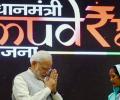
Not only has the Mudra loan mela generated no jobs, it has frittered away trillions of taxpayers' money and it's time to bury the scheme, argues Debashis Basu.

The key demand drivers -- such as low home loan rates and income tax sops, particularly for affordable housing -- that supported the recovery in H2 FY2021, remain in place and will spur recovery again, feel experts.

The Pune-based company sells the Platina and CT brands in the entry-level - 100-110cc - segment.

The current wage revision for PSBs, as well as some private lenders, is due from November 2017 for five years - up to October 2022.

UBS, Credit Suisse see emerging markets doing well next year, but expect India to underperform, given its rich valuations.

Expressing commitment to augment the country's infrastructure, Finance Minister Nirmala Sitharaman on Monday proposed to significantly enhance capital expenditure to Rs 5.54 lakh crore in the next fiscal, besides creating institutional structures and giving a big thrust to monetizing assets to achieve the goals of the National Infrastructure Pipeline (NIP). Sitharaman said NIP, that was launched in December 2019 with 6,835 projects, has now been expanded to 7,400 projects and around 217 projects worth Rs 1.10 lakh crore under some key infrastructure ministries have been completed. "For 2021-22, I propose a sharp increase in capital expenditure and thus have provided Rs 5.54 lakh crores which is 34.5% more than the BE of 2020-21," the finance minister said.

Is the worst over for Indian banks? The past two years saw them ride on treasury trades as deposits soared and credit growth dipped sharply. Gross and net non-performing assets (NPAs) moved south, and the provision coverage ratio (PCR), capital buffers, and profitability indicators are back at pre-pandemic levels. So, what's the plot ahead?

Most rating agencies had projected contraction in India's GDP for the first quarter of 2020-21.
Providing comfort to the government on the revenue front amid fiscal stress, direct tax collection is moving closer to the revised Budget target for 2021-21 and may get a further thrust from the last instalment of the advance tax payment, the deadline for which ended on Monday. The contraction in net direct tax collection narrowed to 5 per cent year-on-year as on March 15 compared to a 9 per cent decline seen in January. In absolute terms, net collection stood at Rs 8.2 trillion against Rs 8.67 trillion in the same period last year, according to the provisional numbers shared by a government official.

A key trigger for the increased retail participation in equities has been the lockdown triggered by Covid-19 that saw investors channelising their savings to capital markets in search of better return on their investments and the need to increase their disposable income.

If Sebi and RBI remain quiet about this brazenly illegal activity, will someone in the finance ministry or the NITI Aayog take a closer look, asks Debashis Basu.

The analyst said since servicing of principal and interest on loans will beome challenging for mall operatos in the next couple of months.
