
The Nifty Bank index has come off 15 per cent from its peak in February, underperforming the benchmark Nifty which is down 6%.
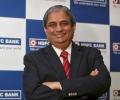
He said companies with a good strategy, technology, capital, liquidity and a motivated team will emerge as winners after the crisis.

Over the next three - six months, UBS believes earnings will be the main driver for EM equities outperformance.
Gross bad loans of banks may rise from 6.9 per cent in September 2021 to 8.1-9.5 per cent by September 2022 if the Omicron variant strikes the economy hard, as per the financial stability report of the Reserve Bank released on Wednesday. The report also said that the rising stress level in the retail loan portfolio of banks -- the mainstay of bank credit for many years now -- was led by home loans, which grew in double-digits so far this fiscal. While asset quality improved, with gross non-performing assets (GNPA) and net NPA (NNPA) ratios declining to 6.9 and 2.3 per cent, respectively, in September 2021, the slippage ratio inched up during the same period as private sector banks showed a higher rate of deterioration in asset quality, as per the report.

That's a big change that was made possible due to corporate tax cuts. Corporation tax collection in FY22 will be lower than even the FY18 levels, reports

'Is taxable amount above 1 Lac is also to be shown as income from other sources?'

'Banks have to be braver, willing to take more risks and give confidence to the customer,' observes Joydeep Ghosh.

Stocks of Indian companies with exposure to Europe fell on Tuesday amid concerns about the impact on their sales in case the Russia-Ukraine crisis worsens and the US and its allies impose economic sanctions on Russia. While top conglomerates, including Reliance Industries, the Tata group, and Aditya Birla Group, said they did not have any significant exposure to Russia, executives of some of the oil and gas, pharmaceutical, and tea companies said they were monitoring the situation closely as they earned substantial income from the region. Russian President Vladimir Putin on Monday ordered troops into two breakaway regions of eastern Ukraine after announcing that Russia would recognise their independence.
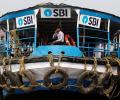
The country's largest lender SBI on Thursday reported a 4.20 per cent decline in consolidated December quarter net at Rs 6,257.55 crore, largely because of a higher base in the year-ago period where it had benefitted from a Rs 4,500 crore one-off income. On a standalone basis, the city-headquartered lender's net profit came in at Rs 5,196.22 crore as against Rs 5,583.36 crore in the year-ago period and Rs 4,574.16 crore in the preceding September quarter. SBI chairman Dinesh Kumar Khara told reporters that the year-ago period had seen the resolution of the Essar Steel loans, resulting in an over Rs 4,000 crore interest income and Rs 500 crore other income benefit.

Citing faster-than-expected recovery, rising consumer confidence and the resultant spending spike, Swiss brokerage UBS Securities has revised upwards its growth forecast for the current fiscal to 9.5 per cent from 8.9 per cent in September. The brokerage also sees the economy clipping at 7.7 per cent in FY23 but moderating to 6 per cent in FY24, as it expects the benefit of the low-interest rate regime to end by the end of FY23, and it sees the central bank hiking policy rates by 50 bps in the second half of the next fiscal. The Reserve Bank also forecasts 9.5 per cent GDP growth this fiscal while the average projection ranges from 8.5 to 10 per cent.

'The overall death claims have gone up.'

TCS was the top gainer in the Sensex pack, rising around 4 per cent, followed by ONGC, ICICI Bank, HDFC Bank, Dr Reddy's, HDFC and HCL Tech. NSE Nifty advanced 76.65 points to 14,581.45.

Nikunj Saraf, Vice President Choice Wealth, answers your queries.

Vodafone Idea (Vi) lost 12.4 million subscribers in the first quarter of FY22, the most since the fourth quarter of FY20, as the second wave of Covid hurt its operational and financial performance. Vi had managed to trim subscriber losses in the third and fourth quarters of FY21. However, it lost 12.4 million subscribers and its customer base shrunk to 255.4 million in the first quarter of FY22. Sequential fall in 4G users was modest, indicating that most of the loss was in the low-margin 2G segment.

ONGC was the top loser in the Sensex pack, shedding around 5 per cent, followed by Sun Pharma, PowerGrid, Bajaj Finance, IndusInd Bank, Dr Reddy's and Maruti. On the other hand, Reliance Industries, Titan, HDFC Bank and ITC were the gainers.
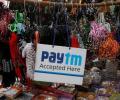
Paytm's Rs 18,300 crore IPO was oversubscribed 1.89 times on the last day of India's biggest share sale on Wednesday, making it one of the country's most valued companies. The initial public offering of Paytm's parent company One97 Communications Ltd received bids for 9.14 crore equity shares against the offer size of 4.83 crore shares, according to information available from stock exchanges. While the portion set aside for retail investors was oversubscribed early, institutional buyers including FIIs flooded the share sale with offers on Wednesday, seeking 2.79 times the number of shares reserved for them.
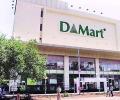
Ramping up e-commerce operations and going beyond its current strongholds are key challenges for the grocery chain in its battle with Mukesh Ambani's retail behemoth.
COVID-19 forced people to work from home turned into the fuel for new demat accounts, observes Debashis Basu.
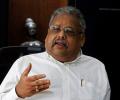
Jhunjhunwala holds a stake in more than 30 listed firms.

Kerala Finance Minister K N Balagopal has sought systemic changes in the GST structure, saying every state and consumer has lost because of its basically flawed architecture that has also led to rampant revenue leakage for the states. The Goods and Services Tax (GST) regime came into force in July 2017. Even though the framework is focused on having a one-nation-one-tax model, quite a few items, including petroleum products and liquor are still out of the GST purview.

Chairman A M Naik said H2 of 2020-21 will herald better economic and business activity in terms of tendering, good liquidity, as well as revival of labour and supply chains.

When Finance Minister Nirmala Sitharaman tables her Budget on February 1, the numbers could be something to cheer.
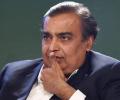
Mukesh Ambani's Reliance group has struck acquisition deals worth $4.2 billion with a dozen companies in just two years to expand its retail business. The latest purchase was of a majority stake in Justdial for Rs 3,497 crore. Elaborating on his acquisition strategy a few weeks ago during the AGM, Ambani stated that one of the key planks would be to acquire businesses that enhanced Reliance's offerings and experiences to customers and that they would be both physical and digital.

With the rise in interest rates, bond yields have been on the rise; this will dent banks' treasury profits. Also, many retail borrowers may find it difficult to service their loans when the loan rates rise, points out Tamal Bandyopadhyay.

Finance Minister Nirmala Sitharaman cut fuel subsidies while slapping additional fuel taxes on unblended transport fuels in the latest Union Budget. The former will hit the rural poor, households that secured a subsidised LPG connection under the Pradhan Mantri Ujjwala Yojana (PMUY), a programme that was partly instrumental in helping the Bharatiya Janata Party (BJP) win the 2019 general elections. The latter will pretty much hurt the entire population after it kicks in from October. That's what it looks like. Or, perhaps, it's not as it appears to be, at least on the subsidy front.

The real estate sector had been going through a rough phase even before the COVID-19 crisis, marked by falling sales and piling up of inventories.

However, the company says it will suspended promotions and salary increments this year.

It will bear fruit in the next five years, which is why FDI is so strong. The foreigners clearly know what Indians don't, asserts T C A Srinivasa-Raghavan.
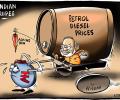
The Union government has collected Rs 94,181 crore through levy of excise duty on petrol and diesel in the first three months of the current fiscal on the back of a record tax on fuel that yielded 88 per cent higher revenue the previous financial year, the Lok Sabha was informed on Monday. Excise duty on petrol was hiked from Rs 19.98 per litre to Rs 32.9 last year to recoup gain arising from international oil prices plunging to multi-year low as pandemic gulped demand. The same on diesel was raised to Rs 31.8 from Rs 15.83 a litre, according to a written reply by Minister of State for Petroleum and Natural Gas Rameswar Teli in the Lok Sabha. This led to excise collections on petrol and diesel jumping to Rs 3.35 lakh crore in 2020-21 (April 2020 to March 2021), from Rs 1.78 lakh crore a year back, he said.

In a bull-case scenario it sees the Sensex at 61,000 levels, while it's bear case scenario pegs the Sensex at 41,000 levels by December 2021.
RBI Governor Shaktikanta Das on Thursday said financial inclusion will continue to be a "policy priority" for the central bank to make the post-pandemic recovery more equitable and sustainable. The Reserve Bank of India will very soon be coming out with the first financial inclusion index, which will assess progress in terms of access, usage and quality, Das said, while speaking at the Economic Times Financial Inclusion Summit. It is the responsibility of all stakeholders to ensure that the financial ecosystem (including the digital medium) is inclusive and capable of effectively addressing risks like mis-selling, cybersecurity, data privacy and promoting trust in the financial system through appropriate financial education and awareness, he added.

Prosus-backed fintech firm PayU is set to acquire India's earliest payment gateway BillDesk in an all-cash transaction of $4.7 billion. This will be the largest acquisition in India's digital payments space. The deal will also give exit to investors General Atlantic, TA Associates, Temasek, Clearstone Ventures, and Visa. The proposed acquisition will help PayU, the payments and fintech business of Prosus which operates in more than 20 markets, become one of the leading online payment providers globally by total payment volume (TPV).
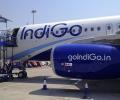
IndiGo, India's largest airline, is in talks to raise fresh funds as a second wave of pandemic has led to collapse in travel demand. The airline may look to raise Rs 3,500-4,000 crore. On Monday, only 97,761 passengers flew. With flyers cancelling bookings, airlines had to put aside flights and operated only 1,306 of them.

A 2019 investigation of Bombay Dyeing by market regulator Sebi has put a brake on the initial public offering process of sister company Go Air. The Wadia group-owned low cost airline had earlier planned to launch the IPO to raise Rs 3,600 crore by August, but may be forced to postpone it by a month or two as Sebi completes its investigation.
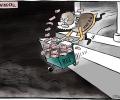
RBI Governor Shaktikanta Das has assured Finance Minister Nirmala Sitharaman that the Rs 12.05-trillion gross borrowing programme for FY22 will go through smoothly.
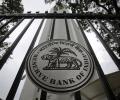
The non-food component in the price basket will continue to keep inflation at a high level and result in a "long pause" in interest rates, a foreign bank said on Wednesday. The central bank is likely to pare the pandemic-driven emergency response as well, the report by Singaporean lender DBS said. It can be noted that the high inflation driven by the food prices has forced the RBI to go for a status quo in rates for the three consecutive reviews of the bi-monthly policy meetings, even as growth continues to be in the negative territory.

After outperforming the broader market and their public sector peers for the better part of the post-Lehman period, private sector banks - such as HDFC Bank, ICICI Bank, Axis Bank, and Kotak Mahindra Bank - are now underperforming. Last week, the Nifty Private Bank index was up just 6 per cent year-to-date in the calendar year 2021, against nearly 13 per cent rally in the Bank Nifty and a 15 per cent rise in the benchmark Nifty50. Public sector (PSU) banks, such as State bank of India, Bank of Baroda, and Punjab National Bank, are now rally leaders and outperforming the broader market. The Nifty PSU Bank index was up 42 per cent since the beginning of this calendar year. But on a longer term, the Nifty Private Bank index is up 101 per cent since March 2016, against a 118 per cent rally in the Bank Nifty and just 2 per cent rise in the Nifty PSU Bank index in the period.
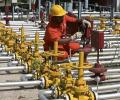
India's natural gas production is projected to jump by 52 per cent to 122 million standard cubic metres per day by 2024 as state-owned Oil and Natural Gas Corporation (ONGC) and Reliance Industries Ltd-BP combine raise output from the KG basin fields. Natural gas production in 2019-20 was 85 mmscmd, which is estimated to have fallen to 80 mmscmd in the following year, HDFC Securities said in a report. The output is projected to rise in the current fiscal that started on April 1 to 93 mmscmd, 107 mmscmd in the following year and 122 mmscmd in 2023-24, the brokerage estimated.

The relentless rally in small- and mid-cap stocks continues as large-caps show signs of fatigue. In July, the Nifty Smallcap 100 rose 8.1 per cent, extending its year-to-date (YTD) gains to 48.5 per cent, while the Nifty Midcap 100 added 3.1 per cent, taking its YTD rise to 33.5 per cent. On the other hand, the Nifty50 remained unchanged for the month, with YTD gains of 12.7 per cent.

'My father was asking me what an IPO is. He has no clue and he has never been an investor.' 'My mother, who was the one to ring the bell, has been an investor in Policybazaar for the past 6-7 years and I would say she has made good returns.'
