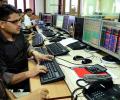
Among the Sensex firms, Titan, Asian Paints, ITC, Hindustan Unilever, Nestle India, Bajaj Finserv and Bharti Airtel were among the gainers. In contrast, UltraTech Cement, Tech Mahindra, Tata Steel, Power Grid, HDFC Bank, HCL Technology, State Bank of India and ICICI Bank were the laggards.

Two young men jostle in a rickshaw as it clatters along a narrow, bustling lane of North Kolkata, each with a leg dangling over the side of the vehicle, a bulging sack of cosmetics nestled between them. The protagonists here are the founders of Emami - Radhe Shyam Agarwal and Radhe Shyam Goenka - childhood friends who gave up cushy corporate jobs to build a fast-moving consumer goods (FMCG) company. From a 200-square-foot rented space on Muktaram Babu Street in North Kolkata, brand Emami stepped into the competitive world of FMCG 50 years back, armed with just three products: Vanishing cream, talcum powder, and cold cream.

Net capital gains from the sector over a full cycle may be more than the gains logged by cyclical sectors.

Among the 30-share Sensex blue-chip pack, Bharti Airtel, ITC, Kotak Mahindra Bank, Hindustan Unilever, Titan, UltraTech Cement, HCL Technologies, and Power Grid, were the biggest gainers. Tata Steel, IndusInd Bank, JSW Steel and Bajaj Finserv were the laggards.

Leading FMCG maker HUL said that it has received a demand notice of Rs 962.75 crore from the Income Tax Department and will go in for an appeal against the order. The notice relates to non-deduction of TDS on payment of Rs 3,045 crore to GlaxoSmithKline Consumer Healthcare (GSKCH) for the acquisition of Intellectual Property Rights of the Health Foods Drinks (HFD) business consisting of brands as Horlicks, Boost, Maltova, and Viva, according to a recent exchange filing.

Companies whose products have not been picked up for distribution in Gujarat under a "non-cooperation movement" include Marico, Dabur, Emami, Britannia, Reckitt Benckiser, and Godrej Consumer Products.

The paint sector is seeing heightened competition with the entry of deep-pocketed groups like Aditya Birla and JSW. However, some brokerages see an opportunity in select stocks.

60-65 per cent of the FMCG industry's overall sales come from urban areas; 35-40 per cent from rural areas.

Corporate India's struggle with subdued revenue and earnings growth persisted in the October-December quarter of 2024-25 (Q3FY25). The combined net sales (gross interest earnings for lenders) of listed companies grew in single digits for the seventh consecutive quarter, while their combined net profit rose by a single digit for the third straight quarter.

Mahindra & Mahindra, UltraTech Cement, Bajaj Finserv, Titan, Maruti, Axis Bank and Tata Steel were among the other big laggards. However, Tech Mahindra, Infosys, Power Grid, Larsen & Toubro and State Bank of India were among the biggest gainers.

'Unless a comedian is involved in something society deems unforgivable...'
From the 30-share blue-chip pack, Zomato surged over 7 per cent. Maruti, ITC Hotels, ITC, Mahindra & Mahindra, Asian Paints, Titan and IndusInd Bank were among the biggest gainers. Power Grid, Larsen & Toubro, NTPC, UltraTech Cement, HCL Tech, Tech Mahindra, Infosys and Adani Ports were among the laggards.

ITC was the top gainer in the Sensex pack, rallying over 7 per cent, followed by Asian Paints, Hero MotoCorp, Maruti, Bajaj Auto, Sun Pharma, TCS and HCL Tech. On the other hand, IndusInd Bank, NTPC, Bajaj Finance, HDFC and L&T were among the laggards. NSE Nifty advanced 39.70 points, or 0.44 per cent, to 9,106.25.

Infosys fell the most among Sensex stocks, declining by 2.85 per cent. Among other IT stocks, TCS fell by 1.87 per cent, Wipro by 1.52 per cent, and HCL Tech by 1.70 per cent. NSE Nifty plunged by 174.65 points to close at 17,938.40.

Nestle surged 4.25 per cent after the FMCG major reported 4.94 per cent increase in net profit at Rs 688.01 crore for the quarter ended December 31, 2024. IndusInd Bank, Titan, Tata Motors, Tata Steel, ITC and Maruti were the other major gainers. ITC Hotels, Bharti Airtel, Bajaj Finserv, Bajaj Finance and ICICI Bank were among the laggards.


Benchmark Sensex advanced 110 points in a choppy trade on Wednesday, extending its gains to the fourth day in a row helped by buying in HDFC Bank, ICICI Bank and fresh foreign fund inflows. The 30-share barometer rose by 110.58 points or 0.14 per cent to settle at 80,956.33 with 14 of its constituents ending with gains and 16 stocks with losses. During the day, it jumped 399.64 points or 0.49 per cent to 81,245.39 and dipped to a low of 80,630.53.

Marico may buck the industry trend with the fast-moving consumer goods (FMCG) major reporting strong growth and favourable commentary in a weak quarter for the industry. The company reported consolidated revenue growth of 8 per cent year-on-year (Y-o-Y) in Q2FY25. Domestic revenue growth was 8 per cent Y-o-Y with 5 per cent volume growth (4 per cent in Q1FY25).

'Our target will come from rural areas as there are more outlets there.'

The surge in IT, auto and FMCG stocks were led by investors seeking safety against market volatility.

FMCG has been behaving unlike a defensive category in recent quarters.

'This is the Bengal story, where businesses are nurtured, dreams are realised, and legacies are built.'
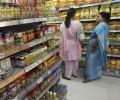
The lowest FMCG index valuation has been around PE 27, while the highest have been above 42PE.

The slowdown had been brewing since 2016 but was intensified further by several disruptions in the past two years including demonetisation.

Home-grown FMCG major Dabur India on Thursday said it will set up a Rs 400-crore manufacturing plant in Tamil Nadu's Villupuram district, marking the company's maiden foray into the South. State Industries Minister TRB Rajaa said, Dabur has signed a Memorandum of Understanding (MoU) with the state government to this effect on Thursday. The MoU outlines an approved Phase 1 investment of Rs 135 crore, scaling up to Rs 400 crore over five years, Dabur India said in a statement.

Today, the company has created a portfolio of vibrant world-class brands.

The October-December quarter (Q3FY25) results of fast moving consumer goods (FMCG) major Hindustan Unilever (HUL) indicated weak demand, with urban growth muted and rural showing recovery. Consolidated revenue grew by 1.6 per cent (volume was flat) to Rs 15,818 crore, due to price hikes. Prices of key raw materials such as palm oil and tea remained elevated, leading to compression of gross margin.

From the 30 Sensex pack, Hindustan Unilever fell by nearly 6 per cent after the FMCG major reported a 2.33 per cent decline in consolidated net profit at Rs 2,595 crore for the second quarter ended in September 2024 impacted by moderation in demand from the urban market.

ITC was the top loser in the Sensex pack, shedding 1.97 per cent, followed by Tata Steel 1.80 per cent, HUL 1.57 per cent, Vedanta 1.44 per cent, Bharti Airtel 1.37 per cent and M&M 1.35 per cent.

'Regardless of whether you invest Rs 100 or Rs 1 crore per month, risk is inevitable.' 'Positive returns at the end of the year can never be guaranteed.' 'This is a fundamental truth every SIP investor must grasp.'

Global factors and FII activity will dictate trends in domestic equity markets this week while assembly poll results of Maharashtra and Jharkhand may impact stocks on Monday, say analysts. Stock markets witnessed a spirited recovery on Friday with benchmark Sensex and Nifty notching the best single-day gains in more than five months and offering relief after weeks of correction.

To double its current turnover of Rs 13.53 billion in five years, the firm plans to generate 25 per cent of this consolidated revenue from FMCG sales.

Foreign portfolio investors (FPIs) withdrew Rs 14,790 crore ($1.8 billion) from financial stocks in the first half of August, driven by global risk aversion sparked by US recession fears. Additional factors contributing to the decline in banking stocks included subdued earnings growth in the June quarter, concerns about slowing deposit growth, and stricter liquidity norms imposed by the Reserve Bank of India.
Industry officials say the crunch has not only affected manufacturing of edibles but even of items like nozzle pumps and other goods used in packaging.

Private consumption is back driven by festive spending, and the medium-term economic outlook remains bullish as the innate strength of the macro-fundamentals reasserts itself, the Reserve Bank Bulletin said on Wednesday. Global economic activity remained resilient during Q4:2024 amidst fragile confidence and rising protectionism, said an article on 'State of the Economy' published in the November Bulletin.

'When I am working on a series, be it Paatal Lok on Amazon Prime or Kohrra on Netflix, I never take it for granted that we will be back with another season.' 'It's only at the end of the season that I ask myself if I still have it in me to take the story further and if I would like to meet the characters again.' 'If the answer is yes, then I find ways to make the journey exciting for myself, like taking Inspector Haathiram Chaudhary to Nagaland.'

The prospective bidders of Haldiram Snacks Foods (HSFPL), a leading food firm, have sought clarity on the ownership of the brand as it is currently owned by different family factions. The Delhi and Nagpur families have decided to merge their operations and formed a joint venture to sell part of their stake. On the other hand, the Kolkata family runs its separate, independent operations. Bankers said prospective bidders of the company do not want any confusion over the brand in future. They have sought clarity over usage of the brand.

'We plan to touch Rs 1 trillion of Amul brand's turnover in the next five years.'

Launched this April, the FCG business will end the year with a turnover of Rs 500 crore
From the 30 Sensex firms, Mahindra & Mahindra, Bajaj Finance, Asian Paints, Nestle, Bharti Airtel, UltraTech Cement, Hindustan Unilever, ITC, and HDFC Bank were the major laggards. In contrast, Infosys, Tech Mahindra, Tata Motors, Axis Bank, Tata Consultancy Services and State Bank of India were among the gainers.
