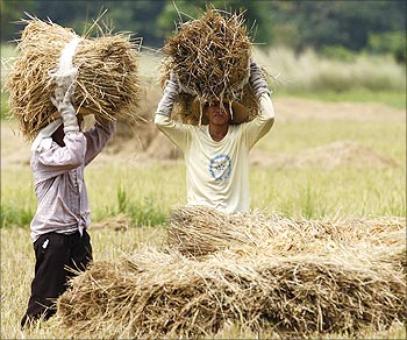
This may also be the second-strongest El Nino after 1998. El Nino winds bring drastic changes in the weather pattern, which will hit the agriculture sector.

Though early days, meteorologists point towards a neutral La Nina during the initial phase of the four-month monsoon season this year that starts from June. If this holds true, by the time the rains hit the mainland, it could mean there would be one less reason to worry about the prospects of the monsoon this year. Weathermen said making any accurate prediction of how El Nino will behave and what impact it can have on the progress and distribution of rains is difficult to say at this point. A clear picture will emerge around late May or early June.

The IMD DG said there should not be an impression that climate change leads to rise in the temperature, but on the contrary, it leads to erratic weather.

Global trends and trading activity of foreign investors would largely dictate terms in the equity markets this week amid a lack of major domestic triggers, analysts said. Markets may face near-term consolidation due to elevated valuations, they noted. "While the previous week was predominantly shaped by developments in the US Federal Reserve policy, attention will now shift to the Bank of Japan's policy decision on December 19," Santosh Meena, Head of Research, Swastika Investmart Ltd, said.

Renewed inflationary pressures, led by a spike in prices of vegetables and cereals, have cast a spell on the equity markets in the past month. The BSE Sensex and Nifty50 have declined up to 2 per cent each during the period, clipping the 13 per cent rally from the March lows, shows data from ACE Equity. Investors typically consider shares of fast-moving consumer goods (FMCG) companies as defensive bets, putting their weight behind them in a falling market.

Seven out of eight women street vendors reported experiencing high blood pressure, while women in the middle age group raised concerns about delays in their menstrual cycles due to the extreme heat.

'In case the El Nino pattern plays out negatively and/or the political situation becomes messy, we may see markets correcting and waiting for the situation to become clear by early/mid-2024.'

East India, along with a major portion of central India, is likely to be at a higher risk of being rain deficient, especially during the first half of the season.

The Reserve Bank on Friday retained the inflation forecast for 2023-24 at 5.4 per cent, and vowed to take timely measures to prevent any spillovers of global food and fuel price shocks. Stressing that the Reserve Bank has identified high inflation as a major risk to macroeconomic stability and sustainable growth, Governor Shaktikanta Das said the September retail inflation number may be lower than August and July prints. The headline inflation based on Consumer Price Index (CPI) moderated to 4.6 per cent in first quarter of 2023-24 as compared to 7.3 per cent in the same period a year ago.

https://www.rediff.com/business/report/quality-control-orders-what-does-this-mean-for-domestic-industry/20240425.htm

Intense heat swept through east India and parts of the southern peninsular region on Thursday, testing power grids and prompting the Kerala government to order closure of educational institutions till May 6.

As Singapore, New York and Melbourne have shown, cities can mitigate the impact of heatwaves if they have the will to create green infrastructure, explain Amit Kapoor & Bibek Debroy.

Dozens of farmers have already committed suicide in India after damage from unseasonal rains this year.
The Reserve Bank of India on Thursday marginally lowered its inflation projection for the current financial year to 5.1 per cent, as Governor Shaktikanta Das said the central bank's monetary policy actions are yielding the desired results. In April, the Reserve Bank had estimated the consumer price index (CPI) based retail inflation at 5.2 per cent during the fiscal 2023-24. CPI inflation fell sharply to 4.7 per cent in April 2023, from 6.4 per cent in February, on the back of favourable base effects, with softening observed across all the three major groups.

The index is currently trading at 149 per cent of its historical P/B valuation, surpassing its previous peak of 125 per cent made in 2020-21.

On the back of sound macroeconomic policies and softer commodity prices, India's growth momentum is likely to be sustained in 2023-24 in an atmosphere of easing inflationary pressures, said the Reserve Bank's annual report released on Tuesday. It, however, added that slowing global growth, protracted geopolitical tensions and a possible upsurge in financial market volatility following new stress events in the global financial system could pose downside risks to growth. "On the back of sound macroeconomic policies, softer commodity prices, a robust financial sector, a healthy corporate sector, continued fiscal policy thrust on quality of government expenditure, and new growth opportunities stemming from global realignment of supply chains, India's growth momentum is likely to be sustained in 2023-24 in an atmosphere of easing inflationary pressures," it said.

The El Nino risks for this year is rising in India and it could result in sub-par rains, says a report.

El Nino refers to abnormal warming of surface ocean waters in the Pacific that disrupts weather pattern causing drought and floods in many regions of the world.

Sri Lanka and southern India could continue to experience higher than normal rainfall and this could cause further flooding, particularly urban flooding, in certain locations, the report said.
'The first two months of monsoon are not looking good.' 'In case both the halves fail, it is going to be misery.'

While weather forecasters remain divided on how the monsoons will play out in India over the next few months, analysts believe the news at the current juncture - at best - can trigger a knee-jerk reaction in the markets. They believe it is too early to say whether the sub-par monsoon on account of El Nino can seriously dent the market sentiment in the short-to-medium term. "These are just initial forecasts and we will have another round / status update from the weather forecasters a month down the line.

'Because of global warming, the chances of heatwaves like this are much higher.'
Pre-monsoon rainfall, colloquial referred to as "mango showers", is vital to many parts of the country.

The government's decision to impose a 20 per cent export duty on parboiled rice and a $1,200 per tonne minimum export price (MEP) on basmati rice has pulled down overseas shipments of the former by almost 83 per cent and around 30 per cent of basmati exports in a month. Data sourced from various trade agencies and shippers showed that between August 25 and September 20, export of basmati rice has shrunk from 342,605 tonnes in 2022 to around 241,083 tonnes in 2023. Similarly, export of parboiled rice, after the imposition of 20 per cent duty during the same period, has dropped from 1.16 million tonnes in 2022 to just around 204,190 tonnes in 2023.

Prime Minister Modi last week called for optimal grain storage, fire audits and mock drills in hospitals as preparations for the harsh summer forecast by the meteorological department.

The IMD defines a normal monsoon as one which delivers between 96 and 104 per cent of the 50-year average rainfall for the season.

El Nino is expected to occur in August-September, but it is unlikely to have any major impact on the monsoon, and the weatherman expects a positive Indian Ocean Dipole, which has a strong influence on rainfall in the country.

Improved monsoon, solid fiscal performance, and capex push by the public and private sectors augurs well for India's macroeconomic stability and growth, the finance ministry's monthly economic review for June 2023 said. But the report said that while India's domestic fundamentals remain strong, negative cross-border spillovers and adverse global developments could act as a deterrent in achieving the high growth path this financial year. "An improved matching of aggregate supply and aggregate demand in the Indian economy underpins the progress made in the control of domestic inflation and the consequent strengthening of macroeconomic stability," the review said.

While it hit the national capital two days before schedule, its entry into the financial capital is two weeks late, the Met office said.

Apart from the human body, human food will bear direct repercussions. From staples such as wheat, to coffee, dairy, and even the great Hilsa face the threat of reduced supply due to the extreme heat.

Fitch Ratings on Thursday retained India's growth forecast for the current fiscal at 6.3 per cent citing economic resilience despite tighter monetary policy and exports weakness, but upped year-end inflation projection on El Nino threat. The Indian economy grew 7.8 per cent in the April-June quarter of current fiscal on strong services sector activity and robust demand. "The Indian economy continues to show resilience despite tighter monetary policy and weakness in exports, with growth outpacing other countries in the region," Fitch said, while projecting 6.3 per cent growth for current fiscal (April-March), and 6.5 per cent for next fiscal.

The warmest six years have all been since 2015, with 2016, 2019 and 2020 being the top three. The differences in average global temperatures among the three warmest years are indistinguishably small. The average global temperature in 2020 was about 14.9C, 1.2 ( 0.1) C above the pre-industrial (1850-1900) level.

'In FY23, PV sales are expected to end the year at a record 3.8 million units, up 26 per cent. In FY24, however, the industry is expecting 5-7 per cent volume growth'
The exercise, Agriculture Minister Radha Mohan Singh said, will help ease any possible impact of sub-par rainfall on farmers.
The IMD chief also allayed fears of occurrence of an El-Nino.

The India Meteorological Department (IMD) seems to have taken a cautious stand over the World Meteorological Organisation's (WMO) projection of a 'poor monsoon' due to a probable 'El Nino' impact. The IMD did not agree with WMO's projections, saying, "El Nino and the progress of monsoon are not mutually exclusive events", and remained non-committal over its earlier projection of a "normal monsoon" for the June-September 2009 season.
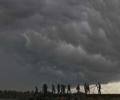
For the second successive year, Monsoon is likely to be below normal with parts of north-west and central India to be the most affected.

Monsoon is likely to be 96 per cent of the long period average

The seasonal temperature would be above normal by more than one degree Celsius over Northwest India.

Retail inflation declined to a 25-month low of 4.25 per cent in May mainly on account of softening prices of food and fuel items, with experts saying that RBI is expected to hold interest rates steady in the current fiscal. This is the fourth straight month when retail inflation has declined and the third straight month of Consumer Price Index (CPI) based inflation remaining within the RBI's comfort zone of below 6 per cent. CPI-based inflation stood at 4.7 per cent in April and 7.04 per cent in May 2022.
 © 2026 Rediff.com - Advertise with us - Disclaimer - Privacy Policy - Sitemap - Feedback - About us - Terms of use - Grievances