The 11th round of the Corps Commander-level talks began at around 10.30 am at the Chushul border point on the Indian side of the Line of Actual Control (LAC) in eastern Ladakh, they said.

'Why wouldn't so strategically-minded an adversary, such as China, not militarily exploit to the maximum Indian timidity, stupidity, and cupidity all along the LAC and legitimate, as it has done so often in the past, the fait accompli of incremental territorial grabs which, by the way, is its strategy and policy as implemented on the ground?'
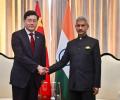
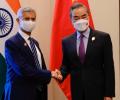
Qin's first in-person meeting with Jaishankar on Thursday came on the sidelines of the G20 foreign ministers conclave in New Delhi amid the over 34-month-long border row in eastern Ladakh.

The discussions took place on the sidelines of the G20 Foreign Ministers' Meeting.
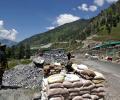
It will be the third road link to Ladakh after the other two roads: the Manali-Leh road and Srinagar-Leh highway. The work on reopening an alternative road to Ladakh from Himachal Pradesh has been expedited as it is a strategically key road, said an official on condition of anonymity, adding the project is expected to be completed by the end of 2022.

The paper suggests the strategy needs to be area-specific eg, border tourism can be promoted aggressively in the Turtuk or Siachen sector, and Daulat Beg Oldi or Depsang plains.

The summit is also being attended by Pakistan Prime Minister Shehbaz Sharif, Iranian President Ebrahim Raisi and leaders of several central Asian countries.
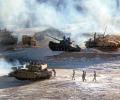
'We must be careful because China has not given its design in Eastern Ladakh.'

'When armies start attacking with clubs and batons, then at some point this can take an escalatory spiral and spin out of control.'
India and China are likely to hold the 16th round of high-level military talks on July 17 to resolve the issues in remaining friction points along the Line of Actual Control (LAC) in eastern Ladakh, people familiar with the development said on Wednesday.
Two days after the India-China military talks, the joint statement, issued in New Delhi by the Indian Army said both sides had a 'candid and in-depth exchange' relating to disengagement along the Line of Actual Control (LAC) in the Western Sector of India-China border areas.
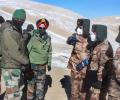
The Indian side forcefully pressed for early resolution of the standoff and particularly insisted on expeditious disengagement in Hot Springs and Gogra, a source said.

Assistance from PLA has been sought to locate the individual on their side and return him as per established protocol, sources noted.
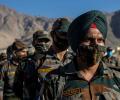
A joint statement released on Thursday said both sides exchanged views in an 'open and constructive' manner to resolve the 'relevant issues' and that it was agreed to maintain 'security and stability' on the ground in the region.

The move comes amid reports in a section of media that claimed that Chinese soldiers had displayed their flag in the region a few days ago.

'The last ten months show that India is not going to trust China.' 'Our military commanders are not going to believe that all is well till it actually is.'
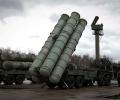
RInstead of disengagement, the Indian and Chinese armies have deployed an estimated 35,000 to 40,000 soldiers each along the LAC. The PLA has deployed S-400 air defence missiles to neutralise the IAF's advantage in air power
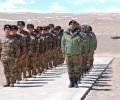
There was no official word on the outcome of the talks.

Chinese President Xi Jinping, who made a rare visit this week to the restive Xinjiang region which borders Ladakh, met the troops and officers stationed there and praised their "outstanding contributions" to the border defence and stabilisation of the volatile province.

Indian Army officers are convinced China is maintaining the pretence of dialogue and negotiations in order to create the opportunity to occupy more Indian territory. Senior Indian planners apprehend this might be a Chinese ploy to divert attention from Depsang, in Northern Ladakh, which might be China's actual target.
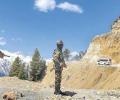
The meeting primarily focused on implementation of certain decisions taken at the fifth round of talks between Corps Commanders of the two armies last week on the disengagement process as well as to bring down prevailing tension in the region, sources said.

The Chinese military on Friday confirmed that the troops of China and India have begun the process of disengagement from the Patrolling Point 15 in the Gogra-Hotsprings area of eastern Ladakh in a 'coordinated and planned way'.

In the confrontation in Doklam, where Indian and Chinese soldiers were lined up eyeball-to-eyeball, senior Indian commanders recount they could sense the uncertainty in the Chinese. While Indian soldiers had to be restrained from pushing the Chinese troops back, our chief interpreter heard the Chinese officers threatening to open fire on PLA soldiers who wavered or withdrew, reveals Ajai Shukla.
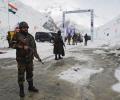
External affairs ministry spokesperson Arindam Bagchi said it is essential that "appropriate agreements between India and China of 1993 and 1996 are scrupulously followed".

India is looking forward to a "constructive" dialogue with China to resolve issues in remaining friction points in eastern Ladakh, sources in the security establishment said on Monday ahead of the 14th round of military talks between the two sides on the 20-month row.
Indian and Chinese militaries on Monday moved back their frontline troops to the rear locations from the face-off site of Patrolling Point 15 in the Gogra-Hotsprings area in eastern Ladakh and dismantled temporary infrastructure there as part of a five-day disengagement process.

The Army said Gen Pande witnessed Parvat Prahar exercise besides interacting with officers and troops deployed in the region. The exercise featured a display of operational capabilities by artillery guns and other key weapon systems.
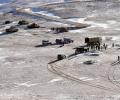
The development comes after after reaching a consensus in the 16th round of military talks, the two sides said in a joint statement this evening.

'The PLA has continued to do exercises and drills and recently carried out air exercises with fighter jets.'
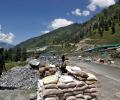
Chinese troops have been camping in the Finger area for over three months now and have even started fortifying their bases there with construction of bunkers and sangars.
'We hope the Indian side will work with China to follow through the important consensus of our two state leaders, abide by relevant agreements and treaties to de-escalate the tension at the border'

'The Chinese are retaining geostrategic pressure on India by keeping troops there and building infrastructure continually.'
The actions on the ground would be confirmed and are expected to be followed up soon.

"All temporary structures and other allied infrastructure created in the area by both sides have been dismantled and mutually verified. The landform in the area has been restored by both sides to the pre-standoff period," the Army said in a statement.

'China is unwilling to restore the status quo ante of April 2020.' 'India will have to weigh its options based on this premise.'
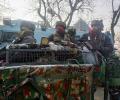
'On the LAC, China can undertake military action at any place with much fewer resources. It can do 'salami slicing'.'
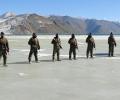
A day after the nearly 12-and-half-hour talks, the two sides, in a joint statement on Monday, reaffirmed that the resolution of the pending issues would help in the restoration of peace and tranquility along the Line of Actual Control (LAC) in the region and enable progress in bilateral relations.
The talks till now have resulted in the resolution of issues in North and South Bank of Pangong Tso, Galwan and Gogra Hot Spring areas.
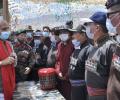
The dedication of Indian soldiers and veterans towards the country is an 'exemplary example', Defence Minister Rajnath Singh said on Sunday soon after arriving in Ladakh on a three-day visit aimed at taking stock of India's military preparedness in the region in the face of a prolonged border row with China.

Senior officers recounted extreme Chinese brutality to the Indian prisoners, with some of them being pushed over cliffs and soldiers' bodies being recovered from the Galwan River.
