
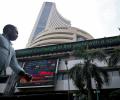
Indian benchmark indices Sensex and Nifty ended a four-day rally, closing lower on Tuesday following the introduction of a new Closing Auction Session (CAS) for F&O stocks, which has added a layer of volatility and led to an early adjustment in market structure.

The Closing Auction Session (CAS) on expiry day led to unprecedented volatility in the Nifty 50 and Sensex, causing the indices to swing wildly in just 14 minutes and raising concerns among traders about market manipulation and increased speculation.

Indian benchmark stock indices, Sensex and Nifty, experienced mixed trading following the introduction of a new Closing Auction Session (CAS) for shares with futures and options (F&O) contracts, aimed at enhancing price discovery transparency. Track Sensex, Nifty on August 4

The Securities and Exchange Board of India (Sebi) has swiftly barred Copthall Mauritius Investment and Mansi Share & Stock Broking from the securities market for alleged manipulative trades during the closing auction session (CAS) on Sensex expiry. The regulator has also directed the impounding of wrongful gains totalling 3.67 crore from the two entities.

Indian stock exchanges are actively preparing to implement a new closing auction mechanism (CAS) from August 3, aimed at enhancing transparency in determining closing prices for securities with derivative contracts.

Sebi Chairman Tuhin Kanta Pandey has defended the newly rolled out Closing Auction System (CAS), stating that it is a transparent mechanism and that the industry needs time to understand the change. He acknowledged initial turbulence and concerns from fund houses but noted an increase in mutual fund participation.

The divergence between the Sensex and Nifty closing values narrowed on the third day of the Closing Auction Session (CAS) rollout, but market participants, including Zerodha's Nithin Kamath, highlight structural issues and the unfortunate timing of its introduction alongside new RBI norms.
Market experts have largely supported Sebi's proposed changes to the expiry-day trading framework, including delinking derivatives settlement prices from cash-market closing prices and discontinuing live indicative index values during the Closing Auction Session (CAS), believing these will address volatility and manipulation.

The Reserve Bank of India (RBI) maintained its key policy rates for the fourth consecutive time, keeping the repo rate at 5.25 per cent, while the benchmark BSE Sensex closed 152 points higher in a volatile session, recovering from an intraday dip.

The Nifty's stunning 200-point jump in the final minute of trading wasn't a glitch. It marked India's shift to a new, globally accepted system of end-of-day price discovery.

The Nifty 50 experienced significant volatility during its closing auction session, leading to losses for both long and short retail options traders due to thin liquidity and rapid price swings, particularly in private-sector banks.
Sebi chairman Tuhin Kanta Pandey acknowledged that all global jurisdictions experienced lower liquidity during the initial implementation phases of the closing auction session (CAS), a stock price determination framework introduced in India on August 3.

August 2026 witnessed a significant surge in India's primary market, with 21 mainboard initial public offerings (IPOs) raising approximately 21,000 crore, marking the highest monthly deal count of the year, even as benchmark indices experienced declines.

Analysts predict that crude oil prices, geopolitical tensions in West Asia, and upcoming inflation data will be the primary drivers of the Indian stock market this week, alongside foreign investor activity and domestic quarterly earnings.
India's market regulator, Sebi, is set to issue a consultation paper proposing changes to the methodology for determining settlement prices of derivative contracts, following significant feedback and 'sharp price spikes and distortions' observed during the recently implemented Closing Auction Session (CAS) mechanism.

Indian stock market indices closed on a mixed note, with the Sensex gaining 374 points driven by buying in Reliance Industries and ICICI Bank, while the Nifty remained flat. This divergence is attributed to a new Closing Auction Session (CAS) mechanism introduced by stock exchanges, impacting market liquidity and price discovery.
India's derivatives market experienced a significant 23 per cent fall in average daily contracts traded in August, reaching a 13-month low of 224 million. This decline is primarily attributed to regulatory changes, including a higher securities transaction tax (STT) and enhanced collateral requirements, alongside the introduction of a closing auction session.

Indian benchmark equity indices, Sensex and Nifty, closed mixed on Friday. While a drop in crude oil prices offered some relief, weakness in IT stocks and several Tata Group counters, including a significant dip in Tata Chemicals and ongoing boardroom issues at Tata Sons, limited a broader market recovery.
Indian benchmark indices, Sensex and Nifty, saw early gains driven by lower crude oil prices and buying in Reliance Industries, even as the Reserve Bank of India maintained its benchmark policy rate for the fourth consecutive meeting, reinforcing confidence in the domestic economy.
The Securities and Exchange Board of India (Sebi) is reportedly 'close' to approving the National Stock Exchange's (NSE) initial public offering (IPO) draft documents, with an expected market debut by early next month. Sebi Chairman Tuhin Kanta Pandey also emphasised the regulator's focus on enhancing market resilience against evolving risks, including technology failures and the impact of artificial intelligence.

The benchmark BSE Sensex rebounded by 362 points, ending a four-day losing streak, driven by strong buying in metal, private banking, and oil and gas shares, while the broader NSE Nifty saw modest gains despite paring some advances in the closing session.

Indian benchmark indices, Sensex and Nifty, experienced declines in early trade, primarily due to a surge in crude oil prices and a retreat in Wall Street, as investors reduced exposure to risk assets amidst geopolitical uncertainty. Track Sensex, Nifty on August 7, 2026.
Indian benchmark indices, Sensex and Nifty, closed lower, primarily due to a downturn in banking and financial stocks, coupled with crude oil prices remaining above USD 80 per barrel. Geopolitical uncertainties and new regulatory proposals for the non-bank lending sector also contributed to cautious investor sentiment.
Indian benchmark indices, Sensex and Nifty, closed marginally lower due to elevated crude oil prices, fresh US-Iran tensions, and expectations of a tighter monetary policy from the US Federal Reserve, despite strong domestic GDP growth.

'Regulations give a particular minimum amount of shares to be given in the OFS or IPO -- without which one cannot do the IPO.' 'We got that number on the day of filing of updated DRHP -- sufficient for us to go live with the IPO.'

An inside look at the world of IPL net bowlers, the unsung heroes who hone their skills while bowling to cricket's biggest stars, hoping for a chance to shine.

Sri Lankan pacer Matheesha Pathirana is set to join Kolkata Knight Riders, providing a much-needed boost to their struggling bowling attack as they seek their first win in the IPL season.

'That has been the big factor behind me coming so far in my career.'

Venkatesh Iyer discusses his role within the Royal Challengers Bengaluru (RCB) team, his motivation despite limited playing time, and his experiences with Kolkata Knight Riders (KKR). He also praises Dinesh Karthik and Rajat Patidar.

Riyan Parag says Sanju Samson is irreplaceable as Rajasthan Royals reshape squad with Jadeja and Curran ahead of IPL 2026.

Riyan Parag resumes batting in nets

'He moved to few other teams but never felt settled at those teams.'

Sreejesh, a two-time Olympic bronze medallist, believes India have the potential to finish on the podium in the upcoming junior World Cup to be held in Chennai and Madurai from November 28 till December 10.

Shedge will also reunite with his Mumbai teammate Musheer Khan at Punjab Kings as both were picked by their base price of Rs 30 lakh.

'...whether he is a top player or not, it doesn't matter.' 'If I go by a player's name I won't be able to bowl at my best.' 'For me he is just a batter, and my only focus is where I need to land the ball.'

Punjab Kings head coach Anil Kumble was extremely satisfied with the new players, including Liam Livingstone and Odean Smith, coming to his franchise during the IPL 2022 Player Auction, the dynamics of which were "very different and challenging".

Ashutosh, who has been picked by DC for INR 3.8 crore at the mega auction, first crossed paths with Dhawan during his stint with Punjab Kings, where he found not just a teammate but a mentor, who had a massive influence in his approach to the game.

Wicketkeeper-batter Rishabh Pant will be back in action at the next IPL season, says Delhi Capitals Director of Cricket Sourav Ganguly.

Sitharaman also said different departments of the government are working to provide relief to industry, which could be severely impacted by the fast-spreading virus.

While the market for satellite broadband currently is small, the potential is large as an estimated 30 per cent of the country does not have reliable terrestrial broadband services.
