
'We were in a heavily nuclearised environment. China had tested for Pakistan in the 1980s and helped their missile programme stay just one step behind us.'

The government today informed the Rajya Sabha that the United States has not requested India to sign the CTBT in recent bilateral discussions.

External Affairs Minister S M Krishna has said that the country has taken a 'principled' stand on the Comprehensive Nuclear Test Ban Treaty (CTBT) and there is no scope for change in its position unless a number of other developments take place to address the concerns.This comes after a high-level conference on disarmament in the United Nations on Thursday, addressed by UN General Secretary Ban Ki Moon, asked India and eight other countries to ratify the agreement.

India-US relations, like Rome, were not built in a day, nor can they be demolished in a day.
All said and done, when the new global order emerges, India can only remain with the democracies, asserts Ambassador T P Sreenivasan.
India, which came out of the nuclear closet in 1998 conducting five tests, has resisted signing CTBT describing it as discriminatory.
Two nonproliferation hawks, who vehemently opposed the US-India civilian nuclear deal, will soon man the White House and State Department and lead the charge to push President Obama's non-proliferation agenda to seek a worldwide ratification of the Comprehensive Test Ban Treaty and a strengthening of the Nuclear Nonproliferation Treaty that is bound to bring pressure to bear on India that has been loath to sign the CTBT and has maintained the NPT is discriminatory.

Trump's new rules for how countries should treat him have led to the current breakdown in India-US relations, explains Ambassador T P Sreenivasan.
A day after the US underlined its determination to strengthen the nuclear non-proliferation regime, a top US official said Washington would not push New Delhi to sign the Comprehensive Test Ban Treaty (CTBT) until the American Senate ratifies it.
Expressing concern over the nuclear arms race in South Asia, a senior Democratic lawmaker, who opposed the Indo-US civilian nuclear deal, has asked the Obama administration to "encourage" India and Pakistan to sign Comprehensive Nuclear Test Ban and halt production of nuclear-weapon fissile material.

In a bid to strengthen non-proliferation, the United States wants to secure loose nuclear material within four years and also ratify the Comprehensive Test Ban Treaty, which bans all forms of atomic explosions, the country's top diplomat to the United Nations has said. "We want to secure loose nuclear material within four years. We want to start a follow-on agreement. We want to ratify the CTBT. We want to have a fissile material cut-off," US Ambassador to UN Susan Rice said.
The United States will not conduct nuclear tests and move to seek the ratification of the Comprehensive Test Ban Treaty, the Obama administration said today, as it underlined the importance of the NPT to the non-proliferation regime, the two pacts that India has failed to support in its present form.
In a departure from tradition of not singling out countries by name, the United Nations has asked India, Pakistan and Israel to join the Nuclear non-Proliferation Treaty and the Comprehensive Test Ban Treaty without further delay and pre-conditions.

Ghose was head of Indian delegation to the conference on the CTBT in Geneva in 1996 and she is hailed for strongly outlining India's position in opposing the treaty.
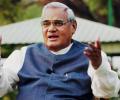
It was good fortune for India to have Atal Bihari Vajpayee lead the government at a crucial moment in our history. He avoided India meeting the fate of Iraq or Ukraine, asserts military historian Colonel Anil A Athale (retd).
Pressed by Japan to sign the Comprehensive Test Ban Treaty, India clearly put the onus on the US and China on Tuesday for taking a lead in this direction by ratifying it.
India will most likely sign the Comprehensive Test Ban Treaty--a top non-proliferation priority of the Obama Administration--if the world moves "categorically towards nuclear disarmament in a credible time-frame," India's point man for nuclear issues has indicated.
Dr A N Prasad, former director of the Bhabha Atomic Research Centre and a distinguished nuclear scientist, explains the reasons behind Santhanam's statement on Pokhran II and its possible implications for India.
Breaking the tradition of not naming countries, the first draft of the final document of the 2010 Nuclear-Non Proliferation Treaty Review conference has asked India, Pakistan and Israel to sign the NPT and the CTBT. "The conference calls upon India, Israel and Pakistan to accede to the treaty as non-nuclear weapon States, promptly and without conditions, thereby accepting an internationally legally binding commitment not to acquire nuclear weapons," it said.
However, she said that during her discussions with Indian leadership in New Delhi starting on Sunday she would explore how India could help the US to ensure that nuclear material and knowledge is kept out of rogue states and non-state actors.

The landmark civil nuclear deal sealed on Friday with Japan is strikingly similar to the agreements India has with the US and some other countries but contains some added features on safety and security, reflecting Japan's concerns on the issue.
International Atomic Energy Agency Director General Mohammad ElBaradei has said that he does not expect India to sign the Nuclear non-Proliferation Treaty, but feels the Comprehensive Test Ban Treaty could be more "acceptable".

United Nations chief Ban Ki-moon has appealed to India, China and the US along with five other nations to ratify the Comprehensive Nuclear Test-Ban Treaty, saying the international community should complete the "unfinished business" of achieving a world free of atomic weapons.
'It will be a very positive step,' said Norwegian Foreign Minister Jonas Garh Store.

Would Ukraine be such a pushover if it had that nuclear stockpile?' asks Shekhar Gupta.

'India must close the missile technology gap with both China and Pakistan as early as possible, or else the credibility of India's nuclear deterrence will remain suspect,' says Brigadier Gurmeet Kanwal (retd).

'When the Brexit bomb goes off, the shrapnel will wound us.' 'We will in the time-honoured tradition apply band-aids all over.' 'Those who shout the loudest will get economic relief like interest rate reduction and debt restructuring.' 'Others will go on living lives of quiet despair,' says S Muralidharan.

'The call to isolate Pakistan on the ground of sponsoring and supporting terrorism, particularly when the UN has not even defined terrorism, is a wild goose chase.' 'The responses of the various countries to the Uri attack provides testimony to this fact.' 'No country, not even Russia, was willing to condemn Pakistan for this dastardly act,' says Ambassador T P Sreenivasan.

For me, Arundhati (Chukku) Ghose was the last word on multilateral economic issues when we worked together in the ministry of external affairs on UN affairs. If her disarmament persona had not made her a celebrity in that area, she would have been known for the work she did in economic matters in different capitals. She was highly respected for her views and no one wanted to be seen on the opposite side of the argument with her. But she was always patient in explaining her position and in accommodating different perspectives, says Ambassador T P Sreenivasan.

China's state media on Tuesday defended Pakistan's nuclear record, saying it was A Q Khan who was responsible for atomic proliferation which was not backed by the government and argued that any exemption to India for Nuclear Suppliers Group entry should also be given to Pakistan.

'When economic policies were attacked by people on his own side, he went ahead despite all the criticisms in the coalition, within the party and the Sangh Parivar.'

'Taranjit has the ideal temperament to deal with the Americans who understand firmness and appreciate flexibility.' 'He can hold his ground with a cheerful face and still make it clear that India and the US are partners, rivals,' says Ambassador T P Sreenivasan.

Vajpayee had always felt that India must act with conviction and panache. He decided that, irrespective of the attendant risks, he would undertake what many felt was a precarious course. A fascinating excerpt from N K Singh's Portraits Of Power: Half A Century Of Being At Ringside on Atalji's 96th birthday, December 25.
