
Unprecedented rains and floods in the northern region in the past few days have not only caused extensive damage to lives and property but have also impacted business and commercial establishments. Vegetable prices have gone through the roof in the national capital and many other parts of the country since rains started pouring earlier this month. Traders say vegetable prices would come down only after roads open and skies clear, even as water in the fields will take time to recede.

India always faces a Hobson's choice as far as feeding coal-fired generators goes - even if the government is reluctant to admit it. The country cannot do without shipping in the world's most polluting fuel from overseas. And it will continue to do so unless it decides to reduce demand by forcing citizens, farmers and businesses to live without electricity for part of the day, or use diesel generators to fire facilities.

Analysts are divided on their retail price inflation forecast, with some saying the first quarter numbers will overshoot the RBI target by as much as 60 bps while others are softer in their estimate. Consumer price inflation retreated from its 15-month peak of 7.4 per cent in July to 6.8 per cent in August, much lower than the market expectations, despite vegetable prices remaining elevated at 26.1 per cent. Food inflation eased to 9.9 per cent from 11.5 per cent, led by some cooling of inflation in vegetables, cereals, pulses and milk.

The Department of Investment and Public Asset Management (Dipam) has asked ministries, government departments, and public sector undertakings (PSUs) to send a list of assets that can be monetised under the proposed National Monetisation Pipeline. The list will be used for creation of an asset monetisation dashboard, which will keep a track of such assets. The government, meanwhile, has asked CRISIL to prepare a road map for monetising assets of PSUs and government departments.

However, a prolonged and intense second wave that curtails oxygen supply to industries for a longer-than-expected period will exacerbate downside risk in affected sectors

Even before NCP-Ajit Pawar leaders came to meet in Delhi, the central government decided to buy 200,000 tonnes of onions from farmers at Rs 24.1 per quintal. This was among the highest prices at which onions have ever been bought from farmers.

The development of private data sources is a hugely positive development. It should serve as a challenge to the government to improve its own record on producing timely and reliable statistics, points out T N Ninan.

At an aggregate level, the late ace investor's portfolio that was valued at Rs 32,445 crore as on March 31, 2023 is now worth Rs 35,979 crore.

Untimely rains during March have caused damage to rabi crops and may result in lower yields, a report said on Wednesday. Between March 1 and 21, cumulative rains have been 20 per cent more than normal, and in the past four days, it was 3-4 times more than usual, according to a report by Crisil Market Intelligence and Analytics. On March 21, the rain volume in central India was 1,600 per cent more than normal, the report said, adding that unfortunately, this ongoing harvest window for rabi crops has been lashed by an untimely torrent.

Petrol and diesel prices on Wednesday were hiked by 80 paise a litre each for the second day in a row since the ending of an over four-and-half month hiatus in rate revision. Petrol in Delhi will now cost Rs 97.01 per litre as against Rs 96.21 previously while diesel rate has gone up from Rs 87.47 per litre to Rs 88.27, according to a price notification of state fuel retailers.

That would reverse the growth trend of around 11 per cent per annum, which the industry has logged over the past ten years, making it one of the most adversely-affected sectors of the economy.

Less-than-expected rainfall and a poor spatial distribution, experts say, can rekindle fears of a rise in food and fuel inflation that can have an impact on the RBI's monetary policy. The fear of less than optimal rainfall due to El Nino this year, analysts believe, is the biggest short-term risk for the markets, which they said has not been fully priced in yet by them. Monsoon set over Kerala on June 08, a week later than its scheduled date.

Nirma's tryst with the pharmaceutical space started in 2006 when it acquired the ailing Core Healthcare in a deal reported to be worth Rs 300 crore. The Ahmedabad-based manufacturer of intravenous fluids was subsequently renamed Nirlife. Pharma industry insiders say Nirma, which broke open the detergent market in the 1990s with low prices and massive advertising, tried an encore of the low-price strategy in pharma, but with mixed results.

Bank credit is likely to grow at a four-year high of 11-12 per cent in fiscal 2023, on the back of better economic growth and budgetary support from the government, according to a report. In the fiscal ended March 2022, bank advances have likely grown at 9-10 per cent. "Healthy economic growth and budgetary support from the government should lift bank credit growth by 200-300 basis points to 11-12 per cent this fiscal," Crisil Ratings said in the report. The higher credit growth expectation is also supported by the improved resilience of the banking system, it added.

'Instead of ACs, the government should do something to increase our salary.'

Benefitting from the economic rebound, banks are expected to report a healthy bottom-line and asset quality profile in the quarter ended March 2023 (Q4FY23). The net profit of listed commercial banks is projected to grow by an average 43.6 per cent year-on-year (YoY) in Q4FY23 amid better net interest margins (NIMs) and declining credit costs. This is based on a combined assessment of analyst estimates for 17 banks on Bloomberg database.
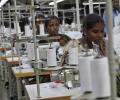
'We have 750 districts across the country, and each district can create one cluster like Tirupur on any product of their choice.' 'This way, we can even have $3 trillion in exports.'

In the longer-term, analysts expect IHCL to see revenue CAGR of 15 per cent between FY23 to FY25 and Ebitda CAGR of 20 per cent in the same period. Analysts are seeing targets of around Rs 375-Rs 380 for the stock, which is a significant upside from the current Rs 313.

Shares of companies having investments of late billionaire investor Rakesh Jhunjhunwala ended on a mixed note on Tuesday. The 62-year-old investor, who was known as the Big Bull and Warren Buffett of India for his investment acumen, passed away on Sunday. Jhunjhunwala had investments in more than three dozen companies, the most valuable being watch and jewellery maker Titan, part of the Tata group. Titan ended 0.88 pe cent higher at Rs 2,493.65.

India Inc is set to post an 18-20 per cent revenue growth for July-September as compared to the year-ago period, domestic rating agency Crisil said on Thursday ahead of the filing of quarterly earnings by companies. The handsome growth in the topline will be driven by both higher volumes and higher commodity prices, the rating agency said. However, the rising input prices may have capped operating profit margin expansion for companies when compared to the preceding quarter, the agency said.

The duty hike on cigarettes by 16 per cent announced in the Union Budget 2023-24 would have a nominal impact of around 7-12 paise per stick across cigarette categories, according to experts. This upward revision in National Calamity Contingent Duty (NCCD) would have negligible impact on smokers and the companies could easily absorb the shock as it may not also have any resultant impact on margins, they said. Finance Minister Nirmala Sitharama in the Union Budget for 2023-24 on Wednesday proposed to revise and increase the duty on cigarettes to about 16 per cent.

Even as the semiconductor shortage has limited the demand for new cars, the pre-owned car segment is seeing a surge. A preference for personal mobility, availability of multiple organised online platforms, including e-commerce channels, aggregators, and classifieds, have been fuelling growth. The growth rate of the pre-owned car market is expected to be 1.5x that of the new car market over the next five years.

Kerala is likely to witness all-time high liquor sales this Onam, the harvest festival, with the season already reporting a 30 per cent hike. According to the Kerala State Beverages Corporation (BevCo), the first few days of this Onam season have set the tone for record sales. "During last year's Onam season, our sales were around Rs 561 crore. This year, we expect it to be over Rs 700 crore," said Yogesh Gupta, chairman and managing director, BevCo.

At risk of entrenched rough times are sectors like hospitality and those with discretionary spends.

Diamond industry expects revenues to drop by 20-25% in the current financial year.

No expecting mother ever needs to travel for more than 30 minutes to reach one of their hospitals, believes the Cloudnine group.

Since its launch in late March after India went into a lockdown, concerns about transparency have been expressed about the PM-CARES Fund

When the world was upended by the Covid-19 pandemic, metals got its shine back. In the last two years, infrastructure spending by major economies spurred demand, energy transition and intermittent supply disruptions fuelled a scorching rally in metals after a downturn during the first Covid wave. Now, Russia's war on Ukraine is ensuring that elevated prices stay the course.

As a percentage contributor to nominal GDP, PFCE's share was 60.1 per cent in FY23, compared with 59.6 per cent and 60.8 per cent in the two preceding fiscal years. "Although PFCE is expected to grow 7.7 per cent in FY23, we believe it is still short of a broad-based recovery. "The current consumption demand is highly skewed in favour of goods and services consumed largely by the households falling in the upper income bracket. "A broad-based consumption recovery, therefore, is still some distance away," said Sunil Kumar Sinha, principal economist with India Ratings.

Sebi has restructured its advisory committee on market data that recommends policy measures pertaining to areas like securities market data access and privacy. Rejigging its market data advisory committee, Sebi has said the panel will now have 21 members, as per the latest information with the regulator. Earlier the committee had 20 members. The committee is chaired by M S Sahoo, Professor at National Law University, Delhi and former chairperson, Insolvency and Bankruptcy Board of India (IBBI).


The dreary, cold months from December to February may prove to be the undoing of many a nation as they grapple with sky-high fuel prices - a result of the Ukraine conflict and the pandemic. Many - Europe, South Korea, Japan, and China - will still pull through on the strength of their wealth or because of strong storage infrastructure. But India will have its back to the wall. Signs of liquefied natural gas (LNG) rates hitting new records this winter are already evident.

New Delhi's timing couldn't have been worse, both for India's fledgling electric vehicle (EV) sector and prospective electric bike buyers. It was hard to miss the perfect storm brewing for India's EV industry since early 2022. On one hand, you had several accidents involving battery fires that unnerved consumers; on the other, uncertainty had crept in over subsidies.

Led by Trent, which hit its lifetime-high recently, apparel retailers have gained between 10 per cent and 36 per cent over the past three weeks. Given the network of physical stores, these stocks shall be major beneficiaries of the unlock theme, with most states doing away with Covid restrictions. Amid improving footfall, analysts expect the sector to post double-digit growth in FY23.

Sluggish rural demand along with higher inflation is set to mute revenue growth of the fast-moving consumer goods (FMCG) sector at 7-9 per cent this fiscal and the next compared to 8.5 per cent in the previous fiscal, a report said. Almost 40 per cent of the Rs 4.7-lakh-crore sector come from the hinterland markets, which have been hit by high inflation, low wages and high job losses since the Covid pandemic. Revenue growth of the FMCG sector will be muted at 7-9 per cent this fiscal and the next compared to 8.5 per cent in the last, while volume growth will be just about 1-2 per cent, down from 2.5 per cent last fiscal, Crisil said in a report on Monday.

India Inc's philanthropic spends have grown by 3.62 per cent to Rs 22,000 crore in FY21 as profits expanded, and a majority of the allocations have been done to pandemic-linked causes, a report said on Tuesday. The report by rating agency Crisil said that while the first wave saw greater spending in cash largely through the PM-CARES Fund, the preference shifted to more direct support through in-kind spends in the second wave. Corporate contributed only Rs 85 crore to the PM-CARES Fund during the second wave between March and June 2021, as against Rs 831 crore to what was classified as 'others'.

Companies are not able to pass on the pressure from rising input costs to buyers, and this is likely to result in a compression in corporate profit margins for the March quarter, a report said on Monday. Operating profit margins for companies are set to fall by as much as 3 percentage points compared to the year-ago period, and up to 0.60 per cent as compared to the preceding December quarter, the research wing of rating agency Crisil said in a report. The report comes ahead of the earnings season when major companies start reporting their profits.

Real estate development on Mumbai airport land and the work on Navi Mumbai airport have been inordinately delayed, which have prompted rating downgrades and raised questions on its financial capabilities. It is also trying to stave off Adani group's entry as a shareholder in the Mumbai airport project.

While sales in the domestic market declined 4.2 per cent during the April-July period, exports grew steadily at 9.5 per cent during the same period.

Among the lot, Rallis India, Escorts, Jubilant Life Sciences, and Crisil added half of the total gains made in the ace stock-picker's portfolio.
