
The India Meteorological Department (IMD) has predicted below normal monsoon rains for India this year, citing the potential emergence of El Nino conditions. This could significantly impact the country's agriculture-dependent economy.

The India Meteorological Department said on Tuesday monsoon rains are expected to be below normal at 95 per cent of the long period average, with margin for error of plus or minus 4 per cent.

A below-normal monsoon is likely to drag down the food output with India's agricultural GDP growth likely to slump to 0.8 pc in the current fiscal, says a report by the Japanese brokerage firm Nomura.

India is likely to experience below-normal monsoon rainfall this year, with a 20 per cent chance of drought due to the end of La Nina conditions and the potential for El Nino to take hold, private forecasting agency Skymet Weather said on Monday.

South-west monsoon is likely to be below normal this season, government announced on Wednesday raising concerns about its impact on agriculture and economy.
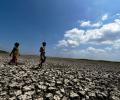
'The first two months of monsoon are not looking good.' 'In case both the halves fail, it is going to be misery.'
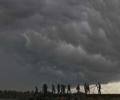
For the second successive year, Monsoon is likely to be below normal with parts of north-west and central India to be the most affected.

Monsoon rains are expected on time this year, hitting Kerala on June 1.

Skymet expects a good monsoon over western and southern India.

A poor monsoon could drag overall economic growth and compound the impact of the West Asia conflict on the Indian economy.

The Brihanmumbai Municipal Corporation (BMC) has announced a 10 per cent water cut across Mumbai starting May 15, citing concerns over a below-normal monsoon forecast due to the El Nino weather pattern. The current water stock in the city's seven lakes is expected to last until July 6.

The monsoon has so far disappointed and if rainfalls do not increase soon it will push up inflation as well as the subsidy bill, further limiting the room for RBI rate cuts, an HSBC report says.

India has received 20 per cent less rainfall since the start of the monsoon period on June 1, with the rain-bearing system making no significant progress between June 12 and 18, according to the India Meteorological Department (IMD).

India is likely to witness a mixed temperature pattern along with wetter-than-usual conditions in May, with the India Meteorological Department (IMD) indicating that rainfall across the country is "most likely to be above normal" at over 110 per cent of the long period average (LPA).

'Monsoon is the pran (life) of our water system.' 'A weak monsoon will have a very negative impact on crops and people's lives.'

The India Meteorological Department (IMD) has forecasted an early onset of the southwest monsoon over Kerala, expected around May 26. This marks the beginning of the crucial rainy season for India.

June rainfall accounts for 15 percent of the total precipitation of 87 cm recorded during the four-month monsoon season in the country.
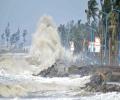
The India Meteorological Department (IMD) has announced that conditions are becoming favourable for the onset of the southwest monsoon over parts of the south Bay of Bengal, Andaman Sea, and Andaman and Nicobar Islands towards the end of this week.
India, hit by a devastating drought last year that hurt economic growth, is expected to experience a below normal monsoon this year.

The IMD defines a normal monsoon as one which delivers between 96 and 104 per cent of the 50-year average rainfall for the season.

East India, along with a major portion of central India, is likely to be at a higher risk of being rain deficient, especially during the first half of the season.
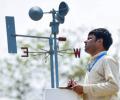
'This system will be of immense help in agricultural planning, disaster management and water resources management.'

Mohapatra said there is a 40 per cent chance of a normal rainfall, 22 per cent above normal, 12 per cent excess and 18 per cent below normal.

It's still early days, but the southwest monsoon has been nearly 37 per cent 'below normal' in the first seven days (June 1-7) of this month. According to the data furnished by the India Meteorological Department (IMD), between June 1 and June 7, India received 14.5 millimetres (mm) of rainfall, against a 'normal' 23.1 mm. Among places where rains have arrived, monsoon in Kerala in the first seven days has been 48 per cent 'below normal', while in Puducherry, it has been 56 per cent 'above normal'. In Tamil Nadu, rains were 21 per cent 'above normal' between June 1 and June 7.

'During the hot season (April to June), above-normal minimum temperatures are likely over most parts of the country, except in some regions of Maharashtra and Telangana, where minimum temperatures are expected to be normal to below normal,' IMD said.

July and August are expected to receive 107 per cent and 104 per cent of rainfall

Skymet is the first major Indian weather forecasting agency to have issued a monsoon forecast for 2016.

A normal monsoon will augur well for the country's agriculture sector and boost crop yields. However, good rains - and surplus crops - could also depress prices, hurting farm income, unless adequate steps are taken.

A minister said the country had 7% less rain than normal.

India's consumption stocks, which have outperformed the broader market, are now facing significant pressure due to a gradual rise in fuel prices and the potential for higher inflation. Analysts warn that companies may be forced to pass on increased input costs to consumers, potentially hurting demand across both staples and discretionary categories, with a looming threat of deficient monsoon rainfall further exacerbating inflationary concerns.

'We should expect extreme heat, extreme rains, floods, landslides and maybe cyclones. Not just this year, in the coming year as well.'
Commission for Agriculture Costs and Prices cairman Ashok Gulati tells Business Standard that IMD's prediction should be taken with a pinch of salt, as data shows there is usually a deviation of eight-10 per cent from the standard margin of error in many met predictions.

Skymet said the monsoon this year could be 100 per cent of the long period average (LPA) with a model error of plus and minus 5 per cent.

https://www.rediff.com/business/report/quality-control-orders-what-does-this-mean-for-domestic-industry/20240425.htm

The rainfall in July was minus seven per cent which comes to around 93 per cent of the Long Period Average, IMD Director General Mrutyunjay Mohapatra said.

JPMorgan has downgraded Indian equities to 'neutral' from 'overweight', citing elevated valuations, rising earnings risks, and limited exposure to next-generation technology like AI. The brokerage believes other emerging markets offer more attractive risk/reward propositions despite India's strong structural growth story.

Above-normal cold wave days are expected in some areas of central India, eastern Uttar Pradesh and Bihar during January 2026.
Though early days, meteorologists point towards a neutral La Nina during the initial phase of the four-month monsoon season this year that starts from June. If this holds true, by the time the rains hit the mainland, it could mean there would be one less reason to worry about the prospects of the monsoon this year. Weathermen said making any accurate prediction of how El Nino will behave and what impact it can have on the progress and distribution of rains is difficult to say at this point. A clear picture will emerge around late May or early June.

The India Meteorological Department (IMD) has predicted above-normal rainfall for most parts of India during the post-monsoon season (October to December), except for some areas in the northwest. The southwest monsoon season ended with the country recording eight per cent above normal rainfall.

Contrary to some predictions, rainfall is adequate so far.
 © 2026 Rediff.com - Advertise with us - Disclaimer - Privacy Policy - Sitemap - Feedback - About us - Terms of use - Grievances