
The talks are being held with an aim of resolving the ongoing standoff in eastern Ladakh and reaching an agreement on the last remaining friction point in the Hot Springs area which had emerged post April-May 2020 aggression shown by Chinese troops along the Line of Actual Control (LAC) in Ladakh.

'We have to be equally vigilant in the central sector which is where Barahoti lies and also in the Joshimath area.'
The Chinese activity at an air base near the Barahoti area has also gone up and a large number of drones have been deployed by them there, they said.

The transgression took place on August 30, and the Chinese troops returned from the area after spending few hours, they said.

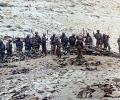
A group of shepherds were asked to vacate the land by troops of the PLA.

The Indian side is expected to seek disengagement as soon as possible in the remaining friction points besides pressing for resolution of issues in Depsang Bulge and Demchok.

The Indian side is expected to seek disengagement as soon as possible in the remaining friction points besides pressing for resolution of issues in Depsang Bulge and Demchok.

It is learnt that the face-off took place after a Chinese patrol tried to enter Indian territory and the troops of China's People's Liberation Army were forced back.

In the fourth such incursion since March, two helicopters of the People's Liberation Army of China hovered for about five minutes in Uttarakhand's Chamoli district and "could have carried out aerial photography of Indian ground troops," according to official sources in the government.
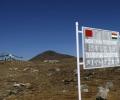
The incident took place on July 19 when a team led by Chamoli District Magistrate and others including officials from Indo-Tibetan Border Police went for a survey of Barahoti ground, official sources said.

How does blatantly claiming Indian territory help to maintain 'peace in border regions', is a mystery that only China can explain, notes Claude Arpi.
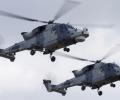
The Indian Air Force is probing the incident, an IAF source said.

The gap between the existing air bases in China close to the LAC for fighter aircraft operations was around 400 kms but this would be bridged with the operationalisation of the Shakche airfield.
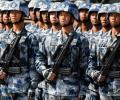
"The Chinese military has done military build-up not only just in Ladakh but also in other sectors including Himachal Pradesh, Uttarakhand, Sikkim and Arunachal Pradesh wherever it shares borders with us. The build-up includes troops and heavy weaponry which are deployed in rear positions," government sources told ANI.
The Congress on Friday questioned the silence of the government on the veracity of a video which purportedly shows injured Indian soldiers in captivity of the Chinese and said if it is genuine, then Prime Minister Narendra Modi must ensure that China is held globally accountable for indulging in war crimes.

At least 37 incursions of Chinese forces have been reported during the last five years in Uttarakhand, which has a 350 kilometer long border with China, Chief Minister Vijay Bahuguna said on Monday.
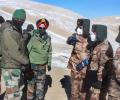
"The meeting thus did not result in resolution of the remaining areas," the Army said in a statement.

'India has to prepare for future warfare where kinetic use of force at the border will be limited. War will take place in the realms beyond the border.'

'China is unwilling to restore the status quo ante of April 2020.' 'India will have to weigh its options based on this premise.'
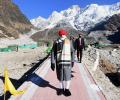
We understand the electoral compulsions, the desperate need for the BJP to have at least 50 per cent of the Hindus vote for them in Uttar Pradesh in a few months. For that, you need polarisation, put your own Muslim compatriots on the 'other' side. This is how your domestic politics runs contrary to your national, strategic interest, warns Shekhar Gupta.
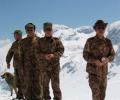
The issue was raised by Congress leader Jyotiraditya Scindia after Chinese troops entered Chamoli district of Uttarkhand.

China has not limited the 'battle' to the diplomatic field alone; the People's Liberation Army has become aggressive on the ground too. The recent 'fights' in Northern Sikkim and Ladakh are part of the pattern, asserts Claude Arpi.
So far, the Central Sector has never seen active hostilities, remaining peaceful even through the 1962 war. A reason for the Central Sector having remained peaceful is the towering Himalayan watershed that defines the border.
