This is the second straight increase in ATF price this month. Rates were hiked by a record 56.5 per cent (Rs 12,126.75 per kl) on June 1. Simultaneously, petrol and diesel prices were hiked for the 10th day in a row.

Amid record-high fuel prices, Finance Minister Nirmala Sitharaman on Monday said there is no proposal as of now to bring crude oil, petrol, diesel, jet fuel (ATF) and natural gas under the Goods and Services Tax (GST). When the GST was introduced on July 1, 2017, amalgamating over a dozen central and state levies, five commodities - crude oil, natural gas, petrol, diesel, and aviation turbine fuel (ATF) - were kept out of its purview given the revenue dependence of the central and state governments on this sector. This meant that the central government continued to levy excise duty on them while state governments charged VAT. These taxes, with excise duty, in particular, have been raised periodically.

Petrol and diesel price on Sunday was hiked again by 35 paise a litre and the auto fuels now cost a third more than the rate at which ATF is sold to airlines. The fourth straight day of 35 paise per litre hike sent petrol and diesel rates to record highs across the country. The price of petrol in Delhi rose to its highest-ever level of Rs 105.84 a litre and Rs 111.77 per litre in Mumbai, according to a price notification of state-owned fuel retailers.

In the first reduction in rate in two months, jet fuel or ATF price on Thursday was cut by 3 per cent in line with softening international crude oil prices. Aviation turbine fuel (ATF) price was reduced by Rs 1,887 per kilolitre, or 3 per cent, to Rs 58,374.16 per kl in the national capital, according to a price notification of state-owned fuel retailers. This is the first reduction in rates after four rounds of increase since February. Rates were increased by Rs 3,246.75 per kl on February 1, followed by a 3.6 per cent hike on February 16, and a steep 6.5 per cent raise on March 1. On March 16, prices were again raised by Rs 860.25 per kl. On Thursday, a Rs 10 per cylinder reduction in price of domestic cooking gas LPG also came into effect.
The windfall tax on oil produced within India and fuel exported overseas will make up for more than three-fourths of the revenue that the government lost when it cut excise duty on petrol and diesel to cool soaring inflation, industry sources said. India on July 1 joined a select league of nations globally that have taxed windfall gains accruing to oil companies from soaring energy prices. The government slapped a Rs 6 per litre tax on the export of petrol and jet fuel (ATF) and Rs 13 a litre on the export of diesel effective July 1. Additionally, a Rs 23,250 per tonne tax was levied on crude oil produced domestically.

Consumption-related stocks, such as hotels, and quick service restaurants (QSRs), have been hitting the ball out of the park ahead. On the other hand, the Miss World Pageant scheduled for later this year in New Delhi, too, could provide some tailwind to these stocks, especially hotels and aviation. However, analysts suggest investors put their best foot forward and buy these counters only on a decline given the recent rally and economic headwinds.


These stocks offer the best combination of maximum 'buy' recommendations from brokerages and share price upside over the next 12 months.

What goes in favour of Asur 2 is its pace and novelty, even though the approach has all the hokiness of a comic book, observes Deepa Gahlot.
Despite the best ever quarterly net profit of Rs 3,091 crore during April-June of financial year 2023-24 (Q1FY24), challenges are mounting for InterGlobe Aviation-run IndiGo in the near term, said analysts. Given this, most brokerages have retained their ratings from 'buy to underperform', as well as their target price for the stock. For instance, Motilal Oswal Financial Services has retained its 'neutral' rating on the scrip as it believes the low-cost airline is facing teething issues at present.
The windfall taxes on domestic crude oil production and fuel exports will generate close to $12 billion (Rs 94,800 crore) for the government in the remainder of the current fiscal while trimming profits of firms such as Reliance Industries Ltd and ONGC, Moody's Investors Service said Tuesday. On July 1, the government imposed windfall gain taxes on the export of petrol, diesel and aviation turbine fuel (ATF), and on the domestic production of crude oil. It has also mandated exporters to meet the requirements of the domestic market first.

IOC, BPCL and HPCL on Thursday afternoon stopped ATF supplies to Air India at six airports - Kochi, Pune, Patna, Ranchi, Vizag and Mohali - over payment defaults. AI flights from these places were tanking up from other airports.

Reliance Industries Ltd on Friday reported an 11 per cent drop in its June quarter net profit largely due to weak oil-to-chemical (O2C) vertical and higher interest and depreciation cost. Net profit was Rs 16,011 crore, or Rs 23.66 per share, in April-June - the first quarter of current 2023-24 fiscal year - compared with Rs 17,955 crore, or Rs 26.54 a share, earning a year back, according to a company's stock exchange filing.

India's fuel sales surged past pre-pandemic levels in March on twin impact of the economy rebounding from the lifting of pandemic-related restrictions and anticipation of price increases leading to stocking. In the first two weeks of March, dealers, as well as the public, topped up their tanks in anticipation of an increase in prices that had been on hold in the run-up to the elections in states like Uttar Pradesh. While daily price revisions restarted on March 22, the increases were calibrated.
Benchmark indices settled lower on Friday, with the Sensex declining 111 points on the back of a sharp fall in index heavyweight Reliance Industries. The BSE benchmark went lower by 111.01 points or 0.21 per cent to settle at 52,907.93. During the day, it tanked 924.69 points or 1.74 per cent to 52,094.25. The NSE Nifty dipped 28.20 points or 0.18 per cent to close at 15,752.05.
India's fuel consumption slumped by over 66 per cent in the first week of April as a nationwide lockdown halted economic activity and travel, which eviscerated demand. Petrol and diesel demand is down 66 per cent in April, while aviation turbine fuel (ATF) consumption has collapsed by 90 per cent as most airlines have stopped flying, industry officials said.

The domestic aviation industry is expected to report a net loss of Rs 25,000-26,000 crore this fiscal with elevated jet fuel prices and fare caps continuing to pose a major challenge for the airlines' profitability, domestic rating agency ICRA Ltd said on Thursday. The domestic airlines, however, are likely to post a reduced net loss of Rs 14,000-16,000 crore in the next financial year on the back of a "notable recovery" in air passenger traffic and lower level of debt, ICRA said. The ratings agency also estimates that the industry will require an additional funding in the range of Rs 20,000-22,000 crore during FY22-FY24.

Equity benchmarks shrugged off lacklustre global cues to clock smart gains on Tuesday, buoyed by strong buying interest in index heavyweights Reliance Industries and HDFC twins. However, a depreciating rupee and unabated foreign fund outflows capped the gains, traders said. The 30-share BSE Sensex rallied 562.75 points or 0.94 per cent to settle at 60,655.72.
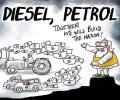
The Centre has garnered around Rs 2,500-3,000 crore in the first five weeks after it imposed a windfall tax on oil and gas companies for the export of fuel, Business Standard has learnt. It is likely that the government will continue with the one-time tax till the Indian crude basket is above $80 a barrel, sources said. The next review of the windfall tax on oil companies is early next week.
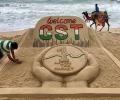
Six years after the rollout of the biggest indirect tax reform in India, Goods and Services Tax (GST) revenue of Rs 1.5 lakh crore every month has become a new normal and tax officers are focusing on dealing with fraudsters who are adopting newer modus operandi to game the system, causing loss to the exchequer. To apprehend black sheep, who operate as syndicates and create fake entities on the basis of forged documents to claim input tax credit (ITC), tax officers have started using data analytics, artifical intelligence and machine learning aiming to curb evasion, which was over Rs 3 lakh crore since inception of GST. It was over Rs 1 lakh crore in 2022-23. Thinktank Global Trade Research Initiative (GTRI) said the most critical pending GST reform is upgradation of GST Network to prevent fake supplies and fraudulent claims of Input Tax Credit (ITC).

The rupee depreciation will work in favour of students who are currently studying in the US and plan to secure a job that pays in dollars.

Jet fuel prices on Monday were hiked by a steep 6.5 per cent on the back of a rally in international oil prices. Aviation turbine fuel or ATF price was hiked by Rs 3,663 per kilolitre, or 6.5 per cent, to Rs 59,400.91 per kl in the national capital, according to a price notification of state-owned fuel retailers. This is the third increase in jet fuel prices since February. Rates were increased by 3.6 per cent on February 16, and by Rs 3,246.75 per kl on February 1. The increase in rates will add to the margin woes of airlines who continue to operate flights at less than capacity, amid pandemic-driven travel restrictions.
Petrol and diesel sales in India jumped in September as economic activity picked up with the nearing festival season and the ending of the monsoon raised the demand, preliminary industry data showed. Petrol sales soared 13.2 per cent to 2.65 million tonnes in September when compared to 2.34 million tonnes of consumption in the same month last year. Sales were 20.7 per cent higher than Covid-marred September 2020 and 23.3 per cent more than pre-pandemic September 2019.

India, the world's third largest energy consumer, has enough petrol, diesel and cooking gas (LPG) in stock to last way beyond the three-week nationwide lockdown, as all plants and supply locations are fully operational, Indian Oil Corp (IOC) chairman Sanjiv Singh said.an Singh, who continued to oversee the mammoth operations of ensuring that fuel reaches every nook and corner despite the loss of his father on the day the 21-day lockdown was declared, said there was no shortage of any fuel in the country and customers should not resort to panic booking of LPG refills.

The government should scrap the windfall profit tax on domestically produced crude oil as the levy is adversely impacting the capex-intensive exploration of oil and gas, the industry said in its recommendation for the forthcoming annual Budget. India first imposed windfall profit taxes on July 1, joining a growing number of nations that tax super normal profits of energy companies. At that time, a Rs 23,250 per tonne ($40 per barrel) windfall profit tax on domestic crude production was levied.

With crude oil price crossing $100 per barrel mark, the airlines have begun to pass some of the cost on to the consumer to meet the increased air turbine fuel expenses, and asked the government to take steps to reduce the cost of aviation fuel.

India's fuel sales fell in the first half of April as a record rise in prices in a short 16-day period dented demand, preliminary industry data showed on Saturday. Petrol sales fell almost 10 per cent in the first half of April when compared with the same period in the preceding month, while diesel demand slid 15.6 per cent. Even cooking gas LPG, which had consistently shown growth even during the pandemic period, saw a 1.7 per cent month-on-month fall in consumption during April 1-15.
Petrol and diesel sales in the country fell in July over the previous month as the onset of monsoon chipped away demand in some sectors and restricted mobility, preliminary industry data showed. Diesel, the most widely used fuel in the country, saw consumption drop 13.1 per cent to 6.44 million tonnes from 7.39 million tonnes of demand in June. The arrival and intensity of monsoon weigh heavily on diesel demand in the country and consumption traditionally is lower in July-September than in April-June.
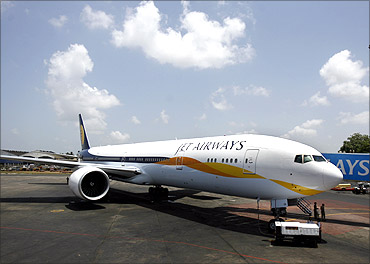
Refuting all the allegations, IOC has clarified that no monopolistic situation exists in supply and pricing of aviation turbine fuel (ATF) to airlines.
In reply to a question in Rajya Sabha as to whether Air India was eyeing Rs 300 crore (Rs 3 billion) saving via direct fuel import, the Minister said, "AI has not yet decided about import of Air Turbine Fuel directly.

The budget has increased the outlay for the Ministry of Civil Aviation by 21% at Rs 12165 crore from Rs 10031 crore for FY2008-09. However, the revised estimate for FY2008-09 was at Rs 7490 crore against the outlay of Rs 10031 crore.
Domestic air passenger traffic plunged around 43 per cent month-on-month at 64 lakh in January 2022 as the third wave of the pandemic and the resultant restrictions by state governments kept flyers away from air travel, Icra said on Tuesday. The domestic passenger volume in December 2021 was recorded at 112 lakh. The rating agency said it is expecting the recovery process to remain subdued during March quarter and that the jet fuel prices continue to be a drag on the sector. The passenger traffic declined 17 per cent last month over 77 lakh passengers transported by domestic airlines on local routes in January 2021, Icra said.

India's macroeconomic fundamentals are strong to deal with global challenges and the central government is committed to sticking to the fiscal deficit target of 6.4 per cent of the GDP for the current fiscal, official sources said on Monday. The government is taking steps to deal with the spiralling crude oil prices in the international market, the sources said. India meets nearly 85 per cent of its oil demand through imports and a weaker rupee makes imports costlier.

Rising fuel prices, intense competition and inability to pass on spiralling expenses have been negatively impacting the domestic airlines.
As all airlines have raised carriage charges, private couriers have increased their tariffs 8-20 per cent. India Post, on the other hand, has not tinkered with its tariffs at all. As a result, India Post's tariff is 70 per cent cheaper for domestic destinations and 30 per cent cheaper for international destinations.

The Reserve Bank is expected to go for another rate hike of 0.40 per cent at the scheduled review of the monetary policy next week, a foreign brokerage said on Friday. The central bank's rate setting panel will follow it up with a 0.35 per cent hike in rates at the next review in August, or make it into a 0.50 per cent hike next week and a 0.25 per cent increase in August, to make the total quantum of rate hikes at 0.75 per cent, the report by Bofa Securities said. On May 4, the Reserve Bank of India (RBI) hiked rates by 0.40 per cent, and Governor Shaktikanta Das has already called a rate hike at the forthcoming review as a "no brainer" given the pressure to maintain its core mandate of inflation in the targeted band of under 6 per cent.
The cost of non-subsidised LPG -- the one that consumers buy after exhausting their quota of 12 bottles of 14.2-kg at below market price -- has been cut by Rs 100.5 to Rs 637.

The hike comes on back of two massive hikes effected on February 1 and 16.
Domestic air passenger traffic jumped 57 per cent to around 49 lakh in July, reflecting a significant sequential as well as year-on-year growth amid a decline in coronavirus infections, according to a report. Recording continued recovery, traffic rose 56-57 per cent to 48-49 lakh in July compared to June this year when it was about 31.1 lakh. As against June 2020, the growth is 132 per cent, rating agency Icra said in the report on Thursday.
