
The latest numbers are the lowest since December 2009 when headline inflation was at 7.15 per cent.
Food inflation is back in double digits after a gap of a month-and-a-half and stood at 10.60 per cent for the week ending October 8 on the back of costlier vegetables, fruits, milk and protein-based items.

Headline inflation, as measured by the wholesale price index, was 9.7 per cent in March, 8.7 per cent in April and 9.1 per cent in the following month.

Inflation, as measured by the Wholesale Price Index, stood at 9.78 per cent in August.
Overall, vegetables were 47.06 per cent cheaper during the week under review, from the same period last year.
Food inflation remained in the negative zone for the third straight week, at (-)0.42 per cent for the week ended January 7, mainly due to fall in prices of onion and vegetables.
Food inflation, as measured by the Wholesale Price Index, was on a declining trajectory for the previous three weeks.
The latest numbers are the lowest since December 2009 when headline inflation was at 7.15 per cent.

Food prices fell for the second consecutive week as food inflation remained in the negative zone at (-)2.90 per cent for the week ended December 31, 2011.
According to official data released on Thursday, onions grew cheaper by 59.04 per cent year-on-year during the week under review, while potato prices were down by 33.76 per cent.
Food inflation fell sharply to a near four-year low of 1.81 per cent for the week ended December 10 as prices of essential items like vegetables, onion, potato and wheat declined.

Inflation, as measured by the Wholesale Price Index, was 7.55 per cent in May. In June last year, it was 9.51 per cent.
According to data released by the government on Thursday, onions became cheaper by 39.20 per cent year-on-year during the week under review, while potato prices were down by 15.75 per cent.

Continuing decline in food prices, including vegetables, pulled wholesale price inflation to a five year low of 1.77 per cent in October.

Food inflation, as measured by the Wholesale Price Index, stood at 11.81 per cent in the previous week ended October 29.
Food inflation was recorded at 9.23 per cent in September.

The rate of price rise of food items stood at 12.68 per cent in the corresponding week of the previous year.
Tata Motors was the top Sensex loser, down nearly 5%
Overall food inflation rose to 10.74 per cent in May, from 10.49 per cent in the previous month. Food articles have 14.3 per cent share in the WPI basket.

Data showed the country's wholesale price-based inflation eased to an eight-month low in January as food prices moderated, offering some relief to policymakers who have long battled to get a handle on surging prices.
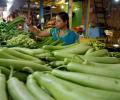
Not only primary vegetables, but also additives like garlic, ginger and chilly have recorded a sharp increase in prices
Eggs, meat and fish also became 13.36 per cent more expensive on an annual basis, while cereal prices were up 4.13 per cent.

The all-time high price of silver is Rs 75,000 a kg, recorded in April 2011.

Food inflation, as measured by Wholesale Price Index, stood at 9.13 per cent in the previous week.

In August, wholesale prices rose 3.74 per cent year-on-year.

Finance Minister Pranab Mukherjee termed the rise in food inflation as an area of 'grave concern'.
Prices of most commodities, barring wheat, continued to remain firm on an annual basis, as per Wholesale Price Index data released by the government in New Delhi.

The rate of price rise stood at 8.87 per cent in August, 2010.

Overall inflation, as measured on the basis of the Wholesale Price Index, has been revised to 9.04 per cent for March from the original projection of 8.98 per cent.

In separate petitions filed at the Telecom Disputes Settlement and Appellate Tribunal, ESPN Software India, MSM Discovery, Zee Turner and Star Den Media Services said the tariff suggested by the sectoral regulator was not commercially viable.

As per the official data released on Monday, inflation in food items was 9.94 per cent in March, as against 6.07 per cent in February.

Industry chamber Assocham on Monday said that 2011 may witness continuation of high inflationary pressures, a view contrary to the government that expects inflation to slow down to around 6 per cent by March next year.

RBI's unique focus on WPI inflation is misguided even as demand-driven factors have become relatively less important.

In its 'Asia Economic Alert', the banking and asset management behemoth also said that the Reserve Bank is likely to hike the short-term lending (repo) rate by 100 basis points in 2011 with the purpose of curbing inflationary pressure.

Ahead of the monetary policy review on May 3, Reserve Bank of India (RBI) Deputy Governor Shyamala Gopinath said inflation was a concern, mainly on account of the high prices of non-food manufacturing goods.
On an annual basis, prices of food articles went up by 8.19 per cent in July, which is lower than the 8.38 per cent inflation recorded in June.

The decline could also be attributed to the high inflation figure of 18.56 per cent for the corresponding year-ago period, a phenomenon dubbed the 'high base effect' in economic parlance.

RBI says food supply constraints to taper off only over time.
Headline inflation rose to 9.44 per cent in June on the back of rising prices of fuel and manufactured products, which may prompt the Reserve Bank to raise key rates again in its quarterly policy review later this month.
 © 2026 Rediff.com - Advertise with us - Disclaimer - Privacy Policy - Sitemap - Feedback - About us - Terms of use - Grievances