
WPI at 3-month high; surge in all broad categories; CPI at 2-month high.

Young investors could allocate in the proportion of 70:20:10 to equity, debt and gold.
The rupee appreciated 7 paise to 79.74 against the US dollar in early trade on Thursday as a positive trend in domestic equities supported the local unit. However, a strong American currency overseas and forex outflows restricted the rupee's gain, dealers said. At the interbank foreign exchange, the rupee opened at 79.72 against the American dollar, then went lower to trade at 79.74 against the greenback in early deals, registering a gain of 7 paise over the last close.

Bajaj Finserv was the top loser in the Sensex pack, shedding around 3 per cent, followed by Bajaj Auto, Bajaj Finance, L&T, Asian Paints, Dr Reddy's, ICICI Bank, HDFC Bank and RIL. NSE Nifty finished 101.45 points down at 14,929.50.

Inflation in onion continued to rule high at 42.22 per cent and in potato at 43.25 per cent.

Wholesale price inflation stood at 4.78 per cent in November. The consumer price index for agricultural labourer and rural labourers were 13.73 per cent and 13.51 per cent in October.

International Monetary Fund (IMF) chief economist Gita Gopinath has made a strong case for regulating cryptocurrencies, saying it will always be a challenge to ban them as they operate from offshore exchanges. Gopinath also suggested a global policy and co-ordinated action for regulating cryptocurrencies. "I think cryptocurrencies are a particular challenge for emerging markets. "It seems to be more attractive to adopt cryptocurrencies and assets in emerging economies than in advanced economies," she said while addressing an event organised by the National Council of Applied Economic Research (NCAER) on Wednesday.

India's annual rate of inflation, based on its monthly Wholesale Price Index, climbed to 6.01 per cent for the month of May 2014, as against 5.20 per cent for May and 4.58 per cent during the corresponding month of the previous year, which has set off alarm bells.

As per commerce and industry ministry data, food inflation fell to 4.91 per cent in March from 7.79 per cent in the previous month.

Inflation in food articles was at 0.87 per cent in April 2018, as against a deflation of 0.29 per cent in the preceding month.

A Kotak research report expects RBI to cuts rates by 50 basis points in the first half of 2019. RBI will announce its sixth bi-monthly monetary policy on February 7.
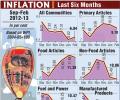
The wholesale price index, the main inflation indicator, rose an annual 6.84 per cent in February, higher than the 6.54 per cent rise estimated by analysts.

This increases expectations that RBI may cut rates later this month.

'The finance ministry and the RBI will never admit to the difficulties in the economy because if they do so, it will adversely impact the financial markets, etc.' 'They like to present a rosy picture that everything is fine and under control.'
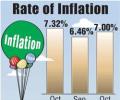
Food prices rose 18.19 per cent year-on-year in October, slower than an annual rise of 18.4 per cent in September.
Chief economic adviser to the finance ministry Arvind Virmani on Wednesday said the retail price-based inflation, which is ruling above the wholesale price index, will come down with a lag but would not fall as much as the rate of rise in wholesale prices is falling.

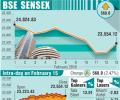
Stock market barometers Sensex and Nifty ended marginally higher on Monday as rise in wholesale inflation capped early gains despite a positive trend in global markets. The 30-share index settled 32.02 points or 0.05 per cent higher at 60,718.71 with half of its constituents ending in green. The broad based Nifty edged up 6.70 points or 0.04 per cent to close at 18,109.45.
The wholesale price-based inflation accelerated to a record high of 12.94 per cent in May, on rising prices of crude oil and manufactured goods. Low base effect also contributed to the spike in WPI inflation in May 2021. In May 2020, WPI inflation was at (-) 3.37 per cent. This is the fifth straight month of uptick seen in the wholesale price index (WPI)-based inflation. In April, 2021, WPI inflation hit double digit at 10.49 per cent. "The annual rate of inflation, based on monthly WPI, was 12.94 per cent for the month of May, 2021 (over May, 2020) as compared to (-) 3.37 per cent in May 2020.

Build up inflation rate in the financial year so far was 2 per cent compared to a build up rate of 4.56 per cent in the corresponding period of the previous year. Inflation in food articles as a group rose to 11.08 per cent during the month as against 9.80 per cent in the previous month, mainly driven by exorbitantly high onion prices, the rates of which spiked by over 172 per cent from a year-ago. The annual rate of inflation, based on monthly wholesale price index was at 0.16 per cent in October.
The government is working towards further review and simplification of the foreign direct investment (FDI) policy to facilitate the proposed initial public offering (IPO) of the Life Insurance Corporation (LIC), Department for Promotion of Industry and Internal Trade (DPIIT) secretary Anurag Jain said on Thursday. The final decision will be taken by the Cabinet. The industry department is working together with the finance ministry's department of financial services (DFS) and department of investment and public asset management (DIPAM) towards a successful listing of the life insurer on the domestic bourses, which is expected to be the largest in India.
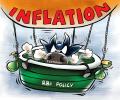
With pricing power of producers unlikely to strengthen and commodities ex-crude oil likely to remain sluggish in the immediate term, the core-WPI inflation may remain sub-zero in the rest of this calendar year.

The March Wholesale Price Index-based inflation was at (-) 0.85 per cent.
In November, wholesale prices, India's main inflation measure, rose 7.52 percent, their fastest pace in 14 months.

American brokerage BofA Securities on Friday said the Indian economy continues to be "weak", pointing to activity indicators tracked by it. On the positive side, the brokerage said credit demand is bottoming out and the real lending rates adjusted for wholesale price inflation are falling. It can be noted that there has been a slew of reports lately about a stronger recovery being underway after the jolt caused by the pandemic.
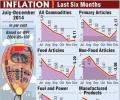
The wholesale price index rose 0.11 per cent year-on-year compared with a 0.6 per cent jump forecast by economists in a Reuters poll.

Unabated buying by domestic institutional investors and wholesale price inflation falling to 2.60 per cent in September, helped both the key indices to scale new highs.

The median forecast for wholesale price index-based inflation in the first quarter of 2010/11 is at 10.4 per cent, according to Reserve Bank of India's survey, higher than 9.5 per cent in the previous survey.

The wholesale price index inflation is projected at 6.4 per cent for 2017-18.

The excise duty cut will translate into a reduction of Rs 9.5 a litre on petrol and Rs 7 a litre in diesel after taking into account its impact on other levies.

India's macroeconomic situation is certainly better than what it was a year ago, eminent economist Pinaki Chakraborty said on Monday, while expressing hope that the country will be back on the path of economic growth if there is no major third wave of the COVID-19 pandemic. In an interview with PTI, Chakraborty, who is the director of the National Institute of Public Finance and Policy (NIPFP), said that inflation may remain at an elevated level as there was a significant fiscal and monetary expansion in the last 18 months. "The current macroeconomic situation is certainly much better than what it was one year back. We are seeing recovery in most sectors," he said. Chakraborty noted that COVID-19 vaccination has been going on at a very fast rate in India.

Emerging markets such as India have always run higher inflation rates than developed economies such as the US and countries of Western Europe. But for the first time in the past 30 years, the US reported a higher consumer price inflation (CPI) rate than India in five consecutive months. The US reported a CPI rate of 7.5 per cent in January 2022 against 6.01 per cent in India and analysts expect the trend to continue for at least a few months more

The country's gross domestic product (GDP) growth is likely to be 8.8 to 9 per cent in the current financial year, driven by agriculture and industry sectors, Care Ratings said in a report. The country's economy had contracted by 7.3 per cent in fiscal 2020-21. The agency said the outlook for the Indian economy on almost all counts in FY22 would look seemingly better than FY21 on account of the negative base effect.

Data on primary and fuel items would continue to be released on weekly basis.
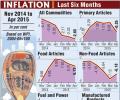
The deflationary trend has bolstered the case for a rate cut by RBI.

As per official data, retail price of sugar has gone up to Rs 47 a kg in New Delhi from Rs 22 a year-ago.
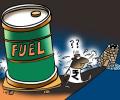
Inflation in food articles, fuel and power contracted in July.

Onion prices have been rising due to speculation amid anticipation of below normal monsoon despite sufficient supply in the country.

There was acceleration in prices of fuel and power (11.69 per cent) and manufactured products (2.55 per cent).

 © 2026 Rediff.com - Advertise with us - Disclaimer - Privacy Policy - Sitemap - Feedback - About us - Terms of use - Grievances