
The Indian economy has recovered 'handsomely' from the pandemic-induced disruptions, former Niti Aayog vice chairman Arvind Panagariya said on Tuesday, while expressing hope that the recovery will be sustained and the growth rate of 7 to 8 per cent will be restored. Panagariya suggested that the government must now signal its intention to wind down fiscal deficit by cutting it by half-to-one percentage point in 2022-23. "The Indian economy has recovered handsomely, returning to its pre-COVID GDP... "Only private consumption is still below its pre-COVID-19 level," the eminent economist told PTI in an interview.
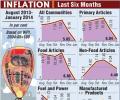
This is the second straight month of decline in wholesale price based inflation.

During the week, prices of fish marine were dearer by 10 per cent, arhar, fruit and vegetables by 2 per cent each while urad and moong rose by 1 per cent each.
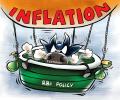
Inflation in food articles basket was 6.99 per cent In May, 2019, down from 7.37 per cent in April. However, onion prices spiked in May with inflation at 15.89 per cent, as against (-) 3.43 per cent in April.

In the current fiscal so far, retail inflation stabilised around 5 per cent, while wholesale price-based inflation averaged around 2.9 per cent during April-December.
Inflation based on the wholesale price index moved up to 4.54 per cent for the week ended November 26 from 4.32 per cent in the previous week, according to data released by the government on Friday.

The projects - Delhi-Varanasi, Mumbai-Nagpur, Delhi-Ahmedabad, Chennai-Mysore, Delhi-Amritsar, Mumbai-Hyderabad, and Varanasi-Howrah - are expected to cost around Rs 10 trillion.

The wholesale price inflation was negative for 10 weeks in a row, but retail prices of items consumed by people in villages rose at the rate of nearly 13 per cent in the month of July.

We have not suffered such huge price shocks across so many basic commodities, at the same time, in decades. Has the inflationary impact of all this been factored into stock prices as yet, asks Debashis Basu.

ITC was the top loser in the Sensex pack, shedding 1.97 per cent, followed by Tata Steel 1.80 per cent, HUL 1.57 per cent, Vedanta 1.44 per cent, Bharti Airtel 1.37 per cent and M&M 1.35 per cent.
Even as the government grapples with a surge in prices, a three-year old initiative to recast the index that measures wholesale prices is not getting anywhere fast. The revised index is likely to take at least another year to implement and may spill over into the tenure of the next government.
Fruits and vegetables, pulses, eggs meat and fish got expensive during the period, while some manufactured food articles like atta, maida got cheaper. Among other manufactured items, prices of cement, lead ingot and some basic heavy inorganic chemicals got dearer.
Inflation based on the wholesale-price-index was unchanged at 3.5 per cent for the week ended December 29, 2007.
The good news on inflation continues as the wholesale price index fell for the tenth week in a row to an almost 11-month low of 5.24 per cent for the week ended January 3, prompting the Finance Ministry to project that it would go down to 3-4 per cent by March 31.

Potato, a daily consumable vegetable, witnessed maximum inflationary pressure at 60.58 per cent
Wholesale prices-based inflation rate rose to a ten-month high of 5.02 per cent for the week ended February 23, as food and some manufactured products turned costly. Inflation rate for the previous week was at 4.89 per cent and was last above five per cent on May 19, 2007 (5.06 per cent).

Top gainers in the Sensex pack included ICICI Bank, Infosys, Bajaj Finance and HDFC Bank, rising up to 2.67 per cent.

'The robust tax collections give the finance minister a fair amount of headroom for an expansionary fiscal policy.'

There is no direct impact of the Russia-Ukraine crisis on India in terms of bilateral trade but a surge in oil prices poses considerable risk to the economy, an analyst report said on Friday. International oil prices which have surged past $100 per barrel "pose risks to external stability and currency movement," a Bank of Baroda Economics Research report said. Russia has launched military operations against Ukraine, stoking fears of significant disruption in the region, including loss of life. The West is ramping up financial sanctions against Russia and support for Ukraine.
The finance ministry has proposed that services should be included in the widely tracked wholesale price-based inflation index to reflect true picture of price changes in the economy.

Price of potato, a daily consumable vegetable, rose 58.78 per cent during the month
Inflation remained unchanged at the previous week's level of 5.16 per cent for the week ended October 7
Inflation rose to 5.32 per cent for the week ended December 9, from 5.16 per cent in the previous week mainly due to increase in prices of some food articles including vegetables.
Inflation crossed five per cent mark to touch 5.16 per cent for the week ended September 30 from 4.77 per cent in the previous week mainly due to increase in the prices of energy, food and manufactured items.
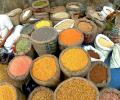
The government on Monday exempted importers of pulses from stock limits, and also relaxed the norms for millers and wholesalers, in view of softening of prices of the key pulses in the country. Now, the stock limits will be applicable only on tur, urad, gram and masoor for a period up to October 31, it said. However, these entities will continue to declare their stocks on the web portal of the Department of Consumer Affairs, it added. A revised order in this regard has been notified.
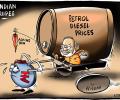
The Union government has collected Rs 94,181 crore through levy of excise duty on petrol and diesel in the first three months of the current fiscal on the back of a record tax on fuel that yielded 88 per cent higher revenue the previous financial year, the Lok Sabha was informed on Monday. Excise duty on petrol was hiked from Rs 19.98 per litre to Rs 32.9 last year to recoup gain arising from international oil prices plunging to multi-year low as pandemic gulped demand. The same on diesel was raised to Rs 31.8 from Rs 15.83 a litre, according to a written reply by Minister of State for Petroleum and Natural Gas Rameswar Teli in the Lok Sabha. This led to excise collections on petrol and diesel jumping to Rs 3.35 lakh crore in 2020-21 (April 2020 to March 2021), from Rs 1.78 lakh crore a year back, he said.
Inflation declined marginally to 4.91 per cent for the week ended August 19 from 4.92 per cent in the previous week despite increase in prices of minerals, food and manufactured items.
Inflation declined marginally to 4.61 per cent for the week ended July 29, from 4.67 per cent in the previous week mainly due to cheaper food items, including milk.
Inflation fails marginally to 4.52 per cent for the week ended July 15 from the 4.68 per cent in the previous week, despite increase in prices of vegetables, some edible oils and metals.
Inflation declined to 4.68 per cent for the week ended July 8, from 4.96 per cent in the previous week mainly due to cheaper fruits, vegetables, pulses and milk.
Inflation rose to 3.55 per cent for the week ended April 15, from 3.24 per cent in the previous week mainly due to costlier manufactured and non-food items.
Wholesale price rise slowed down to 3.51 per cent for the week ended April 1 even though essential items like vegetables; industrial fuels and some manufactured products became costlier.
Inflation fell to 4.06 per cent for the week ended March 18 as against 4.28 per cent in the preceding week, mainly due to cheaper food articles including vegetables and non-food items.
Inflation declined to 5.16 per cent for the week ended December 2 from 5.30 per cent in the previous week mainly due to a fall in the prices of fuel and food items.
Inflation rose to 4.77 per cent for the week ended September 23 from 4.56 per cent in the previous week, mainly due to spurt in prices of pulses, wheat and iron ore.
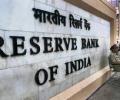
Inflation, remained in negative territory for the 7th month in May

Nirmala Sitharaman is proving to be a better finance minister than her initial rookie status might have led people to expect, observes T N Ninan.
Inflation further rose to 4.74 per cent for the week ended May 20 from 4.32 per cent in the previous week mainly due to increase in the prices of food, non-food, minerals and some manufactured items.
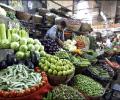
Inflation, as measured on the Wholesale Price Index (WPI), has been in the negative zone since November 2014.

Inflation print for food articles, as a basket, remained nearly flat at 7.47 per cent during the month.
 © 2026 Rediff.com - Advertise with us - Disclaimer - Privacy Policy - Sitemap - Feedback - About us - Terms of use - Grievances