
The volume of shares traded in the stock market had fallen 28 per cent in April. Turnover, or the value of securities changing hands, fell 12.6 per cent. This trend of falling volumes seems to have stabilised in May.

Experts find it difficult to predict a bottom for the bourses.

Renewed buying interest in late trades on hopes of BJP-led NDA win pushed indices to record closing highs.
Markets rebounded to end marginally higher on value buying at lower levels.
Markets ended at fresh all-time closing highs, led by aggresive buying in capital goods and bank shares.

Markets
Realty, consumer durables, capital goods lead losses, Broader markets underperform.

After the Franklin Templeton episode, investor confidence has been shaken. Known brands have become more relevant to investors, as long as this psychological impact lasts.

While Greece may well hang on through its next handout or two, it is hard to see how it can survive in the euro.
Both indices are down nearly 9 per cent from their all-time highs in mid-January. A sharp reversal seems difficult this time as the peak impact of the virus is yet to play out.

Analysts attribute this volatility to selling by FPIs and FIIs.

Market sources said other brokerages are also looking to streamline their business models as market volatility, along with increasing competition, has taken a toll on earning yields.
Market experts predict that the equity markets are likely to remain volatile for the rest of the year.

Nifty advanced 46 points, at 5,833.

Other markets in Asia also ended in higher except Japan which closed flat due to uncertainty over the nuclear plant and economic recovery.

Nifty continued to register successive new highs as it crossed the 9,200 mark on Friday

In the Sensex pack, Sun Pharma was the biggest gainer, rallying 4.48 per cent, followed by Bajaj Auto, Tata Motors, Coal India, Hero MotoCorp, Maruti and HCL Tech, rising up to 3.01 per cent. While, RIL, PowerGrid, HDFC, L&T, IndusInd Bank, NTPC and Bajaj Finance declined up to 1.50 per cent.

Running a SIP plan for more than six years almost completely eliminates the chances of earning negative returns.

'People always short-change the resilience of the economy.'

The Nifty closed at 10,335.30, down 28.35 points, or 0.27 per cent.

If you ignore market upheavals and stay the course, you end up making money, says Larissa Fernand
The 50-issue NSE Nifty in range-bound movements settled higher by 59.15 points, or 0.58 per cent, at 10,252.10.

Banking stocks dipped with Nifty PSU Bank index falling 1.7% after the government notified the ordinance that seeks to tackle non-performing loans in the sector.

The rupee has lost ground since pre-Budget, against three major hard currencies (yen, dollar and euro). The European Central Bank and the Bank of Japan maintained status quo in recent policy meetings

For a while, it seemed the markets were going on a free fall.

Extending losses for 7th session, Nifty fell below the 8,000 mark for the first time since Nov 25

It is too early to judge if the fall in Nifty from an all-time high of 11,170 to February 12 closing of 10,539 is a big trend reversal or merely a short-term correction, says Devangshu Datta.

The British pound was down nearly 9 per cent in early morning trade.
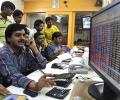
Brokers have asked for a longer session on poll result day and an additional one on May 17

The focus is on corporate results at one level but global news will also have an impact

'Global investors expect the rupee to be more vulnerable in the downturns in the future than ever before,' notes Apoorva Javadekar.

Foreign portfolio investors have been net positive since the Union Budget

The market has zoomed to new highs for calendar 2017.

Q3 results have been poor but better than extremely low expectations.

It was a case of 'buy on hopes and sell on news' as the Indian market posted only modest gains despite a landslide victory to Narendra Modi-led Bharatiya Janata Party (BJP).

The market is moving up because there is a high degree of speculative retail and operator action. This is rarely a situation sustainable for any lengthy period, says Devangshu Datta.


Textile and telecom shares have gained ahead of the Cabinet meet later today which is likely to announce new measures for both the sectors.

The market is clinging to support above the 8,000 mark and hitting resistance above 8,150.
'This looks like a long-term bear market and there could be mounting losses in the near-term,' says Devangshu Datta.
 © 2026 Rediff.com - Advertise with us - Disclaimer - Privacy Policy - Sitemap - Feedback - About us - Terms of use - Grievances