
Indian benchmark stock indices Sensex and Nifty rallied for the second consecutive day, closing nearly 1 per cent higher, driven by gains in metal and auto sectors and positive global market trends.

Stock markets rebounded on Friday with the benchmark Sensex closing higher by 316 points after heavy buying in banking and metal shares amid optimism over trade deal progresses and India's participation in Pax Silica.

The BSE Sensex plummeted 1,236 points, wiping out nearly Rs 7 lakh crore in investor wealth, driven by escalating tensions between the US and Iran and subsequent market selloff.

Indian benchmark equity indices Sensex and Nifty experienced a significant crash in early trade, triggered by a sharp increase in crude oil prices and escalating tensions in the Middle East.

The latest spike in the Vix is a sign that investors are visibly rattled by global developments and fear a further drawdown in stock prices, experts said.

Among the Sensex constituents, Eternal, Tata Steel, Kotak Mahindra Bank, UltraTech Cement, Maruti Suzuki India, Sun Pharmaceuticals, Tech Mahindra, HDFC Bank, Tata Motors Passenger Vehicles, Infosys, Trent, Mahindra & Mahindra, Reliance Industries and HCL Technologies were the gainers. However, Asian Paints, Bharti Airtel, Bajaj Finance, PowerGrid, Axis Bank, ICICI Bank and Titan were among the laggards.

'Despite the current uncertainties, the long-term outlook remains constructive due to strong fundamentals, government initiatives, and a stable banking sector.'

Under its new chairman Tuhin Kanta Pandey, the Securities and Exchange Board of India (Sebi) has gravitated towards greater transparency and ease of doing business, setting an objective of "effective and optimum" regulation. On Monday, during its first board meeting under Pandey, the regulator has decided to constitute a high-level committee (HLC) to review conflicts of interest and unveiled initiatives to simplify regulatory processes.

National Stock Exchange on Monday announced the launch of India VIX, a volatility index being disseminated on a real-time basis for the first time.

Mumbai -- home to industry titans and Bollywood stars -- is witnessing a slow offtake of houses priced between Rs 10 crore and Rs 50 crore. Industry insiders and real estate watchers explain why.

Market chatter suggests that the BJP could win fewer than 300.

The National Stock Exchange has launched a volatility index reflecting the market's expectation of volatility over the near term, which is the next 30 day period. From the best bid-ask price of Nifty 50 Options contracts, a volatility figure (percentage) is calculated, which indicates the expected market volatility over the next 30 days. Higher the implied volatility, higher the India VIX. Implied volatility refers to the implied risks associated with the stock markets.

'Market corrections are a natural part of investing, so it's essential to remain focused on long-term financial goals.'

From the Sensex basket, Asian Paints, Sun Pharma, HDFC Bank, Tata Consultancy Services, Axis Bank, Tata Steel, JSW Steel, Larsen & Toubro, ICICI Bank and Power Grid were the major gainers. Tata Motors dropped over 8 per cent despite reporting over three-fold jump in consolidated net profit at Rs 17,528.59 crore for the fourth quarter ended March 31, 2024. NTPC, Bharti Airtel, Titan, State Bank of India and Nestle were the other major laggards.

'The economy is clearly at a very soft spot, and earnings growth is disappointing every day.' 'After three great years, the Indian economy has hit a rough patch.'

On a five-day rolling basis, FPI selling is the highest in 24 years.

'It is advisable to stay away from the markets for now and buy only on a dip.'

Investors' wealth jumped Rs 13.78 lakh crore on Monday as the benchmark equity index Sensex hit its lifetime high after exit polls predicted a massive win for the BJP-led NDA in the Lok Sabha polls. The 30-share BSE Sensex jumped 2,777.58 points or 3.75 per cent to hit a record peak of 76,738.89 in early trade. The benchmark finally ended at 76,468.78, registering a sharp rally of 2,507.47 points or 3.39 per cent.

Overall market reaction to the Budget was neutral. Investors absorbed the changes to the tax rates (positive for salaried class) and capital gains taxes (CGTs, negative due to the removal of indexation and increases. Other proposals largely pertain to supporting rural development, buybacks taxed as dividends, Custom duty changes that impact multiple sectors, higher outlays for clean energy, etc. There's some moderation in the growth of capex outlay across defence, fer

Foreign portfolio investors (FPI) have pulled out $3.5 billion from India's equity markets so far this month. The selling comes on the back of election-induced volatility and the rotation of flows from India to China, where stocks are available at half the valuations. If the selling pressure remains at the current level, this will be the highest FPI pullout since January 2023.

The Indian equity market valuation has been moving in tandem with the US 10-year treasury yield. While the benchmark US bond yield has witnessed a nearly 70 basis point decline since the end of October this year, dropping from 4.93 per cent to 4.23 per cent on Friday, the Sensex earnings yield has slipped by nearly 45 basis points - from 4.5 per cent to 4.05 per cent. Previously, Indian equities' earnings yields rose in sync with the US bond yields.

'If the NDA comes to power with 320-330 plus seats, then we could see some correction. We could possibly see a level of 19,500 to 20,000.' 'If the NDA comes to power with a majority of 400-plus, we could see the markets going to about 23,500-24,000 levels.' 'And from there we could see some correction because markets are expensive at this point of time and a correction is overdue.'

'Investors need to be stock specific and should not rush to buy stocks at the current levels.'

'We emphasise the importance of not basing investment decisions solely on electoral outcomes.' 'Instead, focusing on investing in high-quality businesses capable of prospering regardless of the political landscape is paramount.'

VIX is meant to indicate investors' perception of the annual market volatility over the next 30 calendar days. The higher the value, the higher is the expected volatility and vice versa. VIX touched its historical peak of 85.13 on November 17, 2008, in the aftermath of the collapse of Lehman Brothers. In the past five years, it has stayed below 30.

'Indian markets may initially react and follow the pattern of US and other global markets post US elections.'

'We are not entirely out of the woods.' 'The broader trajectory remains tentative.' 'However, we may expect some near-term bounce.'

Historically, March has been a volatile month for Indian equity markets. To begin with, it marks the end of a financial year, wherein there is some compulsive portfolio rebalancing trade by large funds - domestic and foreign. Retail investors, too, prefer to 'cash in' on their gains and losses before the financial year runs out.

The RBI's financial stability report has on Wednesday highlighted the disconnect between the real economy and equity market yet again. The central bank observed that Indian equities were trading at rich valuations, with several metrics such as price to earnings multiples, price to book ratio, market cap to GDP and the cyclically adjusted P/E ratio, or Shiller P/E, at above historical averages. For instance, as on December 13, the one-year forward P/E ratio for India was 35.1 per cent, above its 10-year average, and one of the highest in the world.

According to a report by BofA-ML, capital markets are 'usually jittery prior to the declaration of election results as it is uncertain about the outcome'.

Sundararaman Ramamurthy has been an interesting choice for the publicly-listed BSE, which has seen its chief move to bigger rival -- the National Stock Exchange (NSE) -- in July. Having spent nearly two decades at the country's largest bourse, Ramamurthy is among the early architects of NSE and understands all the cogs of the exchange wheel like only a few others in the country. Just like NSE's core team, which includes its founder RH Patil, the 59-year-old Ramamurthy has worked at the Industrial Development Bank of India (IDBI) before moving to NSE in 1995.

According to experts, the Nifty has continued to form lower top-lower bottom formations, a trend seen in the last five weeks, and witnessed sharp selling towards 9,700 zones.

Expect heightened volatility and stress to hit the markets. Caution may be the need of the hour, alerts Akash Prakash.

Options data indicates that markets will experience extreme volatility till a clear trend on election results emerges
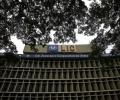
The government may have to rework the valuation of Life Insurance Corporation of India (LIC) for its initial public offering (IPO) if the listing is pushed beyond May, an official said. The current embedded value of LIC, pegged at Rs 5.4 trillion as of September 30 and for the six-month period ended September, will have to be re-evaluated if the issue is pushed beyond May 12, as approved by the Securities and Exchange Board of India (Sebi). This would impact the market value of LIC, that is currently being internally estimated at 3-4 times of the embedded value.

ICICI Bank was the top gainer in the Sensex pack, rising over 2 per cent, followed by Axis Bank, Infosys, HDFC twins, Bajaj Finserv and SBI. On the other hand, ITC, ONGC, Sun Pharma, Bharti Airtel and Titan were among the laggards.
India VIX has been mirroring the CBOE Volatility Index.
'The correction could take two to three months and traders need to be careful.' 'For investors, this could be a good time to nibble in.'

Since the Budget announcement on July 5, FIIs have been busy unloading their stock.

A majority of economists predicted RBI Governor Raghuram Rajan would leave policy rates unchanged on Tuesday and expected a dovish commentary, as crude oil prices and inflation cool off.
 © 2026 Rediff.com - Advertise with us - Disclaimer - Privacy Policy - Sitemap - Feedback - About us - Terms of use - Grievances