
Lal Salaam is not a movie A Ganesh Nadar would recommend.

Uttam Ghosh and Dominic Xavier offer their respective takes on the Modi Sarkar's decision to hike cooking gas LPG prices.

The ongoing weakness in the broader equity market is likely to weigh on primary market investor participation ahead, which has already begun showing signs of fatigue, analysts said. The spillover effect, they say, will continue as long as the midcap and smallcap segments remain volatile. "The effect will be felt in the IPO market. The subscription levels have come down in the last few days and recent 4-5 IPOs have not done well.

Foreign Portfolio Investors (FPIs) selling spree continued as they dumped Indian equity worth over Rs 5,800 crore this month so far on rising interest rates and geopolitical tensions in the Middle East. This came after such investors withdrew Rs 24,548 crore in October and Rs 14,767 crore in September, data with the depositories showed. Before the outflow, FPIs were incessantly buying Indian equities in the last six months from March to August and brought in Rs 1.74 lakh crore during the period.
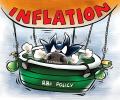
The Reserve Bank on Friday retained its inflation projection for current fiscal year at 6.7 per cent amid global geopolitical developments triggered by Russia-Ukraine war. RBI Governor Shaktikanta Das said the impact of inflation globally is weighing heavily on the domestic market. For September quarter of 2022-23, RBI projected retail inflation at 7.1 per cent.
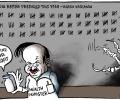
Uttam Ghosh offers his take on Health Minister Harsh Vardhan's statement that India is better prepared in 2021 to handle COVID-19.

Domestic equity markets, which are at record high levels, will be driven by quarterly earnings, global trends and foreign fund movement, analysts said. The movement of rupee and global oil benchmark Brent crude will also be tracked by investors. "The direction of global stock markets, fluctuations in the rupee-to-dollar exchange rate, and movement in crude oil prices will all play a crucial role in influencing the overall market trend.

The country's current account deficit widened to 4.4 per cent of the GDP in the quarter ended September, from 2.2 per cent GDP during the April-June period, due to higher trade gap, as per data released by the Reserve Bank on Thursday. "India's current account balance recorded a deficit of $36.4 billion (4.4 per cent of GDP) in Q2:2022-23, up from $18.2 billion (2.2 per cent of GDP) in Q1:2022-23 and a deficit of $9.7 billion (1.3 per cent of GDP) a year ago [i.e., Q2:2021-22]," the RBI said.

The US Federal Reserve's interest rate decision, global market trends and trading activity of foreign investors are the major factors that would dictate terms in the equity markets in a holiday-shortened week ahead, analysts said. Equity markets will remain closed on Tuesday on account of Ganesh Chaturthi. From the global front, interest rate decisions from the Bank of England and Bank of Japan would also influence market trends.

Uttam Ghosh offers his take on the weekend's whirlwind political developments in Punjab.

Banks are likely to see their net interest margins (NIM) - broadly the difference between interest earned on loans and paid on deposits - shrink by another 30 basis points (bps) over the next few quarters. After hitting a peak of 3.3 per cent in the third quarter (Q3) of the financial year ended March 31, 2023 (FY23), NIMs have been on a downward trajectory, touching 3.13 per cent in Q2FY24 on higher cost of funds, according to capital markets firm CARE Ratings. Banks are still grappling with the Reserve Bank of India's policy rate increases - that have made deposits costlier as the interest payable to customers has increased - and the regulatory actions on unsecured lending.

Uttam Ghosh offers his take on the current state of Indian democracy.

Analysts and economists have hailed the fiscal projections in the interim Budget, saying the lower fiscal deficit forecast shows that the government, even in an election year, is serious about fiscal consolidation and that the numbers look achievable. According to Devendra Kumar Pant, the chief economist at India Ratings, the two broad themes of the interim Budget are fiscal consolidation and stepping up focus on agriculture/rural to course correct, to some extent, the differential benefits of the ongoing economic growth that's tilted in favour of upper-income bracket/urban households. The projected fiscal deficit numbers for FY24 and FY25 suggest that the government is serious about achieving the fiscal consolidation path of 4.5 per cent fiscal deficit by FY26, and given the nominal GDP growth assumption and revenue buoyancy, the target appears plausible, Pant said in a note.

GST collections rose 28 per cent to Rs 1.49 lakh crore on an annual basis in July on the back of economic recovery and measures taken to curb tax evasion, the government said on Monday. In July, 2021, Goods and Services Tax (GST) collections stood at Rs 116,393 crore. The collections in July this year is the second highest since the introduction of GST in July 2017, the ministry said in a statement.

A buoyant equity market, coupled with an improved performance of mutual funds (MFs) on the returns chart, has heightened retail investors' appetite for equities. In the past few months, equity MF schemes have seen a surge in fresh investments through both lump sum (one-time investments) and systematic investment plan (SIP) routes. During the August-September 2023 period, equity MF schemes recorded net lump sum investments of Rs 35,270 crore, compared to just Rs 5,550 crore in the previous three months, according to data from the Association of Mutual Funds in India (Amfi).

Average housing prices have increased in the range of 13-33 per cent in the last three years across seven major cities on high demand, according to real estate consultant Anarock. Hyderabad's Gachibowli recorded the highest 33 per cent increase in average residential prices in the past three years. In Gachibowli, the average residential prices as of October 2023-end stood at Rs 6,355 per square feet as against Rs 4,790 per square feet in October 2020.

India and the US have settled the last trade dispute at the World Trade Organization (WTO) over poultry products, according to a joint statement released on Friday. With this, the two countries have mutually resolved all the seven pending trade disputes at the WTO. "The leaders lauded the settlement of the seventh and last outstanding WTO dispute between India and the United States.

Benchmark indices ended lower on Wednesday, halting their eight days of rally, ahead of the US Federal Reserve's interest rate decision and mixed global market trends. Also, fall in index majors Reliance Industries, Tata Consultancy Services, Infosys and Larsen & Toubro added to the weak trend in equities. The 30-share BSE Sensex declined 161.41 points or 0.26 per cent to settle at 61,193.30.

The number of frauds in the banking sector during the first half of the current financial year has increased substantially to 14,483 cases, although the amount involved is only 14.9 per cent of the previous year's amount, according to a RBI report. The report on Trend and Progress of Banking in India 2022-23, underlined the need to protect the banking system and the payments system from the risks of fraud and data breaches emanating from cyber threats. As many as 14,483 frauds were reported involving an amount of Rs 2,642 crore in the first half of current financial year, as compared to 5,396 cases (Rs 17,685 crore) in the same period a year ago.

India may be 15th among the top 25 Artificial Intelligence nations, but it has the 'the greatest upward potential' according to research by Tufts University's business school, the Fletcher School. At the top is the US, followed by China, fighting for global leadership in AI followed by the UK, Japan, and Germany. In the 15th spot, India is ahead of Brazil, Argentina, Indonesia, Mexico, Turkey, Indonesia and Thailand.

Bankers said the outlook of M&As in India in 2024, especially in the second half after the Lok Sabha election, seems relatively better.

The Competition Commission of India has introduced draft regulations for combinations or mergers, under the new competition Act, to bring global deals in the digital space, including those involving Big Tech companies, under its scanner. The draft regulations would provide guidance on the valuation of merger transactions and the criteria for assessing sustainable operations in India for companies. The proposed rules mention that if the number of users and subscribers, or the turnover or gross merchandise value in India is over 10 per cent of the global figure, the company would be considered to have substantial business operation in India and would need CCI approval for the merger.

Uttam Ghosh offers his take on Sidhu's latest drama.

RBI's exercise will take into account standards of governance, the viability of the payment bank (PB) business model, and changes, if any, if needed.

Everyone (with some exceptions) whose estimated tax liability is Rs 10,000 or more in a financial year must pay advance tax.

Wealthy Indians are adding new residential addresses to their assets, many of them in Dubai. The quality of life in the desert city is comparable to any coveted city in the world. Its property market is regulated to protect investors' interests.

The Union government on Friday said it would not notify the fact checking unit (FCU) contemplated under the amended information technology (IT) rules against fake news till the Bombay high court delivers its judgment on the petitions challenging the amendments.


rediffGURU Anu Krishna tells you how to deal with your emotions in a positive way during the festive season.

Uttam Ghosh offers his take on the renaming of the Sardar Vallabhbhai Patel stadium in Ahmedabad to the Narendra Modi stadium.

Retail investors now own a bigger slice of smallcap companies than at the start of 2023-24 (FY24), underscoring their growing conviction about investing in this red-hot space. Data from Capitaline shows mutual funds' (MFs') average holding in the National Stock Exchange Nifty Smallcap 250 rising to 9.26 per cent from 8.67 per cent during the first six months of FY24, with the number of companies with over 20 per cent MF holdings increasing from 24 to 28. In comparison, MF holdings in Nifty50 companies have gone up only marginally, from 9.67 per cent to 9.75 per cent.

Co-lending deals between non-banking financial companies (NBFCs) and banks are likely to rise after the Reserve Bank of India's (RBI's) decision to increase the risk weight on consumer credit, industry leaders and experts say. Smaller NBFCs, they add, may increasingly opt for co-lending as capital markets could become costlier for them. "Smaller NBFCs will be more comfortable with co-lending because they are geography-specific in terms of industry or customers.

India's outward Foreign Direct Investment (FDI) nosedived to $11.12 billion in January-June (H1 2023) from $23.57 billion in the same period last year, indicative of the slowdown in the global economy, according to the Reserve Bank of India (RBI) data. The outward FDI expressed as the total financial commitment, has three components, namely equity, loan and guarantees. The sharp contraction in the commitments (outward FDI) was prominent in the April-June 2023 period.

Among the Sensex firms, ITC, State Bank of India, Bajaj Finance, NTPC, Power Grid, ICICI Bank, Kotak Mahindra Bank and UltraTech Cement were the major laggards. IndusInd Bank, Tata Consultancy Services, Axis Bank, Mahindra & Mahindra, Tata Motors, HCL Technologies, Asian Paints, Wipro, HDFC and Maruti were among the major gainers.
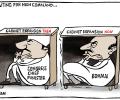
Uttam Ghosh offers his take on a strange regurgitation of history.

Profits of India's top listed companies have been growing at a faster pace than those of their American peers, but when it comes to revenue growth, the order has reversed recently. The combined net profit of the S&P 500 companies was up 14.1 per cent year-on-year (Y-o-Y) during the trailing 12 months (TTM) ended December 2023, as against 17.4 per cent profit growth logged by the BSE 500 companies in the same period. This is the second consecutive year of faster profit growth for the BSE 500 companies.

Funds raised by India Inc. through offshore loan syndication hit a 15-year high in 2023 with companies and banks raising $21.4 billion, the highest since 2007. The momentum is expected to continue in 2024 as well with over $4 billion fund raising expected in the first three months of this year. Companies raise funds, both onshore and offshore, depending on interest rates and activities. Funds raised offshore can be deployed in overseas activities.

The blast at The Rameshwaram Caf has caused distress and concern among the startup and information technology (IT) community, raising questions related to safety and security. Approximately 10 people were reportedly injured in a low-intensity bomb blast at The Rameshwaram Caf, a popular restaurant in Bengaluru's Brookfield. The surrounding area is a major hub for the Indian technology (tech) industry, housing many startups and top IT companies such as IBM, SAP, Accenture, International Tech Park Bangalore, and Prestige Technostar.

Fresh formal job creation cooled for the second consecutive month to decline to a six-month low in September, signalling a downturn in the labour markets this financial year. The number of new monthly subscribers under the Employees' Provident Fund (EPF) declined by 6.45 per cent to 891,583 in September from 953,092 in August, shows the latest payroll data released by the Employees' Provident Fund Organisation (EPFO). Besides, the net payroll additions -- calculated by taking into account the number of new subscribers, the number of exits, and the return of old subscribers -- increased by 14.9 per cent to 1.72 million in September from 1.49 million in August.
