
After a brutal selloff since October, foreign portfolio investor (FPI) flows for the year-to-date (YTD) in 2024 have turned negative. In early September, YTD FPI investments peaked at a record Rs 22,000 crore ($2.6 billion). This wave of selling has also pulled down benchmark indices, with the Nifty's YTD returns declining to 11 per cent from their high of 21 per cent in September.

The gross GST collection increased 8 per cent to Rs 1.74 lakh crore in June, sources said on Monday. The government, however, has discontinued the official release of monthly GST collection data, they added. Sources said the gross Goods and Services Tax (GST) collection so far this fiscal (April-June) stood at Rs 5.57 lakh crore.

With India overtaking China in terms of weightage in the Morgan Stanley emerging markets IMI, Indian equities could see inflows of about $4.5 billion (Rs 37,000 crore), according to estimates. This week, Morgan Stanley announced that India has overtaken China in the MSCI Emerging Markets Investable Market Index (MSCI EM IMI). The weight of India in MSCI EM IMI stood at 22.27 per cent compared to 21.58 per cent of China.

Credit card spending reached Rs 2 trillion in October, a 14.5 per cent rise from September, largely driven by festival season purchases. However, the volume of outstanding credit cards increased only marginally during the same period. The spike in spending comes at a time when nearly all major credit card issuers are calibrating their growth in the segment due to visible signs of stress.

While liquidity in the banking system has turned surplus in the last few weeks, it could go back to deficit again, mainly due to corporate advance tax outflows. The net liquidity surplus of the banking system rose to touch Rs 1 trillion on Tuesday on the back of government spending, according to the data released by the Reserve Bank of India.

The removal of the angel tax is expected to be a boost for startups as it will help in promoting a more conducive environment for them.

Notably, the case was registered 19 days after the Madhya Pradesh high court ordered the police to dispose of the woman's complaint within 90 days after she alleged inaction by the police.

Retail inflation eased to a one-year low of 4.75 per cent in May as prices of some kitchen items declined marginally, according to government data released on Wednesday. The Consumer Price Index (CPI) based retail inflation was 4.83 per cent in April 2024 and 4.31 per cent in May 2023 (previous low).

rediffGURU T S Khurana answers readers' personal income tax queries.

Public sector banks (PSBs) have proposed the Finance Ministry their plan to raise Rs 54,800 crore through Additional Tier-1 (AT-1) and Tier-2 bonds in the current financial year (FY25), 37 per cent more than the Rs 39,880 crore raised in FY24

According to IRDAI, Marsh India had held the premium received from the clients in an Insurance Bank Account for more than 15 days and did not remit the premium to the insurer/reinsurer within the time limit of 15 days.

When investing in fixed-income products, balancing considerations like safety, liquidity, and income is essential.

The Union Budget 2025-26, while promising a new framework for smoother mergers and acquisitions (M&As), has plugged a major loophole on carry-forward losses for a total of eight assessment years between amalgamating company and amalgamated company from the date of loss instead of date of the merger. For all mergers effected on or after April 1, 2025, the losses can be carried forward only for the residuary period (counting from the date of loss).

Union Finance Minister Nirmala Sitharaman's call for making lending rates affordable may not resonate anytime soon as banks still struggle with margin compression, and await clues from the Reserve Bank of India (RBI) on liquidity and rate action. Hinting that any lending rate cut was some time away, State Bank of India (SBI) managing director Vinay M Tonse said there was still some aggression in the market regarding deposit pricing.

The gig economy market is expected to grow at a compound annual growth rate (CAGR) of 17 per cent to reach a gross volume of $455 billion by the end of 2024, according to a white paper by The Forum for Progressive Gig Workers. Estimates suggest the gig economy has the potential to create 90 million jobs and add 1.25 per cent to India's GDP (gross domestic product) over time.

Alternative investment funds (AIFs) have crossed Rs 5 trillion in terms of funds raised, while the investment commitments have surpassed Rs 12 trillion for the first time as of September, according to data released by the Securities and Exchange Board of India (Sebi).

The Fintech Association for Consumer Empowerment (FACE), the only self-regulatory organisation for financial technology/fintech (SRO-FT) companies, is aiming to secure membership from at least 75 per cent of players across all key fintech categories within the next three years, according to a senior executive. The total number of members in the organisation has increased to 110, up from around 60 when it received approval from the Reserve Bank of India (RBI) to operate as an SRO-FT in August.

Donald Trump's Presidency of the United States will open new opportunities for India though certain sectors, especially pharma and IT, may face the heat if the incoming president decides to impose restrictions on imports and H1B visa regulations, experts said on Wednesday. Prime Minister Narendra Modi's friendly relationship with Trump will have a positive bearing on Indo-US relations but India may have to adapt its strategies to maintain cooperation in areas of mutual interest.

The equity market's recent downturn appears unlikely to slow the brisk pace of mutual fund (MF) scheme launches, at least in the coming weeks. Last month, fund houses introduced 21 new equity schemes, with another five launches already lined up for November. The number of filing with markets regulator, Securities and Exchange Board of India (Sebi), suggests this momentum will continue with asset management companies (AMCs) seeking approval for 21 more equity schemes in October.

Life insurers shifted their focus to selling high-value policies in October as the transition to new surrender value norms, effective October 1, limited their ability to roll out all products in their portfolio. This led to a 40 per cent year-on-year (Y-o-Y) drop in the number of policies sold in October. Additionally, distributors engaged in a fire sale of policies in September due to uncertainty about the impact of the new norms on their commission structures.

Shares of state-owned bank stocks were under pressure on Monday due to muted deposit and credit growth numbers reported by these lenders in the October-December quarter (Q3) of 2024-25 (FY25). The Nifty PSU Bank index was down 4 per cent, with Union Bank of India emerging as the biggest loser as its shares fell 7.5 per cent to close at Rs 114.7, followed by a 5.7 per cent drop in shares of Bank of Baroda (BoB) to Rs 228 and a 4.7 per cent slide in shares of Bank of India to Rs 99.8 on the National Stock Exchange.

Private sector bank board members have urged the Reserve Bank of India (RBI) top brass to consider workload management of the boards as they feel there are too many issues that go to the boards for approval and the situation becomes unmanageable at times. The views were conveyed to the regulator on Monday in a conference of directors of private sector bank boards on the theme "Transformative Governance Through Sound Boards". RBI governor Shaktikanta Das, deputy governors Swaminathan J and M Rajeshwar Rao, and other senior officials of the central bank participated in the conference.

Days before Diwali, the monthly economic review by the finance ministry has highlighted moderation in urban demand, softening consumer sentiments and limited footfall as areas that need to be watched. In its review, released on Monday, the ministry also noted the early signs of artificial intelligence displacing workers, as described in anecdotal reports. The commentary from several large consumer goods companies, including Nestl India, Hindustan Unilever, and ITC, in their recent quarterly earnings, has been around a sluggish urban demand. Rural consumption, however, has mostly seen a revival, the companies pointed out.

'Health and motor insurance will continue to be our two most important segments'
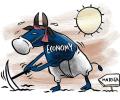
Fewer people participated in MGNREGA during the first six months of this financial year (April-September) compared to the same period last year, a recent analysis of the scheme's performance by LibTech showed.

Ask rediffGURU and PF expert Milind Vadjikar your insurance, stocks, mutual fund and personal finance-related questions.

'Obesity, especially central obesity and increased visceral fat due to physical inactivity, along with the consumption of high-calorie, high-fat, and high-sugar diets, are major contributing factors.'

Uttam Ghosh is devastated by the news that Ajit Ninan, the renowned cartoonist who enlivened the pages of India Today and the children's magazine Target for many years, passed into the ages on Friday, September 8, 2023.

A 24-year-old man in Madhya Pradesh's Gwalior city has claimed his wife left him because of his dark complexion and also filed a harassment complaint against him.
The short-term inflation outlook for India is benign, and the expectation of a normal monsoon and moderating global prices of key imported items give credence to the projections made by the RBI and IMF, the Economic Survey said on Monday. However, to ensure long-term policy stability, the Survey 2023-24 suggested making focused efforts to increase the production of major oilseeds, expanding the area under pulses, and assess the progress in developing modern storage facilities for specific crops.

After a year of decline, mergers and acquisitions (M&As) in India increased 13.8 per cent, reaching $69.2 billion in the first nine months of 2024, as against $60.8 billion during the same period in 2023. Led by Indian companies and private-equity (PE) firms, 2,301 transactions were signed between January and September this year as compared to 1,855 transactions reported in the same period last year, according to the Bloomberg data.

Life insurance companies reported a 13.16 per cent year-on-year (Y-o-Y) growth in new business premium (NBP), totting up Rs 30,347 crore in October, even as the number of policies sold saw a sharp decline. The growth was largely driven by strong performance from private sector life insurers.

Among Sensex shares, Hindustan Unilever, Bharti Airtel, Tech Mahindra, Infosys, Mahindra & Mahindra, ICICI Bank, ITC and Asian Paints were the biggest winners. On the other hand, Kotak Mahindra Bank, Reliance Industries, NTPC, UltraTech Cement and Power Grid were among the laggards.

India's venture capital (VC) landscape saw a strategic shift during the first half (H1) of the calendar year (CY) 2024, with a notable increase in larger-sized investments. This was evident from a 45.3 per cent rise in disclosed funding value year-on-year, despite a 2.1 per cent drop in deal volume, according to GlobalData, a data analytics and consulting company.

As Rahul Gandhi resumed the Bharat Jodo Yatra in Nanded district on November 9, Uttam Ghosh/Rediff.com spoke with yatris who have walked from Kanyakumari for more than 63 days.

rediffGURU Ulhas Joshi answers your mutual fund queries.

'We may see even more restrictive policies during 2.0.'

All that you must know about the pros and cons of gift deeds, tax implications, essentials, documents required, conditions, etc...

Active equity mutual fund schemes have improved their showing across key categories over the past three months vis-a-vis their benchmarks.

Overseas Indians deposited around $4 billion in non-resident Indian (NRI) deposit schemes in April - June FY25, up 79 per cent over the amount deposited in these schemes in the same period last year, data released by the Reserve Bank of India (RBI) on Monday showed. In April - June FY25, inflows into the NRI schemes stood at $3.95 billion, compared to $2.21 billion during the same period a year ago. With this, the total outstanding NRI deposits as of June stood at $155.71 billion.
