
The White House has revised a fact sheet on the interim trade deal between the United States and India, removing the reference to "pulses" from the list of American products on which India would eliminate or reduce tariffs. The revised sheet also changed "committed" to "intends" regarding India's purchase of American products.

The deal shifts the US posture towards India from hostile to neutral, and that matters for growth, points out T T Ram Mohan.

Inflation data, trading activity of foreign investors and global trends would dictate sentiment in the stock market this week, according to analysts.

Greer said that India has taken down some digital services taxes and is moving tariffs down.
India has clarified its position on the proposed interim trade agreement with the US, stating that the joint statement remains the basis for mutual understanding. Amendments to a White House fact sheet reflect shared understandings, with both sides working towards finalizing the agreement.

The rupee witnessed a volatile trading session and settled for the day on a slightly lower note, down 1 paisa at 90.66 against the US dollar on Monday, as traders assessed the details of the India-US interim trade framework.

US and India will promptly implement this framework and work towards finalising the interim agreement with a view to concluding a mutually beneficial bilateral trade agreement.

Both countries commit to provide each other preferential market access in sectors of respective interest on a sustained basis
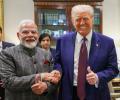
The agreement addresses non-tariff barriers and promotes increased trade in technology products and cooperation between the two countries.
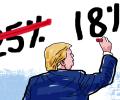
Several farmer organisations in India are protesting the proposed India-US trade deal, expressing concerns about its impact on the agriculture sector and demanding the resignation of the Commerce Minister.
The Congress party has criticized the Indo-US trade agreement, calling it a 'surrender' of India's self-esteem and interests, and a betrayal of Indian farmers and MSMEs.

The US said India will lower tariffs on a "vast array" of American industrial and agricultural goods, such as "fruits, vegetables", to zero per cent under the trade deal announced by President Donald Trump.
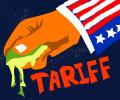
A trade deal makes sense only if it is fair and reciprocal. If the cost is strategic dependence or loss of policy space, waiting is the wiser option, asserts Ajay Srivastava.
The US is "pretty close" to reaching a "fair trade deal" with India, President Donald Trump has said, adding that he will lower the tariffs imposed on Indian goods at "some point".
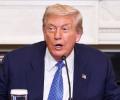
Donald Trump's tariffs, meant as political punishment, have avoided the predicted chaos, lifting US growth, weakening rivals, and letting him claim victory in a resilient global economy, observes T T Ram Mohan.

The US wants India to recognise internationally accredited labs, harmonise labelling requirements and the validity period of test reports and certification with global practices, and eliminate retesting requirements.
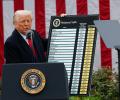
The official said there are both challenges and opportunities for India as many of its competitor countries in exports, such as China Vietnam, Bangladesh, Cambodia and Thailand, face higher duties.
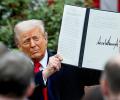
'April 9 announcement of slapping a 125% tariff on Chinese goods has brought the focus back to China, making this new phase feel like a repeat of the original conflict.'
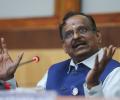
Ahead of Prime Minister Narendra D Modi's meeting United States President Donald J Trump, Russia's ambassador to India and the US charge d'affaires met Indian Space Research Organisation Chairman Dr V Narayanan.
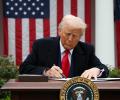
On India, the chart showed that the country charged 52 per cent tariffs on the US "including currency manipulation and trade barriers," and America will now charge India "discounted reciprocal tariffs" of 26 per cent.
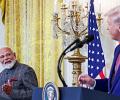
Prime Minister Narendra Modi and US President Donald Trump have vowed to move forward with plans to work together to build US-designed nuclear reactors in India. The decision was made during their meeting at the White House, where they also agreed to significantly expand energy cooperation. The move comes after India announced plans to amend its nuclear liability law and the Atomic Energy Act, which had previously been obstacles to the implementation of the US-India civil nuclear deal.

The escalation in the US-China trade war is expected to help India increase its exports and attract investments from American companies, think tank GTRI said on Friday. He said that last month, the US Senate introduced two bills that could intensify the trade war and have major global economic impacts if passed.

The US Federal Reserve's interest rate decision is the biggest event that would drive sentiments in the domestic stock market this week, besides a host of macroeconomic data from the global front and trading activity of foreign investors, analysts said. The Indian equity market had an exceptional last week, with both the Nifty and Sensex hitting their all-time high levels on Thursday.

The US India Business Council expressed its unease over the Supreme Court on denying a patent on Glivec and said that this would impact innovation and investment climate in India as a time when the country needs foreign direct investment the most.

A coalition of US restaurants, grocers, seafood distributors and others has been launched to fight a US trade panel ruling that could lead to anti-dumping tariffs against six countries, including India.\n\n\n\n

India and the US on Friday said they have started talks to put in place a strategic framework for human space flight by year-end as they plan to send an Indian astronaut to the International Space Station in 2024.

The Indian government headed by Prime Minister Manmohan Singh, who is known as the architect of the country's liberalisation and economic reforms, is inching towards a "protectionist" regime, top American experts have told US lawmakers.
The US textile industry is deeply worried by competitors from India and China as the end of the quota system on December 30 approaches, a media report has said.

India's import of cheap Russian oil scaled another record in May and is now more than the combined oil bought from Saudi Arabia, Iraq, UAE and the US, industry data showed. India took 1.96 million barrels a day from Russia in May, 15 per cent more than the previous high in April, according to data from energy cargo tracker Vortexa. Russia now makes up for nearly 42 per cent of all crude oil India imported in May.

'Small cap funds do have their own merits and they make sense when the investor has a longer investment horizon.'
American corporations have suffered production delays, friction with customers and foreign tourists have decided to take their business elsewhere.

Software major Tata Consultancy Services on Wednesday reported a 14.8 per cent rise in net income to Rs 11,392 crore for the fourth quarter of last fiscal against Rs 9,959 crore in the year-ago period. The country's largest technology services company by market value said its revenue rose 16.9 per cent to Rs 59,162 crore during the reporting season from Rs 50,591 crore a year ago.
Top management of high-tech companies have been asking the US government to rework their Senate immigration bill to allow them to hire more foreign workers.
Commerce Minister Arun Jaitlet said on Monday that India had been successful in getting outsourced business from abroad including the US because of its competitive edge and by virtue of being a low cost economy.
India's drug policy of stringent price control regime is a major concern for United States industries because it creates obstacles to maintaining viable businesses in the country, according to a report by the United States Trade Representative.

GSOMIA does not cover the exchange of classified information with Indian private industry. Washington wanted this covered too, given New Delhi's emphasis on the proposed 'strategic partnership' model of procurement.

With the increased death rate in the ongoing second wave of Covid-19, domestic cement companies are in no better condition than they were in the April-June quarter of FY21 when the country faced nationwide lockdown. "This wave has had high death rate which has impacted the business. "We are in no better situation than last (year) April. "Deaths of drivers, dealers, contractors and also employees have hit the industry really very hard since April (FY22)," M Ravinder Reddy, director of Bharathi Cements said.

The Trump administration terminated India's designation as a beneficiary developing nation under the Generalized System of Preferences in June.

India may adopt norms similar to the US Federal Reserve model, which regulates conglomerate-led banks in the country.
 © 2026 Rediff.com - Investor Information - Advertise with us - Disclaimer - Privacy Policy - Sitemap - Feedback - About us - Terms of use - Grievances