
'The die is cast. The wave is for her.' 'We will win this. The numbers are going to be higher than people are saying.' 'It is going to be more closer to Obama's numbers than Biden's numbers.'

Even as it gasped for breath, American insurance giant AIG was lobbying the United States Congress hard to get the Indo-US civil nuclear energy deal cleared, reports ProPublica.org.


'Now it's for India to also make certain decisions. The sky's the limit. You've got to be strategic.'
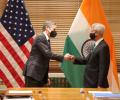
The legislative amendment was passed on Thursday by voice vote as part of an en bloc (all together as a single unit) amendment during floor consideration of the National Defence Authorisation Act (NDAA).
Former Indian Ambassador to the United States Ronen Sen has asserted that any denial of a level playing field to United States industry and business -- that lobbied feverishly for the US-India civilian nuclear deal -- in the wake of the Nuclear Liability Bill passed by the Indian parliament would be 'worse than a breach of faith'.
Nicholas Burns, the lead negotiator on the US-India nuclear deal in the Bush administration, has said that Washington must reassure New Delhi that it is a "valued strategic partner."
In a scathing indictment of the nuclear liability bill passed by Indian Parliament, Nicholas Burns, former under secretary of state in the Bush administration, has warned that if the bill was not amended it could sound the death knell of the historic Indo-US nuclear deal and adversely impact on the envisaged US-India strategic partnership.
The delay in the Nuclear Liability Bill, which has faced vehement protests by the Opposition in Parliament, has become a worrying factor for United States business and industry circles.
'The Congress-Samajwadi Party alliance will shift the centre of gravity of Indian politics to the right, with harmful consequences for the mass of the population which has a stake in Left-of-Centre policies. This shift can only facilitate the rise of the already buoyed-up BJP, and could prove a big setback for secularism.'
The influential Indian-American community has swung back to action to push the N-deal ahead.
It may not be the easiest of deals to forge, but with patience and understanding it can be done

'That they don't have a say in the UN, like China, is hard for me to understand,' says US Congressman Joseph Crowley.

'He is seeking to harness the power of Indian Diasporas to national (support for India in global capitals) and political (enhance the Bharatiya Janata Party's support base) ends.'

'While the Khobragade affair has "upset and diverted attention, it does not mean there is a fundamental flaw in the US-India relationship",' former American envoy Frank Wisner tells Rediff.com's Aziz Haniffa.

'An ardent advocate of nuclear disarmament, Obama may even be secretly heaving a sigh of relief that the NSG is unlikely to reach unanimity of opinion on India's candidature,' says Ambassador M K Bhadrakumar.

United States Secretary of State John Kerry, heading a high-powered delegation of his cabinet colleagues and top military commanders, today left for India as part of his 10-day seven nation Asia trip.
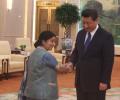
'This is a US-India effort and it is not necessarily to counterweight anyone.'

Making nuclear exemptions for India, says Senator Edward Markey, 'only infuriates Pakistan and leads them to further increase their own nuclear capacities.'

Tripura's popular chief minister shows up the failures of the elitist central leadership of India's Left, says Devesh Kapur

India comes under attack over religious intolerance, human trafficking and slavery at a Senate Foreign Relations Committee hearing.
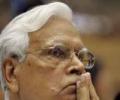
Natwar Singh's book is un-illuminating, largely self-justificatory, often contradictory, and at times tendentious. He is too preoccupied with depicting himself as a victim of the Congress party's machinations, says Praful Bidwai.

The AAP has adopted policies in an ad hoc manner, without thinking them through or deriving them from a broader framework. This must change if the AAP is to become a credible alternative, says Praful Bidwai.

'Whether it's investments in Kashmir, building naval facilities, or selling top-of-the-range military equipment, Pakistan could well benefit more under Xi's watch.' 'Do Chinese concerns about the 'Islamisation' of Pakistan give it pause about how quickly to move forward with security and economic projects? At the moment the indication is quite the opposite: China is doubling down on its support to Pakistan, partly because of its fears about where the country is headed.'
 © 2026 Rediff.com - Investor Information - Advertise with us - Disclaimer - Privacy Policy - Sitemap - Feedback - About us - Terms of use - Grievances