
All Sensex components ended in the red. IndusInd Bank was the top loser, followed by Tata Steel, HDFC, ICICI Bank, Axis Bank, Infosys and ITC. According to traders, volatility heightened in global markets as US Federal Reserve's interest rate cut stoked concerns over an impending economic recession.

Given the uncertainties around gold's future course, stagger your purchases and buy on declines, says Sanjay Kumar Singh.

The Rupee is expected to weaken further against the dollar.

The 30-share Sensex ended down 12 points at 25,610.
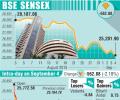
The 30-share Sensex ended down 563 points at 25,202.

Investing in the US market provides Indian investors a hedge against the rupee's long-term tendency to depreciate against the dollar.

'Slower-than-anticipated recovery can be a bigger risk this time than a liquidity-driven event -- at least for India.'

'A time-wise, as well as price correction, so that the market can absorb the gains made over the past 17 months.'

Dealers attributed the rupee's fall to increased demand.
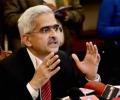
Many analysts over the past week have said the RBI has legroom to cut rates to the tune of 65 bps by June and some like Barclays and BofA have also spoken about the likelihood of an inter-meeting cut.

The US Fed also said that the unemployment rate too would rise to 5.7 per cent.

Total market capitalisation of BSE listed firms stood at Rs 101.49 lakh crore on March 31.

Christopher Wood, global head of equity strategy at Jefferies reiterate his bullish view on Indian equities on the back of a steady fall in Covid cases coupled with a sharp economic recovery in India, reports Puneet Wadhwa.
The surge is a stark turnaround from 2013 when the country's current account gap hit a record high due to outflows on expectations the US Fed would rein in its stimulus programme
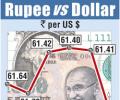
Month-end dollar demand affected the rupee
The Sensex finally ended down 233 points at 18,541. Nifty ended down 77 points at 5,590.

Bank of America (BofA) Securities expects India to be the third-largest economy in the world by 2031. The economic rise could become a reality by 2028, but the Covid pandemic delayed the pace, BofA Securities economists Indranil Sen Gupta and Aastha Gudwani wrote in a report.

As if wanting to be an antidote to the coronavirus pandemic, the Indian stock market adorned carnival robes in 2021 with a tsunami of liquidity unleashed by global central banks coupled with supportive domestic policies and the world's largest vaccination drive sparking off a world-beating rally on Dalal Street, despite bouts of uneasiness over fizzy valuations. While the wider economy shuttled between recovery and relapse, dictated by multiple mutations of the virus, equity market benchmarks appeared headed in just one direction -- skywards. The dizzying upward journey has added a whopping Rs 72 lakh crore during 2021 to investors' wealth, measured as the cumulative value of all listed shares in the country, taking it to nearly Rs 260 lakh crore.

An immediate RBI rate cut will lower lending rates for banks' MSME/retail/mortgage loans before the 'busy' industrial season ends in March.

Investors should allocate 10 to 15 per cent in their portfolios to gold through sovereign gold bonds.

Any market correction, analysts say, would be an attractive entry point for risky assets, which should do well over the medium-to-long term.
This is the first hike in about a decade, signaling a recovery.

The view among the regulator and the government is that the currency is overvalued

'Rising Covid cases and localised lockdowns are being closely monitored.'

Gaurav Garg, head of research at CapitalVia Global Research Limited will answer your stock market queries.
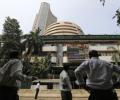
The broader NSE Nifty dropped by 48.65 points, or 0.45 per cent to 10,808.05 after shuttling between 10,773.55 and 10,833.70.
The 30-share Sensex closed 80 points lower at 21,753 levels while the 50-unit NSE Nifty index was down 38 points at 6486 levels. Benchmarks plunged to their lowest levels since March 06, 2014.
US Federal Reserve Chairper Janet Yellen hinted at raising interest rates sooner than expected, in her first press conference after assuming the top job at US central bank.

'In the short term, we may see some disruptions due to Covid, but in the medium-to-long term, we should keep an eye on US inflation and 10-year bond yields.'
December is packed with key economic and political events, both at the domestic and the global level, which will decide how foreign institutional investors (FIIs) fine tune their investment strategies
Foreign institutional investors (FIIs) are back in droves.
Market breadth ended weak with 1,437 losers and 1,095 gainers on the BSE.
The new Guv needs to focus on structural inflation problems.
Gold has dulled a lot lately but investors could still take a shine to it.

The S&P BSE Sensex dropped 1 points to end at 26,396 and the Nifty50 slipped 2 points to end at 8,109.

The sentiment around Indian equities remains positive and unchanged.
The Sensex and the Nifty touched an intraday high of 19,724 mark and 5,949 levels, respectively. Foreign Institutional Investors also turned buyers during the previous two sessions, exchange data showed.
It will have a positive impact on India's trade deficit and GDP growth.
Over the last few months, the Indian economy has been on nothing short of a roller-coaster ride.
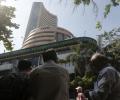
Top gainers in the Sensex pack included Infosys, Bajaj Finance, Maruti, HUL, HCL Tech and Reliance Industries, while M&M, IndusInd Bank, ITC, PowerGrid and L&T were among the losers. The NSE Nifty settled 190.80 points, or 2.51 per cent, down at 7,801.05.
