
Indian rupee is likely to test 76-76.50 levels as a relatively strong greenback, boiling crude prices and COVID headwinds deepen the depreciation bias for the domestic currency, according to experts. One of the significantly-hit Asian currency in recent months amid uncertain economic times, rupee is expected to see a consolidation in the vicinity of the current level before being pulled towards the depreciation bias. While the equity market has been surging with occasional blips, the rupee has mostly been weak against the US dollar in recent months.

Higher levels could not be sustained as participants offloaded their long positions in view of September series expiry.

Despite returns from gold down over 5% in the past three months, it is a good idea to keep this asset class in your portfolio.

On the Sensex chart, Axis Bank, Titan, IndusInd Bank, HDFC Bank, Dr Reddy's, HDFC and Asian Paint were major losers.

The market breadth has turned sharply positive since May amid hopes that a decline in Covid-19 infections will lead to a revival in the economy. At 3.8, the advance-decline ratio (ADR) for May was the best since June 2020. So far this month, the ratio has remained above three - in simpler words, for every declining stock, there were nearly four advancing stocks in May and three this month. ADR is a popular market breadth indicator, with a ratio of more than two signalling an extremely bullish undercurrent.
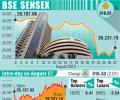
The barometer S&P BSE Sensex ended at 26,231, up by 517 points or 2%.

'Avoid going overweight on gold. But maintain a 10 per cent allocation via sovereign gold bonds,' Bajaj Capital MD Sanjiv Bajaj tells Sarbajeet K Sen.

HDFC Bank was the top loser in the Sensex pack, shedding over 2 per cent, followed by Kotak Bank, Bajaj Finserv, Maruti, Titan, SBI, HUL, HDFC and Tata Steel. On the other hand, Bharti Airtel, M&M, NTPC, Tech Mahindra, Sun Pharma and PowerGrid were among the gainers.

Among the Sensex pack, Yes Bank, L&T, HDFC, RIL, HDFC Bank, PowerGrid and Coal India were the biggest losers -- falling up to 2.43 per cent.

'We expect the bull run to continue until economic growth continues.'

IndusInd Bank was the top gainer in the Sensex pack, rallying over 4 per cent, followed by SBI, Bajaj Finance, Bharti Airtel, Axis Bank, Sun Pharma, HDFC and PowerGrid.

Demonetisation, Donald Trump's surprise victory in the US presidential elections, and the fear that US Fed may hike rates in the upcoming policy review in December have dented market sentiments, report Puneet Wadhwa & Deepak Korgaonkar.
After turning net buyers for the fifth straight month till June, foreign portfolio investors (FPIs) withdrew a net of Rs 11,743 crore ($1.7 billion) in July. This was their highest outflow since October 2018.

The US Fed will decide if it should raise interest rates from near-zero levels first time in a decade.

Chief Economic Adviser K V Subramanian on Monday said India is likely to post current account surplus in the current financial year as there is moderation in import due to under heating of the economy triggered by the COVID-19 crisis. This crisis is different from what the world witnessed during the taper tantrum, he said while addressing a virtual conference organised by industry body CII. Taper tantrum phenomenon refers to the 2013 collective reactionary response that triggered a spike in US treasury yields, after investors learned that the US Fed was slowly putting brakes on its quantitative easing (QE) program.

'Earlier-than-expected tapering from the US, followed by rate hikes, and locally, a potential third wave, which mimics the second wave in terms of severity.'
Markets will be open from 5.45 pm to 6.45 pm on Wednesday.


'It is going to be a tough balance for the RBI to manage economic stability and ensure smooth government borrowing.'

Weakness of dollar in the overseas market also boosted the rupee value against the dollar.

The broader markets are trading inline with the larger peers with BSE Midcap and Smallcap indices up 1.5% each.

'Any normalisation exercise will bring its share of volatility.'
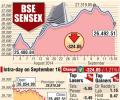
The 30-share Sensex ended down 324 points at 26,493 and the 50-share Nifty closed 109 points lower at 7,933.
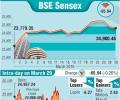
The S&P BSE Sensex ended at 24,900, down by 66 points.

Experts say foreign investor sentiment was bolstered by the US Federal Reserve's decision to go slow with interest rate hikes and hopes of political stability.

'Slower-than-anticipated recovery can be a bigger risk this time than a liquidity-driven event -- at least for India.'

All Sensex components ended in the red. IndusInd Bank was the top loser, followed by Tata Steel, HDFC, ICICI Bank, Axis Bank, Infosys and ITC. According to traders, volatility heightened in global markets as US Federal Reserve's interest rate cut stoked concerns over an impending economic recession.

Investing in the US market provides Indian investors a hedge against the rupee's long-term tendency to depreciate against the dollar.
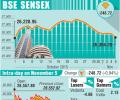
The 30-share Sensex ended down 249 points or 0.94% at 26,304 levels.
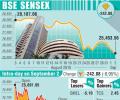
Top gainers in the Sensex pack included Tata Steel, Kotak Bank, NTPC, HDFC twins, PowerGrid and ONGC, rising up to 4.60 per cent.

'A time-wise, as well as price correction, so that the market can absorb the gains made over the past 17 months.'
Given the uncertainties around gold's future course, stagger your purchases and buy on declines, says Sanjay Kumar Singh.

Silver ready rose by Rs 350 to Rs 33,850 per kg.

Gold in Singapore advanced as much as 1 per cent to $1,202.08 an ounce.

The 30-share Sensex ended down 12 points at 25,610.
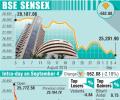
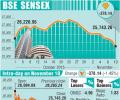
The 30-share Sensex ended down 563 points at 25,202.

The Rupee is expected to weaken further against the dollar.
Many analysts over the past week have said the RBI has legroom to cut rates to the tune of 65 bps by June and some like Barclays and BofA have also spoken about the likelihood of an inter-meeting cut.

As if wanting to be an antidote to the coronavirus pandemic, the Indian stock market adorned carnival robes in 2021 with a tsunami of liquidity unleashed by global central banks coupled with supportive domestic policies and the world's largest vaccination drive sparking off a world-beating rally on Dalal Street, despite bouts of uneasiness over fizzy valuations. While the wider economy shuttled between recovery and relapse, dictated by multiple mutations of the virus, equity market benchmarks appeared headed in just one direction -- skywards. The dizzying upward journey has added a whopping Rs 72 lakh crore during 2021 to investors' wealth, measured as the cumulative value of all listed shares in the country, taking it to nearly Rs 260 lakh crore.
