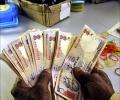
In the global market, dollar fell against most of its rivals on Monday.

The first five months of 2023 have witnessed at least six major events/trends that augur badly for global economic and socio-political prospects, points out Shankar Acharya, former chief economic adviser to the Government of India.

'It was because of the huge selloff in the Indian equities that the rupee fell so sharply against the dollar on Friday.'

The benchmark Nifty50 managed to reclaim its 200-day moving average (DMA) on Wednesday but about half of top 500 stocks continue to languish below this key technical indicator. The 200-DMA - nearly a year's average of closing prices - is analysed by traders to understand the market sentiment. A fall below these levels indicates a weak trend.

At interactions last week with senior officials from the Reserve Bank of India, select banks gave feedback on two key bond market concerns, namely, recent volatility in the rupee-dollar exchange rate and heavy losses incurred on floating rate government bonds due to a demand-supply mismatch, sources told Business Standard. The discussions were held ahead of the RBI's next monetary policy statement, scheduled on August 5. Indian banks are large holders of government securities because of a regulatory mandate to set aside a certain percentage of deposits in sovereign bonds.

Trading in the domestic equity market this week will be influenced by quarterly results from TCS and Infosys, besides inflation and industrial production data as well as global trends, analysts said. Movement of the rupee, which has slumped to record lows against the US dollar, will also be tracked by investors, they added. "This week, participants will be eyeing important macroeconomic data viz IIP, CPI and WPI... Besides, the week also marks the beginning of the earnings season with IT majors like TCS, Infosys, HCL Tech and Wipro announcing their numbers along with two other heavyweights Bajaj Auto and HDFC Bank," said Ajit Mishra, VP - Research, Religare Broking Ltd. Performance of the US markets, FIIs' trend, and movement in currency and crude will also remain on their radar, Mishra added.

With the Big Four information technology services players having disappointed the Street, the focus is on mid-cap IT players who seem to have met expectations, according to analyst reports and management commentary on the demand environment.

Sluggish domestic equities and persistent capital outflows largely pressurised the Indian unit

Inflation data, both at domestic and global level, interest rate scenario in the US, geopolitical situation and general elections in 2024 are some of the major factors that would influence trading in the equity market this financial year, analysts said. Besides, foreign fund trading activity and global trends will also dictate terms in the equity market going ahead. Equity markets across the globe faced major challenges in FY23 due to concerns over high inflation, which resulted in increase in interest rates around the world, lowering investor sentiment, experts added.

This is the biggest one-day fall in the rupee since August 3, 2016

Equity indices fell on Thursday, mirroring weak global market trends following the US Federal Reserve's interest rate hike and hawkish stance. The 30-share BSE Sensex declined 337.06 points or 0.57 per cent to settle at 59,119.72. During the day, it tanked 624 points or 1.04 per cent to 58,832.78. The NSE Nifty went lower by 88.55 points or 0.50 per cent to end at 17,629.80.

Investors have scaled back their allocation to equities as pessimism has reached "dire" levels due to cloudy economic outlook, according to the latest Bank of America (BofA) monthly global fund manager survey that covered nearly 300 money managers with combined assets of $800 billion. The survey showed that the expectations for global growth and profits are at all-time lows and cash levels are at highest since the 9/11 attacks. Interest rate hikes by central banks, the unwinding of an easy monetary regime, disruptions in global supply chains, and fears of recession have heightened market volatility since the beginning of the year.

India's foreign exchange reserves declined $1.15 billion to $571.56 billion for the week ended July 22, according to RBI data. The reserves has been declining amid continuing volatility in the rupee which has also significantly depreciated against the US dollar. In the previous reporting week, the overall reserves had declined by $7.54 billion to $572.71 billion.

There was mild selling of dollars by banks and exporters
Equity market will be guided by global trends, macroeconomic data announcement and foreign fund movement in a holiday-shortened week ahead, analysts said. Movement of the rupee and Brent crude oil will also remain in focus this week, they added. "The bulls need some support from global markets to continue Friday's momentum.

Breaking the streak of continuous fall in outstanding amounts, non-resident Indian (NRI) deposits rose for the first time in the financial year to $134.54 billion in October 2022. The figure was $133.67 billion in September. Reserve Bank of India (RBI) data showed that NRI deposits were in shrinking mode for the first six months of FY23. They fell to $133.67 billion in September from $139 billion in March.

The collapse of Silvergate Bank, Silicon Valley Bank (SVB) and Signature Bank in the US might create temporary liquidity issues but will not have any significant impact on the Indian crypto market in the long run, officials from several exchanges told Business Standard. All three banks are considered crypto-friendly. SVB offered services such as cryptocurrency custody and lending.

Equity benchmarks Sensex and Nifty on Friday spurted by nearly 2 per cent, propelled by heavy buying in IT, metal and financial stocks amid a rally in global markets after lower-than-expected US inflation data. A strong rupee against the US dollar and unabated foreign capital inflows further bolstered sentiment, traders said. Easing US inflation triggered speculation that the US Federal Reserve might slow down the pace of interest rate hikes.

The Reserve Bank of India on Friday raised the benchmark lending rate by 50 basis points to 5.40 per cent to tame inflation.

'India's edtech and start-up story will be in danger.'

The country's foreign exchange reserves declined by $5.01 billion to $588.31 billion in the week ended July 1, according to RBI data released on Friday. In the previous week ended June 24, the reserves had increased by $2.73 billion to $593.32 billion. During the reporting week ended July 1, the fall in the foreign exchange reserves was due to a dip in Foreign Currency Assets (FCA), a major component of the overall reserves, and also in the gold reserves.

Gold prices are struggling and are down 18 per cent from their March highs. But stock prices have fallen even more. As a result, the precious metal has begun to outperform equities - both in the domestic market and international markets. Gold prices are up 2.6 per cent in the domestic market in the current calendar year (CY22) so far, according to the World Gold Council (WGC), compared to a 1.7 per cent decline in the Sensex year-to-date (YTD).

Extending its losing streak for the fourth straight day, the rupee weakened by five paise to 61.01 against the US dollar in early trade today at the Interbank Foreign Exchange market on high demand for the American currency from importers.

The rupee recovered by 11 paise to trade at 60.84 against the US dollar in early trade today on selling of the American currency by banks and exporters.

Equity benchmarks shrugged off lacklustre global cues to clock smart gains on Tuesday, buoyed by strong buying interest in index heavyweights Reliance Industries and HDFC twins. However, a depreciating rupee and unabated foreign fund outflows capped the gains, traders said. The 30-share BSE Sensex rallied 562.75 points or 0.94 per cent to settle at 60,655.72.

Finding a subsitute for the dollar as well as China being able to grow without the US market will both take time.

Sliding for the fourth straight day, the BSE Sensex shed 152 points in choppy trade on Wednesday amid mixed global cues ahead of the US Federal Reserve's policy decision.

Srinivas Bhogle and Purnendu Maji present Rediff.com's Most Valuable Player of IPL 2023.

The rupee had gained 90 paise, or 1.34 per cent.

The Indian rupee on Thursday appreciated by 12 paise to end at 66.71.

Finance minister Nirmala Sitharaman on Wednesday exuded confidence that inflation would further decline and the government is on track to meet its budgetary target for deficit and said that there is no fear of stagflation in India. Replying to the debate on first batch of Supplementary Demands for Grants 2022-23 in Lok Sabha, the finance minister said inflation has come down and it is now in the tolerable band of the RBI. Inflation has been declining since April 2022 and it is declining further, she said.

The International Monetary Fund (IMF) has said India and China will account for half of the global economic growth in 2023, as the multilateral agency retained its growth forecast for Asia's third-largest economy for 2023-24 (FY24). "India remains a bright spot. Together with China, it will account for half of global growth this year, versus just a tenth for the US and euro area combined," the IMF said in its latest update to the biannual World Economic Outlook. Growth in India is set to decline from 6.8 per cent in 2022 (FY23) to 6.1 per cent in 2023 (FY24) before picking up to 6.8 per cent in 2024 (FY25), the global lender said while citing "resilient domestic demand despite external headwinds".

Jet fuel prices on Monday were hiked by a steep 5.3 per cent - the tenth straight increase this year -- to an all-time high, in line with a surge in global energy prices. The price of aviation turbine fuel (ATF) -- the fuel that helps aeroplanes fly -- was hiked by Rs 6,188.25 per kilolitre, or 5.29 per cent, to Rs 1,23,039.71 per kl (Rs 123 per litre) in the national capital, according to a price notification of state-owned fuel retailers. This is the 10th straight increase in jet fuel prices this year.

Radio Free Europe reported that the Asian Infrastructure Investment Bank, a Chinese-led development bank, suspended all business with Russia and Belarus on March 3.

FPIs have turned net sellers in 2022 after being net buyers in the last three years.

'If I were to say, I had the best vegetarian food in my life in Vietnam, nobody would believe me.' 'When I proclaimed this to my friends, they didn't believe me. I had to show them the pictures and make them drool!!'

Global gold demand has seen a year-on-year decline of 8 per cent during the April-June period to 948.4 tonnes and going ahead further monetary tightening and continued dollar strength may pose headwinds, says a report. According to the WGC Gold Demand Trends Q2 2022 report, the total gold demand during the second quarter of 2021 stood at 1,031.8 tonnes. The year-on-year demand was affected by increase in gold electronic traded funds (ETFs) outflow, decline in Central banks buying and lower demand from the technology segment, the report said.

Lok Sabha Speaker Om Birla on Monday warned members against referring to anyone's caste and religion in the House after a Congress MP alleged that Finance Minister Nirmala Sitharaman made certain remarks about his proficiency in Hindi because he belonged to a lower caste.
At the beginning of September 100 dollars could buy 70 euros, now they can buy 72.5 euros.

The rupee depreciated 40 paise to an all-time low of 81.93 against the US dollar in early trade on Wednesday as the strengthening of the American currency and risk-averse sentiment among investors weighed on the local unit. Moreover, a negative trend in domestic equities and significant foreign fund outflows sapped investor appetite, forex traders said. At the interbank foreign exchange, the rupee opened at 81.90 against the greenback, then fell to 81.93, registering a fall of 40 paise over its previous closing.
 © 2026 Rediff.com - Investor Information - Advertise with us - Disclaimer - Privacy Policy - Sitemap - Feedback - About us - Terms of use - Grievances