
Chinese scholars and veteran diplomats noted that the CPC National Congress is bound to take notice of India's rise. Since the 16th National Congress of the CPC held in 2002, India has made important all-round progress and consolidated its national strength, they observed.

'At the previous 18th party congress, Xi vowed to protect China's 'core' interests.' 'As a result, India faced a barrage of serious incidents on the borders with China -- at Depsang, Chumar, Pangong Tso and Doklam.' 'New Delhi will watch closely the political signals emanating from Beijing this week,' says China expert Srikanth Kondapalli.

'That the two sides allowed such a situation to arise exposed the level of inaction and inefficiency in China-India border management.' 'The Modi-Xi meeting in Xiamen initiated a process to to avert such contingencies in the future.'

Chinese President Xi Jinping has underlined the need for building a combat-ready army and accelerate the building of the theatre joint combat command system, amidst the People's Liberation Army flexing its muscles in the disputed South China Sea.

Donald Trump is believed to be the first US President or President-elect to have spoken to a Taiwanese leader since 1979, when the US severed diplomatic ties with Taiwan after its recognition of the People's Republic of China, points out former RA&W officer Jayadeva Ranade.

'The title of 'core' of the leadership gives Xi Jinping greater political authority at a time when China is beset by various problems as well as a slowdown in economic growth,' points out former RA&W officer Jayadeva Ranade.
At a time when Donald Trump is making belligerent noises, Chinese President Xi Jinping responds by overhauling the People's Liberation Army and restructuring the command of the PLA Navy to emphasise Beijing's resolve to dominate the South China Sea.

The operational alert allows troops to get acclimatised to high altitudes, renovate the bunkers and trenches from which they would fight, break out ammunition, and carry out the coordination needed to fight an integrated defensive battle.

Xi, the General Secretary of the Communist Party of China, called the progress China had made under his watch "truly remarkable
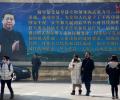
'The boundary dispute notwithstanding, China has always had leaders who have been, on the whole, positively disposed towards India.' 'Given the centrality of the Chinese Communist Party, we need to strengthen the linkages with the crucial personalities in the highest echelons of the Communist party and political leadership,' notes China expert Alka Acharya.

India needs to be alert on how the Doklam standoff plays into the factional infighting in China's Communist Party, says Ambassador Shyam Saran, the former foreign secretary.

'The American fear of the Chinese military is overblown. The countries that should be concerned are China's neighbours,' Jeffrey Wasserstrom tells Rahul Jacob.

'India and China are at new inflection points, domestically and internationally. India needs to throw up a new leader whose vision is clear, experience laden with wisdom and articulation brimming with restraint and tolerance,' says Ambassador K C Singh.

'Clarifying that modernisation of national defence and armed forces should be completed by 2035, Xi Jinping asserted the goal is to make the People's Liberation Army a "world class force" that "can fight and win" by 2050,' points out former RAW officer Jayadeva Ranade.

'China's latest defence White Paper has been issued against the backdrop of the upgraded Sino-Pakistan strategic relationship which has impinged on India's sovereignty and territorial integrity, and Beijing's continuing intransigence on tackling the issue of the disputed border or intrusion by PLA troops,' says Jayadeva Ranade.

'He still has to deal with party norms and traditions and has been careful to follow the order of seniority,' points out Claude Arpi.

'China's moves are of direct significance to India, which will closely monitor Chinese naval activity in the Bay of Bengal and the Indian Ocean not least because of Chinese maps depicting claims over the Andaman and Nicobar Islands.'

'China, which had earlier blockaded New Delhi's bid to join the Nuclear Suppliers Group by citing the nuclear non-proliferation law, finds itself in an awkward position and international isolation.' 'India needs to pursue a policy of mediation between China and the Southeast Asian countries for regional security,' says Srikanth Kondapalli.

'After a strategic pause though, Beijing will revive its policy of slowly creeping towards acquiring sovereignty over the South China Sea.'
 © 2026 Rediff.com - Investor Information - Advertise with us - Disclaimer - Privacy Policy - Sitemap - Feedback - About us - Terms of use - Grievances