
Hindustan Unilever (HUL) has topped the Perpetual Capital Hurun India Impact 50 - 2026 list with 53.9 points (on the scale of 0-100), reflecting a strong performance across key sustainable development goals (SDGs), including climate, water, circularity, gender and biodiversity.

'The DNA of Tata Consumer Products is all food and beverage.'

The stock of fast-moving consumer goods major Tata Consumer Products has been reaching new all-time highs on better-than-expected results for the July-September quarter (second quarter, or Q2), strong growth in the food business, and margin gains in the beverage/international business. Most brokerages are positive on the stock, given growth prospects, and believe that rich valuations are justified. The near-term trigger has been the robust operational performance in Q2.

Tata Sons chairman N Chandrasekaran on Thursday skipped the Annual General Meeting of Tata Consultancy Services (TCS), marking his absence from the group's shareholder gathering for the second consecutive day. This is the first time in over 17 years that Chandrasekaran, who was elevated as the chairman of the diversified conglomerate after working as TCS's chief executive, has missed the AGM of the largest IT services company.
N Chandrasekaran, chairman of Tata Consumer Products, has said in the company's annual report for FY25 that India remains one of the bright spots of economic growth amid a volatile global environment. He said India's long-term growth was underpinned by strong demographic and economic fundamentals as well as structural reforms.

Tata Consumer Products Ltd (TCPL) on Thursday denied reports on the exit of cafe chain Starbucks from the Indian market, terming them as "baseless". Tata in a 50:50 joint venture with US-based Starbucks Corporation operates a cafe chain in India under the brand name of Starbucks, which is the leading cafe chain in India.

'We are seeing signs of improvement in rural overall in terms of demand, but I would still keep my fingers crossed.'
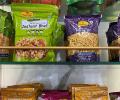
Temasek is nearing a deal to acquire a 10% per cent stake in Haldiram Snacks Foods, valued at $10 billion.

Shares of Tata Group companies on Thursday rose up to 10 per cent, with Tata Chemicals and Tata Teleservices among the major gainers. Tata Sons Chairman Emeritus Ratan Tata, who played a key role in transforming the group into a global conglomerate, passed away late on Wednesday. He was 86. "Investors can pay tribute to Ratan Tata and the great corporate empire he built by buying stocks like TCS, Tata Motors, Tata Steel, Tata Consumer and Indian Hotels.

India's fast-moving consumer goods (FMCG) sector grew 5.7 per cent by value and 4.1 per cent by volume in the July-September quarter driven by rural demand, consumer intelligence firm NielsenIQ said in its quarterly update on Thursday. Price-led growth stood at 1.5 per cent. According to NielsenIQ data, rural volume growth outpaced urban markets for the third straight quarter despite consumption softening in both regions.

The FMCG industry hopes for a revival in consumption growth in 2025 with some 'green shoots' already visible, after having a challenging year amid escalating input costs and a double-digit rise in food inflation, which ultimately slowed down the pace of the urban market growth in the second half of 2024. Soaring prices of commodities such as palm oil, coffee, cocoa and wheat forced FMCG players to go for a hike of 3 to 5 per cent or resort to shrinkflation by reducing pack sizes and grammage to retain attractive price points, fearing a volume loss.

Leading FMCG companies reported a decline in margins in the September quarter on account of higher input costs and food inflation, which ultimately slowed down the pace of urban consumption. Rising prices of commodity inputs such as palm oil, coffee and cocoa were also accentuated and some FMCG firms have hinted at a price hike. HUL, Godrej Consumer Products Ltd (GCPL), Marico, ITC, and Tata Consumer Products Ltd (TCPL) have expressed concerns over squeezing urban consumption, which according to industry experts forms 65-68 per cent of FMCG total sales.

Framing the next chapter in Swiggy's journey as a responsible corporate citizen, co-founder and chief executive officer (CEO) Sriharsha Majety unveiled the company's eagerly awaited public listing. Majety, who has largely shunned the spotlight, shared reflections on his entrepreneurial path and the strategic pivots he and his co-founders navigated in building Swiggy. "We started with code aggregation, then pivoted to logistics, and that became Swiggy.

With Rs 17,087 crore raised so far this calendar year, the total is already 2.4 times that of the full year of 2023, which stood at Rs 7,266 crore.

'Will make sure that we create value. We will again look for organic and inorganic opportunities.'

There were certainly qualities adhering to the Tata Group, which emanated from the persona of Ratan Tata. Most notable of these would be the low profile he maintained, which sharply contrasted the in-your-face celebrity status, celebration of wealth and pursuit of importance many of liberalised India's rich, love, notes Shyam G Menon.

India has been a tea sipping society. But the aromatic wave of coffee culture is wafting across it.

Veteran industrialist Ramesh Chauhan on Thursday said he is scouting for a buyer for his packaged water business Bisleri International and is in talks with several players, including Tata Consumer Products Ltd. However, the 82-year-old pioneer of the Indian packaged water business denied a report that a Rs 7,000 crore deal has been finalised with Tata Consumer Products Ltd (TCPL). When asked if he is selling his Bisleri Business, Ramesh Chauhan answered in the affirmative.

Packaged tea consumption in India has been under pressure due to inflation across the consumption basket coupled with higher tea prices. This is forcing tea drinkers to downtrade, especially in rural areas. Milk prices have also gone up and this has impacted tea consumption along with delayed winters in the north, companies have said. NIQ (formerly known as NielsenIQ) data shows that the packaged tea category grew around 4 per cent in value and volume terms in 2022 compared to 2021.

Fast-moving consumer goods major Dabur India is set to enter the branded spices and seasoning category. It has signed an agreement to acquire 51 per cent in Badshah Masala for a cash consideration of Rs 587.52 crore. The acquisition, the company says, is in line with its strategic intent to expand its food biz to Rs 500 crore in three years.

'As Tata Steel we will obviously use group-level leverage to make progress where we want.'


...followed by financial services, IT, and sales and marketing.

The letter shared with the media on Saturday comes amid Maharashtra losing several big-ticket projects to neighbouring Gujarat.

The current operating environment remains highly volatile and persistent inflation will likely impact demand across categories, Tata Consumer Products Ltd chairman N Chandrasekaran said on Monday. To navigate through these "short-term bumps" in this uncertain environment, the company will focus on strong execution, maintaining agility and nimbleness," he said while addressing shareholders at the annual general meeting (AGM). "Geo-Political tensions, supply chain challenges, and demand-supply mismatches in crude and several other commodities are driving persistent inflation, which will likely impact demand across categories.

Reliance Industries Ltd will acquire German firm Metro AG's wholesale operations in India for Rs 2,850 crore as the conglomerate run by billionaire Mukesh Ambani seeks to strengthen its dominant position in India's mammoth retail sector. "Reliance Retail Ventures Limited (RRVL), a subsidiary of Reliance Industries Ltd, signed definitive agreements to acquire a 100 per cent equity stake in Metro Cash & Carry India for a total cash consideration of Rs 2,850 crore, subject to closing adjustments," said a joint statement. Through this acquisition, Reliance Retail will get access to a network of Metro India stores located in prime locations across key cities, along with a large base of registered kiranas and other institutional customers, and a strong supplier network.

The Tata group firm has enhanced its product portfolio through "targeted acquisitions" as it aspires to be a formidable player in the FMCG category, said Chandrasekaran, who is also the chairman of Tata Sons. Besides, it has stepped up the pace of innovation across markets in line with consumer trends such as health and wellness and convenience, he said in his message to shareholders in the latest annual report of TCPL.
We are adapting to the situation by innovating new delivery modelss, launching brand campaigns that are impactful in the current context and closely monitoring changes in consumer buying behaviour, he said.

The firm is on course to replace state-owned Gail India in the widely-followed index during the semi-annual review set for March.

The total value of India's top 100 brands has increased by 2 per cent, from $162.1 billion in 2020 to $164.9 billion in 2021, according to the latest Brand Finance India 100 2021 report. This uplift in brand value over the course of the first year of the pandemic is an impressive feat given the global economic crisis following the implementation of national lockdowns in March 2020, when business activity was brought to a halt, affecting both production and consumption. Among the brands that came on the top of the list include Tata Group, Reliance Industries, and Mahindra Group.

Leading FMCG companies in the country are expecting their sales growth numbers in high double digit in the April-June quarter, a period when the broader market was severely impacted by the second wave of the COVID-19 pandemic. FMCG companies such as Godrej Consumer Products Ltd (GCPL) and Marico, in their quarterly updates to bourses, informed about double-digit sales growth. While Tata Consumer Products Ltd (TCPL) MD and CEO Sunil D'Souza in an interview had told PTI, the Tata Group FMCG firm expects higher growth in the Q1/FY'22 over Q4/FY'21.

'Younger people have a very strong sense of what is wrong, and what is right, along with the opportunity to call out this kind of behaviour through mechanisms like social media.'
With a revival in demand and consumption, FMCG companies are looking forward to 2022 with positivity and hopes of sustaining a healthy growth trend across both rural and urban markets while gearing up to cater to the ever-increasing digitally active consumers and tackle the challenge of higher commodity prices. Health and wellness and convenience are going to remain key trends and FMCG companies are strengthening their core brands, driving premiumisation across their portfolios with targeted innovations as consumers are gravitating towards trusted brands looking for quality, purity and hygiene, in continuation of the trend that started since the pandemic last year. FMCG makers are accelerating digitalisation and are investing in building capability in e-commerce and Direct-to-Consumer channels, identifying it as a key vector of their growth as the threat of a possible third wave is still not away.

The fast-growing, high-margin branded spices business is turning out to be an interesting growth opportunity, which to an extent was reflected in the Sunrise-ITC deal, with multiple parties from PE to strategic players joining the fray.

With theatres remaining shut, new releases are making a beeline for OTT platforms, and companies are forging tie-ups to reach out to the target audience.

'They are acutely aware of how they can use their power as a means to either continue dominating people or to get ahead.'

'The biggest advantage a company has in today's day and age is its reputation.' 'When something of this nature takes place, their reputation takes a beating.'

Ajit Mishra, vice president, research, Religare Broking, answers your queries.

Ajit Mishra, vice president, Research, Religare Broking, answers your queries.

Ajit Mishra, vice president, Research, Religare Broking, answers your queries.
 © 2026 Rediff.com - Investor Information - Advertise with us - Disclaimer - Privacy Policy - Sitemap - Feedback - About us - Terms of use - Grievances