
He was childlike with a camera in his hands -- not nave, but wonderstruck, as though the world were always on the verge of delivering something unrepeatable. Pulitzer Prize nominee Namas Bhojani recalls his long association with Raghu Rai, the legendary photographer who passed into the ages on Sunday.

The key question is how much of the latest growth record represents recovery from the 2020-2021 downturn, and what is the sustainable growth rate now, asks T N Ninan.
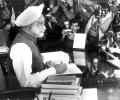
'The critical event signalling a new era for India was Dr Singh's 1991 Budget in which he quoted Victor Hugo to say that no power on earth could stop an idea whose time has come,' recalls T N Ninan.

While India should be concerned about disparities, the fact is that whereas three decades ago about half the people had incomes greater than $2.15 a day, today seven out of eight do, notes T N Ninan.

Even if no statistical jugglery is afoot, only to warn that the 'noise' in the numbers should be eliminated in order to hear the underlying music, without distortion, warns T N Ninan.

The BJP is the preferred choice because it offers what the Mughals and later British offered in their time: A stable polity and an environment in which business could function, explains T N Ninan.

If Ahmedabad is India's preferred candidate, as seems likely, hosting Olympics 2036 should give it a leg up: A bigger airport, a better metro network, more hotels, flyovers and so on, observes T N Ninan.

If it continues to do well economically, develops a large manufacturing sector, gains in technological heft, builds a more capable defence industry, improves its human development indicators, becomes more of a trading nation, and has greater internal cohesion. In short, it is a work in progress, suggests T N Ninan.

With changes to Delhi's architectural map, a re-naming rash, and more Hindu symbolism in secular spaces, the government is making it clear it wants a clean break with post-colonial India, asserts T N Ninan.

The real risk is that the core assumption -- that the votes for a candidate sponsored by an alliance will at least equal the sum total of its parts -- proves to be facile, observes T N Ninan.

This could become tricky territory for India, given its basically adversarial relationship with China, its moves to block imports and investment from that country, and to deny market access for Chinese technologies, observes T N Ninan.

The Opposition parties need to spell out how exactly they will protect the citizen from government excess, asserts T N Ninan.

Even as India strives to climb the development mountain, the fact is that the mountaintop is already crowded. If it got there in 2047, India would be very much a late-comer, observes T N Ninan.

The last time a bear attack was launched on a controversial businessman was when a cabal of brokers launched an assault in the early 1980s on what they thought was an over-priced Reliance share, recalls T N Ninan.
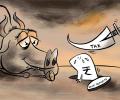
The government's step could push investors to choose riskier equity, or to fall back on bank deposits, thereby negatively impacting the debt market which actually needs to grow, points out T N Ninan.

One could argue that India is not troubled in the same way as China is by a declining population and structural problems in real estate/construction and finance. But India has serious trade and fiscal imbalances, and excessive dependence on capital expenditure by the government, points out T N Ninan.

The broader economy risks a potential flight of foreign portfolio capital, therefore pressure on the rupee and more bad news on the stock market, warns T N Ninan.

India must integrate more with East Asia by getting into regional trade arrangements, lower its tariff walls, and improve the quality of its workforce, suggests T N Ninan.

With a narrow industrial base and dysfunctional politics, and a counter-productive national security agenda, Pakistan could well remain an 'international migraine', observes T N Ninan.

Mr Adani has a fight on his hands. It is not a fight to the death, asserts T N Ninan.

The question in Maruti's relationship with its parent company, Suzuki, is whether the Japanese company intends to treat its minority Indian shareholders fairly.
The funny thing is that the government has the money - but it is going into subsidies that Mr Jaitley has chosen to leave untouched.
Finance Minister Arun Jaitley talks to T N Ninan.

The likelihood is that India will maintain a moderately upbeat economic tempo -- well short of tearaway growth, explains T N Ninan.
Taking up the speeds of inter-city Shatabdi Express trains from the present average of 70-75 km/hour to about 100 km/hour will cut the Mumbai-Ahmedabad travel time from seven to five hours.
The law may be good politics, but politics without grounding in basic economics is the surest guarantee of economic disaster.
The disconnect with the AAP is that its economic agenda sounds suspiciously like Indira Gandhi's of the early 1970s: more subsidies, higher taxes, regulation of private school fees, free water, et al.
What is missing in the government are people with enough weight in the system who can give quality economic advice, and offer subject expertise, says T N Ninan.
It is odd how governments don't learn from their predecessors' mistakes, says T N Ninan.
The original big boys (Tata, Birla, Ambani) were not the stars of the decade.
Focusing on low GDP growth in recent years, therefore, masks the deeper crisis facing manufacturing and mining.

The development of private data sources is a hugely positive development. It should serve as a challenge to the government to improve its own record on producing timely and reliable statistics, points out T N Ninan.
Forget the big-ticket stuff, for years we have not even been able to dredge Mumbai harbour so that submarines can move in and out round the clock, rues T N Ninan
If P Chidambaram's Budget speech was an hour-long attempt at presenting his government's and his own record in a good light - as he is perfectly entitled to do - such a "marketing" effort invites the recounting of an alternative retelling of the record.

Perhaps the finance ministry or NITI Aayog could take a detailed look at what governments actually deliver and at what cost; how their services can be improved and expanded where necessary; how much money can be saved through doing things differently; and how many things the government does which it can safely leave to the private sector, argues T N Ninan.
The relatively poor performance of government-owned banks comes at a cost to taxpayers.
The poor quality of the initial statistics must take some of the blame for the flak that the government has been getting; growth rates have been recorded as plunging more than they may in fact have.

Business has paid a pittance for farmers' land, indulged in widespread illegal mining, and cheated on 'green' commitments.
All those who have been dismayed by the food security ordinance should thank Manmohan Singh and his colleagues for a neat optical trick, says T N Ninan.
In March 2012, the rupee was about 51 to the US dollar - not much cheaper than it was a decade earlier.
