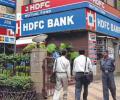
The Reserve Bank of India is likely to take a call on the relaxations sought by HDFC Bank in relation to the merger, as the date of merger draws closer, sources said. The HDFC twins, which announced their decision to merge in April last year, received National Company Law Tribunal's (NCLT's) approval recently - a key milestone to close the deal in due time. The management of both the entities had said that it will take 15-18 months for the merger.

The 30-share Sensex closed at 19,230 mark up 283 points whereas the 50-share Nifty ended higher by 87 points at 5,699 levels.
M&M, Bajaj Auto, Tata Motors and Hero Moto and Maruti Suzuki from Auto sector surged between 1-4%.
The Reserve Bank of India (RBI) clarification on the final norms for new bank licences has much to mull on for the many entities interested. It has clearly ruled out any benefit to the new entrants in terms of more time to meet the cash reserve ratio/statutory liquidity ratio (CRR/SLR) requirements.
HDFC Bank expects to amalgamate its home loan major parent HDFC into itself by September next year, a top official said on Friday. Both HDFC and HDFC Bank held general meetings on Friday to seek shareholder approvals for what is billed as the largest merger in Indian corporate history at over $40 billion. At the time of announcing the merger on April 4 this year, the entities had said the merger will take 12-18 months.

State Bank of India hinted at lowering lending rates to retail customers.
The central bank cut SLR to 23 per cent from 24 per cent.

P2P platforms do not have the safety net. Instead of playing the role of an intermediary, if they run their own balance sheets for safety and growth, it's a recipe for disaster, warns Tamal Bandyopadhyay.
ICICI Bank Chairman K V Kamath on Thursday disagreed with the suggestion of SBI chief Pratip Chaudhuri that RBI should scrap CRR, saying it is part of the monetary policy and no issue can be made of it.
The Reserve Bank of India, in its first-quarter review of monetary policy, kept the benchmark policy rate constant at 8 per cent.

Short-term lending (Repo) rate is unchanged at 8 per cent.

India's inclusion in JP Morgan's bond index can channel billions of dollars into India. How will the government securities market handle it?
The Reserve Bank of India on Tuesday said it was starting to unwind some of the extraordinary policy easing and liquidity support measures taken to shore the economy up against the global credit crisis and economic slump.

RBI is also considering a proposal to re-introduce inflation-indexed bonds.

The RBI, however, kept other key rates and ratios like repo, reverse repo and cash reserve ratio unchanged.
The Reserve Bank of India will provide foreign exchange liquidity to foreign branches and subsidiaries of Indian banks through currency swaps.

The central bank kept cash reserve ratio unchanged at 4 per cent.
NBFCs seek level playing field with banks in terms of treatment of NPAs, TDS on deposits, removal of service tax on HP and lease transactions, refinance mechanism akin to NHB etc
In short, if India Inc lives up to the expectations in the required measure of resilience, innovation, initiative, imagination and leadership, it can help harmonise the imperatives of growth with control of inflation.

For the first time in 21 years, the Reserve Bank of India (RBI) will revise norms for investment portfolios of commercial banks to reflect changes in global standards on valuation and measurement, and progress in the domestic market. This could pave the way for banks to transition to the new accounting standards (Ind-AS). The outstanding investment portfolio of commercial banks was at Rs 45.84 trillion as of November 19 this year.
Banks are parking funds not just in securities qualifying for maintenance of statutory liquidity ratio (SLR), but also in mutual funds (MFs).
The Reserve Bank on Tuesday increased a key statutory deposit ratio for banks to 25 per cent but the move is not expected to push interest rates up. RBI left other key policy rates and ratios unchanged. Due to this, it is unlikely that banks will banks hike their auto, home and education loan rates in the near term.

The central bank raised statutory liquidity ratio, the portion of deposits that banks are required to keep in government securities, by 100 basis points to 25 per cent. Other key rates were unchanged.

The inflation target has been hiked to to 6.5 per cent from 5 per cent. The FY10 GDP target is unchanged at 6 per cent.
Bankers have suggested that the Reserve Bank of India lower the statutory liquidity ratio and the cash reserve ratio as the present liquidity crunch is affecting their business. During the mid-term resource management discussion with the RBI team led by Deputy Governor Rakesh Mohan, the country's top bankers said the tight liquidity condition was pushing up the cost of funds and putting further pressure on margins.

In a mixed bag for HDFC Bank ahead of the parent HDFC's merger with itself, the Reserve Bank of India has declined to make exceptions on certain aspects, and has offered some leeway on others. The country's largest private sector lender, which is aiming to conclude the merger with the home finance major by July, had written to the central bank seeking certain forbearances after announcing the $40-billion merger in April last year. In an exchange filing this evening, HDFC Bank said it received a response from RBI on Thursday and also said that there are a few pending issues.
Banks have asked for an exemption of statutory requirements such as the cash reserve ratio (CRR) and the statutory liquidity ratio (SLR) for lending to the infrastructure sector. While the CRR is a tool where banks have to set aside liquidity with RBI in proportion of the deposits mobilised by them, the SLR requires banks to invest 25 per cent of their liabilities in government securities to generate instant liquidity.
A Bill seeking to give more operational flexibility to the Reserve Bank of India in the conduct of monetary policy was passed in Lok Sabha on Friday.
Finance Minister P Chidambaram on Tuesday said the Rs 14,150 crore (Rs 141.50 billion) worth of oil bonds meant for oil marketing companies will be issued within this month.
Ahead of the slack season Credit Policy, Reserve Bank Governor Y V Reddy on Monday met Finance Minister P Chidambaram amidst expectation of monetary measures to contain prices and keep interest rates stable to sustain high economic growth.
A massive liquidity outflow of over Rs 40,000 crore (Rs 400 billion) in the coming weeks is expected to pull back the overnight call rates from the near sub-zero levels to the central bank-desired 6-7.75 per cent range.
The government on Wednesday said the ordinance seeking to empower Reserve Bank to cut Statutory Liquidity Ratio below 25 per cent is expected to be brought in by this month-end or early February.
The goverment has found serious irregularities in the functioning of the National Bank for Agriculture and Rural Development (Nabard), Finance Minister Jaswant Singh said in the Rajya Sabha Tuesday.
With the government proposing to give flexibility to the Reserve Bank of India in fixing prudential limits, bankers expect a cut in statutory liquidity ratio

Short-term lending rate unchanged at 7.75 pc.
