
With the government proposing to give flexibility to the Reserve Bank of India in fixing prudential limits, bankers expect a cut in statutory liquidity ratio
With the slack season credit policy due to be announced on April 28, bankers are waiting to see how the Reserve Bank of India reacts to the budgetary proposals on freeing caps on statutory liquidity ratio and cash reserve ratio.
A bill to amend Banking Regulation Act, which will enable RBI to lower the mandatory limits on statutory liquidity ratio for commercial banks, will be introduced in Parliament soon.
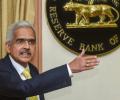
Financial markets are under stress and require steps by the central bank for market stability and revival of economic growth, he said while announcing the decisions taken by the Monetary Policy Committee in Mumbai.

India's current account deficit is expected to deteriorate in the current fiscal on account of costlier imports and tepid merchandise exports, according to the Finance Ministry's monthly economic review. The review released on Thursday by the ministry also said that global headwinds would continue to pose a downside risk to growth as crude oil and edibles, which have driven inflation in India, remain major imported components in the consumption basket. For the present, it said, "their global prices have softened, as fears of recession have dampened prices somewhat. This would weaken inflationary pressures in India and rein in inflation."

HDFC and HDFC Bank's merger - touted as India's biggest-ever corporate merger - pumped up shares of the two entities on the bourses. Shares of Housing Finance Development Corporation (HDFC) skyrocketed 9 per cent while those of HDFC Bank zoomed 10 per cent. In comparison, the benchmark S&P BSESensex and the Nifty50 indices settled 2.2 per cent higher on Monday.

The fifth meeting of Monetary Policy Committee maintained the repo rate, at which it lends to the banks, at 6.25 per cent and the reverse repo, at which it borrows, will be 6 per cent.

Banks may reduce their interest rates.

The move may release funds locked in government securities and add to liquidity. With inflation expectations lowered, this should not impact bond sentiment in the short run

Probably 35 bps. There could be even an encore in February 2023 to take the policy rate to 6.5% before the financial year ends, predicts Tamal Bandyopadhyay.

Leeway on CRR and SLR was a long-standing demand from banks, which the RBI did not agree to till recently.

Although the RBI's open market operations have ensured sufficient system-level liquidity, some sectors are finding liquidity to be a challenge owing to their credit profile.

The move by the central bank follows concerns over tight liquidity conditions and banks' unwillingness to lend to NBFCs.

RBI has cut policy rate thrice during 2015.

The Reserve Bank Officers Cooperative Credit Society, which caters to the credit needs of RBI officers posted all over India, has a fixed deposit of Rs 105 crore in the bank on which the RBI has placed various curbs for six months following revelations of irregularities.

Reserve Bank is scheduled to announce its bi-monthly monetary policy on August 3.

With the widespread use of new technologies, inter-connectedness and dependency, newer risks, threats and vulnerabilities have emerged.
But there are challenges, observes Tamal Bandyopadhyay.

The volume in the anonymous trading platform, NDS-OM, was Rs 7,210 crore - less than half the normal volume, but not as bad as the start of the day indicated.

It may be a 'no-go' for banking licences to large industrial houses.

RBI Governor Raghuram Rajan asked banks to follow suit and pass on the rate cuts.

The onus is on the banks to pass the benefit to customers.
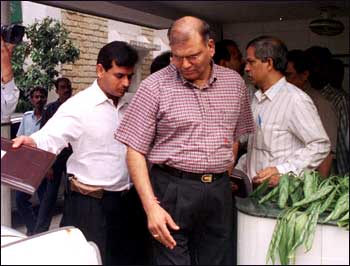
A special Central Bureau of Investigation court in Mumbai has convicted four former bank officials in one of the multi-crore securities scam cases and sentenced them to three years imprisonment, 25 years after the scam involving 'Big Bull' Harshad Mehta came to the fore.

All categories of NRI deposits saw net inflows in July.
.jpg)
Currently, the cash reserve ratio is pegged at a low of 4 per cent, while statutory liquidity ratio that includes securities such as government bonds, stands at 23 per cent, down from 25 per cent in 2010.
.jpg)
The worst performing Asian currency of the year so far hit a new life low of 61.80 rupees per dollar on Tuesday, breezing past a previous low of 61.21 hit on July 8. Central bank intervention helped the rupee recover, but by Wednesday it was sliding once again, to stand around 61.41 by 1.30 p.m.
The RBI on Tuesday maintained status quo on interest rates, saying there have been no developments to warrant further easing since an unscheduled rate cut about a fortnight ago.
.jpg)
The right sequence would be to gradually reduce SLR

On the reduction in the SLR ratio, he said it was a signal from the point of view of long-term reforms.
Better supply management and check on hoarding should be able to prevent food price spikes

The rise in government borrowings through bonds is impeding the growth of the corporate debt market in the country.

During the fourth quarter (January-March), banks step up the activity to meet annual targets. This leads to a race to raise funds from markets often by jacking up deposit rates. This time around, the market has not seen such trend yet.

A lack of adequate disclosures raises the financing costs of corporate firms, especially sub-investment grade ones, and keeps the capital markets small, believes RBI deputy governor Viral Acharya.

'When the rupee was at 65 a dollar, we wanted to go to Thailand for a holiday.' 'Now at 72, we may find Goa much more attractive.' 'That's how correction happens.' 'If you don't let that correction happen, then it's a pressure cooker that bursts one day.'

Investors booked profits after strong 641-point rally in the previous two sessions, brokers said.

Banks normally park almost 27 per cent of their funds in government securitie.

The Reserve Bank of India, in its Second Bi-Monthly Monetary Policy Statement for 2014-15, kept the key interest rate unchanged at 8 per cent.
 © 2026 Rediff.com - Investor Information - Advertise with us - Disclaimer - Privacy Policy - Sitemap - Feedback - About us - Terms of use - Grievances