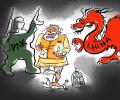
'China need not worry about a truly 'resurgent India'.' 'It's not going to happen.'

'The rise in unemployment, underemployment, discouraged workers and job insecurity is likely to continue, with very adverse consequences for the nation's economic well-being and social cohesion,' warns Shankar Acharya.

Bangladesh might overtake India this year by per capita income in nominal dollars, but it is not yet close to becoming South Asia's economic powerhouse anytime soon, T N Ninan points out.

A panel will examine the merits and demerits of various dates for the commencement of the financial year.

'The new government will have to contend with slowing economic growth, weak private investment, anaemic exports and vulnerable external imbalances, a stressed financial system, mounting fiscal pressures (including high government debt-to-GDP ratios) and an exceptionally bad employment situation,' says Shankar Acharya, former chief economic adviser to the Government of India.

Whether or not such an overhaul will be carried out depends on the government's comfort level.

The ones who came more recently were clutching the green cards that gave them an escape hatch through which to return to green pastures: Arvind Panagariya, Raghuram Rajan, Arvind Subramanian and other perfectly honourable gentlemen like them, points out T N Ninan.
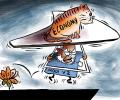
The reform priorities are clear: enhance savings, improve productivity. Just 25 basis points of moving interest rate up or down would not boost investment: Former RBI Governor Y V Reddy.

Listening -- really listening -- to advisers in the government and outside would help. India has plenty of wise economists who have worked within the bureaucracy during previous crises, points out Rahul Jacob.

Experts say the party is undoing what it achieved through MNREGA by targeting beneficiaries

The trio, 'twin shocks' of demonetisation and GST, 'twin balance sheet' problem that has been weakening India's banking system and the 'twin deficit' problem will continue to challenge economic management and performance in the year ahead, says Shankar Acharya.

In its essence, GST is a national level system of value added taxation of goods and services, says Shankar Acharya.

At the pre-Budget meeting at Niti Aayog, Modi called for a focussed effort from all stakeholders in order to achieve the target of $5 trillion economy. The participants urged the government to focus on credit expansion, exports growth, governance of PSBs, increasing consumption and job creation.

To do so, the government will have to tackle a number of broad development challenges successfully, says Shankar Acharya

The challenge ahead for central and state governments remains enormous.

'Event management can distract from, but not permanently mask, execution failures,' points out Rathin Roy, director, National Institute of Public Finance and Policy.

The prospects for strong, sustained economic reforms do not appear to be promising in India.

India's fiscal deficit trends are a bit like an alcoholic trying, unsuccessfully, to reform. Virtue does not last for too long, says Shankar Acharya.

'On the tax front, most of the Budget proposals are sensible'.


Describing the BJP's election victory as an "astonishing triumph of Narendra Modi", noted economist Jagdish Bhagwati on Monday advised him to retain Raghuram Rajan as RBI Governor and to hold monthly press conferences to articulate the government's agenda.
Experts will give their inputs for Budget.

Stability in currency markets was only restored from September.

Economic reforms seem to be on a slow train, while good old fiscal populism is alive and flourishing.

'Tax cuts will have only marginal effects in the short run and significant positive effects in the medium term,' says Shankar Acharya, former chief economic adviser to the Government of India.

RBI unsure whether to cut rates or not in its next monetary policy.

Depreciating the rupee against the dollar to boost economic growth has fiscal constraints and monetary limitations

The Modi government's array of economic policy has been impressive.

'While the GST is structured to be an all-encompassing tax and to create a vastly expanded digital network of recorded transactions, no one knows how traders long used to avoiding taxes will apply their ingenuity,' says T N Ninan.

The estimates of national income and growth do not pass the 'smell test'.

This Budget plans for an increase to 10.3% of GDP from 9.9%.

FM should avoid proposals such as to tax financial transactions and fringe benefits

There are conflicting signs on India's investment cycle.

Businesses coming to terms with Ind-AS (Indian Accounting Standards) implementation, GST can do without further uncertainty and costs, say N Sundaresha Subramanian & Sudipto Dey.

Because of India's weak fiscal position, the plethora of debt-burdened infrastructure companies and the poor asset quality of public sector banks, economic growth in 2015-16 may be limited to about six per cent, say Shankar Acharya.
.jpg)
The toxic brew of fiscal populism, crony capitalism and bad economic management has ensured the collapse of economic growth, industrial stagnation, stubbornly high consumer inflation, declining savings and investment, shrinking employment opportunities, and a dangerously vulnerable external financing situation.

The prime minister's August 15 address was undoubtedly inspirational and outlined important economic and social objectives, such as making India a global hub for manufacturing, ensuring bank accounts for all poor families, major thrusts in sanitation and cleanliness, and a radical restructuring of the Planning Commission.

The most serious recommendations to change the financial year came in the years preceded by deficient rainfall. The Jha committee was formed after droughts in 1979-80 and 1982-83, reports Rishika Pardikar/IndiaSpend.

Against a turbulent and uncertain background, Budget 2017-18 hewed a steady, forward-looking course, says Shankar Acharya, former chief economic adviser to the government.

Substantial gains can still be made with good policies and initiatives.
 © 2026 Rediff.com - Advertise with us - Disclaimer - Privacy Policy - Sitemap - Feedback - About us - Terms of use - Grievances