
'Growth, liquidity and deposit mobilisation are likely to be discussed during the interaction.'

A Bank Investment Company to act as a holding company for state-owned banks would go a long way in minimising government interference and improving governance.

Public resources are scarce and need to be used well.

Bad loans of PSU banks rose by 28.5 per cent.

Net NPAs increased to Rs 36,260 crore in the December quarter from Rs 34,843 crore in September and Rs 33,116 crore in December 2023, observes Tamal Bandyopadhyay.

Fugitive businessman Vijay Mallya has said that he will pursue relief for the Enforcement Directorate and banks taking more than two times the debt he owed. His remarks came following a statement by Finance Minister Nirmala Sitharaman in Parliament about recovery of over Rs 14,130 crore from his attached assets.
The Reserve Bank on Monday said asset quality of banks improved further and their gross non-performing assets (GNPA) or bad loans ratio declined to a 12-year low of 2.6 per cent in September 2024 on the back of falling slippages and steady credit demand. The RBI also flagged concern over a sharp rise in write-offs, especially among private sector banks (PVBs), which could be partly masking worsening asset quality in unsecured lending segment and dilution in underwriting standards.

In a message to public sector banks (PSBs) that only performers will survive, the government, in an unprecedented move, has decided to allocate capital to only nine PSBs.

In 2025 banks are in for challenges such as pressure on margins and slowing credit growth. With the likelihood of a repo rate cut in February or April, external benchmark-linked loans of banks will be repriced immediately. However, deposit rates are expected to adjust more gradually, which could impact the net interest margin (NIM) - a key measure of profitability for banks.

Commercial banks in India reported a sixth consecutive year of rise in their net profits in 2023-24 while bad loans continued to fall, according to the Reserve Bank of India's (RBI's) annual publication "Trends and Progress of Banking in India", released on Thursday. "Banks' profitability rose for the sixth consecutive year in 2023-24 and continued to rise in H1:2024-25 with the return on assets (RoA) at 1.4 per cent and return on equity (RoE) at 14.6 per cent," the report said.

The number of frauds in the banking sector increased over four times in the past five years to 36,075.

Shares of state-owned bank stocks were under pressure on Monday due to muted deposit and credit growth numbers reported by these lenders in the October-December quarter (Q3) of 2024-25 (FY25). The Nifty PSU Bank index was down 4 per cent, with Union Bank of India emerging as the biggest loser as its shares fell 7.5 per cent to close at Rs 114.7, followed by a 5.7 per cent drop in shares of Bank of Baroda (BoB) to Rs 228 and a 4.7 per cent slide in shares of Bank of India to Rs 99.8 on the National Stock Exchange.

HDFC Bank on Wednesday reported a 2.3 per cent year-on-year rise in its consolidated net profit to Rs 17,657 crore for the October-December quarter, restricted by slower loan growth. On a standalone basis, the largest private sector lender's net profit came at Rs 16,735.50 crore for the period, up from Rs 16,372.54 crore in the year-ago period, but marginally down from the preceding quarter's Rs 16,820.97 crore.

Privatisation or consolidation into half a dozen large banks might not rescue public sector banks from the crisis they find themselves in.

rediffGURU Rohit Gupta, co-founder and COO of College Vidya, provides a list of competitive exams that can help you land a job in the public sector.

A grooming branch network for servicing HNIs is a stepping stone for a full-fledged wealth management business.

The government on Friday doubled the limit of Mudra loan amount under the Pradhan Mantri Mudra Yojana (PMMY) to Rs 20 lakh from Rs 10 lakh under a new 'Tarun Plus' category to promote entrepreneurship in the country.
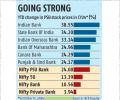
Stock Market News today, PSU banks: The year 2024 was a roller-coaster ride for Indian stock markets, marked by volatility driven by the Lok Sabha elections, Union Budget 2024, a slowdown in corporate earnings, and sticky inflation. Geopolitical tensions - particularly between Israel and Iran in West Asia - along with various stimulus announcements by China and yen carry trade rocked the equity markets throughout the year.

Public sector banks (PSBs) have proposed the Finance Ministry their plan to raise Rs 54,800 crore through Additional Tier-1 (AT-1) and Tier-2 bonds in the current financial year (FY25), 37 per cent more than the Rs 39,880 crore raised in FY24

While the CEO of a public sector bank earns an average of Rs 18 lakh per annum, his counterpart in the private sector earns an average of Rs 3.5 crore.

Reserve Bank of India (RBI) Governor Shaktikanta Das said on Friday said the central bank has developed an innovative artificial intelligence and machine learning (AI/ML) based model MuleHunter.ai to address the growing issue of mule bank accounts that are often used for committing financial fraud. Developed by the Reserve Bank Innovation Hub, the new initiative is piloted with two public sector banks.

The National Financial Reporting Authority (NFRA) will invite public comments on the revised International Standard on Auditing 600 (ISA 600) proposed to be adopted by publicly listed companies and non-public-sector banks, sources close to the development told Business Standard. The decision to take this "graded approach" for the adoption of the ISA, which is meant to rein in auditors often found hiding behind the audit reports signed off by subsidiary companies, was taken at a meeting of various financial sector regulators at NFRA's board meeting on Monday (August 26). The idea behind upgrading the Standards of Audit 600 currently followed by Indian auditors to ISA 600 is to plug current gaps, which have led to major audit lapses in the recent past.

'As we navigate uncertain waters, a conservative approach to largecap investing could provide a strategic advantage.'

The government will come out with a credit guarantee scheme for MSMEs to facilitate term loans without collateral or third party guarantee, Finance Minister Nirmala Sitharaman said on Tuesday. Presenting her seventh straight Union Budget, she also said that public sector banks to build in-house capability for credit assessment of MSMEs.
Public sector banks are inefficient, poorly governed and beset by largescale corruption.

Enterprising women business correspondents, known as BC Sakhis, have facilitated transactions worth Rs 27,000 crore in Uttar Pradesh, earning Rs 75 crore in commission over the past four and a half years. BC Sakhis, appointed under the nationwide women empowerment programme, are members of self-help groups (SHGs) who are trained and certified to provide banking and financial services in rural areas.

Ironically, bad loans and non-performing assets are on the rise in public sector banks in India, say sector watchers.

Finance Minister Nirmala Sitharman on Monday held a performance review meeting with heads of public sector banks and asked them to make concerted efforts to garner deposits. Deposits have been growing 300-400 basis points lower than the credit growth in the last few months, creating an asset-liability mismatch for banks. During deliberations on the deposit mobilisation, she said that while the credit growth has picked up, mobilisation of deposits could further be improved to fund the credit growth sustainably, and asked banks to make concerted efforts to garner deposits by conducting special drives.

Feature for feature, bank FDs are indeed better than debt funds today, mainly thanks to Ms Sitharaman, notes Debashis Basu.

While some equity analysts have raised target prices for public sector banks, others remain cautious

The Bharatiya Janata Party regime will have to make good on this election slogan to restore state-owned banks to health, says Rajiv Lall.

Officials asked what the point was in going through banks when the government has to give guarantees.
Public-sector banks, including Canara Bank and Bank of India, are tapping the infrastructure bond market. Canara Bank on Tuesday raised Rs 10,000 crore at a coupon rate of 7.40 per cent through 10-year infrastructure bonds. This comes after SBI on July 10 raised Rs 10,000 crore also through infrastructure bonds with a 15-year tenor at a coupon rate of 7.36 per cent.

Banks recorded a higher growth year-on-year (Y-o-Y) in raising deposits during the second quarter of financial year 2025 (Q2FY25) compared to Q1FY25, owing to intensified efforts to raise liabilities by offering higher rates and innovative schemes.
Moody's said the asset quality of the banks will remain under pressure.

'The central bank has highlighted that the slowdown in growth has been limited to a few sectors and overall growth is expected to pick up in the second half of the year.'

The RBI has changed the way it approached supervision in the past. Having seen a couple of collapses in the NBFC sector and the near-collapse of a few banks, it is focusing on regular drills to prevent a fire from breaking out, explains Tamal Bandyopadhyay.
Eying benefits from digital banking, lenders are now looking at building Unified Recovery Interface (URI) for enhancing efficiency, reducing costs, and getting good prices for properties of defaulters. This would be managed by PSB Alliance Ltd, a company set up by all public sector banks in the country. M V Rao, chairman, Indian Banks' Association (IBA), said: "Till now we had Unified Payments Interface (UPI), a product developed by National Payments Corporation Ltd (NPCI).

The finance ministry is in favour of extending the August deadline for public sector banks (PSBs) as well as insurance companies to increase their minimum public shareholding (MPS) to the mandated 25 per cent, said a senior government official. "The election results will determine the course of action. "Most likely, those who did not receive an extension to meet the minimum shareholding norm will be granted one," the senior government official said.

The bad assets or gross NPAs of commercial banks fell to a 12-year low of 2.8 per cent in March 2024 and may go down further to 2.5 per cent by the end of the current fiscal, said the RBI's Financial Stability Report (FSR) released on Thursday. Scheduled Commercial Banks' (SCBs) gross non-performing assets (GNPA) ratio fell to 2.8 per cent, and the net non-performing assets (NNPA) ratio to 0.6 per cent at the end of March 2024. "The asset quality of SCBs recorded sustained improvement, and their GNPA ratio moderated to a 12-year low in March 2024. Their NNPA ratio too improved to a record low," said the June FSR.
 © 2026 Rediff.com - Investor Information - Advertise with us - Disclaimer - Privacy Policy - Sitemap - Feedback - About us - Terms of use - Grievances