
Indian officials will visit the US to finalise the legal text for an interim trade agreement, expected to be signed in March, focusing on duty concessions and reciprocal tariffs.

Both countries commit to provide each other preferential market access in sectors of respective interest on a sustained basis

India has fully protected its sensitive sectors like dairy, rice, wheat, pulses, tea, genetically modified (GM) goods, and coffee by not granting any import duty concessions to the European Union (EU) under the bilateral free trade agreement, according to the Commerce Ministry.
US and India will promptly implement this framework and work towards finalising the interim agreement with a view to concluding a mutually beneficial bilateral trade agreement.

India's marine product exports facing rough weather from punitive US tariffs are expected to get a big boost following the reduction of 26 per cent tariff as part of the India-EU Free Trade Agreement (FTA), but concerns over non-tariff barriers, which are a dominant aspect of marine trade to the EU, still remain.

India and the European Union (EU) on Tuesday announced the conclusion and finalisation of negotiations for the proposed free trade agreement (FTA).

India has been on an FTA-signing spree of late. Since 2021, it has signed eight trade agreements, three of which -- with the UK, Oman and New Zealand -- were finalised in 2025 alone.

In a recent letter, the telecom equipment makers and their associations wrote: "We urge the government of India to suspend the October 30 draft DoT notification, clarify that the PMA policy will not be applied to any private sector procurements, and initiate a consultation process with global industry and other stakeholders to more effectively address India's security and economic concerns."

Unrelenting US pressure at the highest levels had led to New Delhi's capitulation.

India and the US desire to give preferential market access to each other's businesses and teams of both the countries are working together on the proposed bilateral trade agreement, Commerce Minister Piyush Goyal has said. In February, US President Donald J Trump and Prime Minister of India Narendra Modi announced plans to negotiate the first tranche or phase of a mutually beneficial, multi-sector Bilateral Trade Agreement (BTA) by fall (September-October) of 2025.

India's policy for agriculture trade must move commodity-by-commodity to gain maximum benefits as US President Donald Trump's 26 per cent tariff on exports from the country take effect, said agriculture economist Ashok Gulati in a recent policy paper.
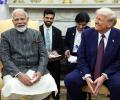
'India has very strong tariffs on certain imports from the US. Like in the automobile sector, India charges 100 per cent'

India's gold and silver imports from its free trade agreement (FTA) partner UAE have skyrocketed 210 per cent to $10.7 billion in 2023-24 and there is a need to potentially revise the concessional customs duty rates under the pact to mitigate the arbitrage driving this surge, a report said on Monday. Economic think tank Global Trade Research Initiative (GTRI) said this sharp rise in gold and silver imports is primarily driven by import duty concessions granted by India to the UAE under the India-UAE Comprehensive Economic Partnership Agreement (CEPA).

During his first term as the US president, Trump described India as a "tariff king" and in May 2019, terminated India's preferential market access.

The Union Cabinet on Wednesday approved the signing of a comprehensive economic cooperation agreement, a kind of a free trade pact, between India and Mauritius which is aimed at liberalising norms to boost two-way commerce
There is deep angst and growing concern by America Inc, over India's Preferential Market Access policy and fears that as a quid pro quo, lawmakers in the US Congress may limit or even prohibit the free movement of Indian technical professionals, including quashing efforts to expand the H-1 B visa program.

On Tuesday, members of Congress from both the Democratic and Republican parties wrote to India's ambassador, Nirupama Rao, asking the Indian government to reconsider its PMA policy and its impact on the information and communications technology sector.

Telecom equipment from China may face fresh curbs after the Cabinet on Wednesday cleared a proposal to secure telecom infrastructure by designating a "trusted source" for the purchase of equipment by service providers. Briefing reporters after the meeting of the Cabinet Committee on Security headed by Prime Minister Narendra Modi, Law, Telecom and IT Minister Ravi Shankar Prasad said a National Security Directive on Telecommunication Sector has been framed keeping in mind the national security.

Expressing deep concerns over India's policy of preferring domestically manufactured information and communication technology goods, the apex body of US telecom industry has told lawmakers that this will have negative impact on exports and economic competitiveness.

The Ministry of Home Affairs in the past has raised concerns on increasing FDI in telecom sector.

In a letter to Speaker of the US House of Representatives Nancy Pelosi, Trump said he was determined that New Delhi had "not assured" the US that it would "provide equitable and reasonable access" to the markets of India.

Currently, India imposes 30-45 per cent duty on textile products from Pakistan.
The government on Friday put on hold the preferential market access (PMA) policy that provided for sourcing of sensitive telecom and electronic equipments and technology from domestic manufacturers over security concerns.

Close on the heels of Boeing's defence of India to the US International Trade Commission's investigation into India's trade, investment and industrial policies, IBM has also sprung to New Delhi's defence in an otherwise sea of criticism of India's violations of intellectual property rights, local content requirements, among other issues of concern to US business and industry.
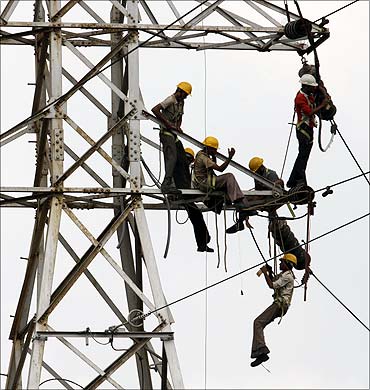
Power transmission infrastructure in 18 major cities could be potentially hacked.
.jpg)
Canadian phone maker Datawind which has supplied about 1,00,000 low-cost Aakash tablets to the government till date says that it would be a challenge to supply the device at Rs 2,500 a unit due to rupee volatility and other factors.
.jpg)
Expressing concern over the investment and innovation environment in India, a top US trade official has said the recent set of economic reforms initiated by the country were not enough to return to the path of robust growth.
Flaring of tempers comes atop much simmering trouble on clashing views; these stands might now get frozen.
 © 2026 Rediff.com - Investor Information - Advertise with us - Disclaimer - Privacy Policy - Sitemap - Feedback - About us - Terms of use - Grievances