
Green think tank Centre for Science and Environment (CSE) said the ongoing smog episode is a public health emergency.
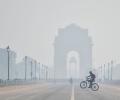
The report, however, shows that Delhi's air quality improved by approximately 15 per cent from 2019 to 2020.

Rohan and Madhav live at the PM's official residence.

The central government's Air Quality Early Warning System for Delhi said a significant increase in the number of "fire points" was observed over Punjab (around 3,000), Haryana and Uttar Pradesh on Wednesday, which is likely to impact the air quality of Delhi-NCR and other parts of northwest India.

The central government's Air Quality Early Warning System for Delhi said a "significant improvement in air quality is not likely" owing to slow wind speed, particularly during night time, and contribution from farm fires.

Experts said while meteorological conditions were "moderately" favourable for dispersion of pollutants, a "very high" number of farm fires in Punjab was the primary reason for "severe" air quality.

No improvement in the air quality in Delhi-NCR is expected for another three days, authorities said on Monday, as the Supreme Court directed the Centre to call an emergency meeting to decide on measures like stopping non-essential constructions, transport and power plants by Tuesday evening.

The national capital on Friday recorded a 24-hour average air quality index of 239. On Thursday, it was 315, the worst since February 12 when the AQI was 320.

The air quality had turned 'severe' on Saturday evening with stubble burning accounting for 32 per cent of Delhi's PM2.5 pollution, but firecracker emissions and calm winds made the situation even worse.
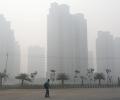
It also asked the governments of Punjab and Haryana to take immediate stringent actions to curb stubble burning and authorities in Delhi-NCR to strictly check biomass burning.
The prime minister's office on Sunday dismissed suggestions that Prime Minister Manmohan Singh had sought to look the other way in issuance of controversial 2G spectrum licenses and said suggestions had been made informally to the Department of Telecom to ensure that there was level-playing field between the existing operators and new entrants.

Long-term exposure to chronically high PM2.5 levels weakens the ability of the lungs to fend off infections, therefore making people more susceptible to COVID-19, the scientists said.

Omkeshwar Singh, Head, Rank MF, a mutual fund investment platform, answers your queries.

Omkeshwar Singh, Head, Rank MF, a mutual fund investment platform, answers your queries.

Nikunj Saraf, Vice President Choice Wealth, answers your queries.

The researchers discovered that just a 4.6 ppb reduction in long-term exposure to NO2 would have prevented 14,672 deaths among those who tested positive for the virus.

According to Central Pollution Control Board's (CPCB) Sameer app, the city's air quality index (AQI) stood at 449 in the severe category at 8 am on Saturday. It was 462 on Friday.

The smog reduced the visibility to merely 300 meters in the morning affecting traffic, an official of the India Meteorological Department said.

The results are based on epidemiological data collected up to third week in June 2020 and the researchers say a comprehensive evaluation will need to follow after the pandemic has subsided.
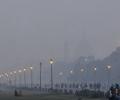
Pollution levels in Delhi during the Diwali period are likely to remain in the higher end of the 'very poor' category in the absence of emissions due to fireworks, the Ministry of Earth Sciences' air quality monitor, SAFAR said.

Less than six months ago, Delhi was gasping for breath. Authorities said air quality had reached "unbearable levels". Schools were shut, flights were diverted, and people were asked to wear masks, avoid polluted areas and keep doors and windows closed. But during the lockdown that began on Mar 22, the concentration of poisonous PM2.5 particles in a cubic metre of air averaged at 44.18, according to a Reuters analysis of government data, indicating a rare "good" rating, the safest level on the scale.

The dip in the air quality can be attributed to low wind speed and temperatures which allowed accumulation of pollutants.

Omkeshwar Singh, Head, Rank MF, a mutual fund investment platform, answers your queries.

Omkeshwar Singh, head, Rank MF, a mutual fund investment platform, answers your queries.

Given the rising levels of pollution, air purifiers have now become a necessity. Manavi Kapur and Veer Arjun Singh check out some of the options in the market.
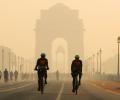
"The overall Delhi's Air Quality Index is in the very poor category with few Delhi locations entering at higher zone but that will be short lived. This is mainly because the extremely calm local surface winds which were prevailing yesterday are likely to increase slightly and may further pick-up by Oct 26," SAFAR said.

The green body's report said three of the world's largest nitrogen oxide air pollution emission hotspots that contribute to formation of PM2.5 and ozone are in India with one in the Delhi-NCR.

Pollution levels skyrocketed by the hour in Delhi on Sunday, turning the air quality hazardous, which agencies consider unfit for inhalation even by healthier people.

According to senior IMD scientist Kuldeep Srivastava, clear sky or absence of clouds allows sun rays to reach the ground, warming up the air close to the ground which lifts up and clears the pollutants.

Rediff Labs has taken the exposure of air pollution, burden due to air pollution and then disease due to air pollution in order to explain how India is affected by it and comparing it to global numbers.

According to the Central Pollution Control Board (CPCB), the 24-hour average concentration of lung-damaging fine particles known as PM2.5 in Delhi-NCR shot up from 243 micrograms per cubic metre at 6 pm on Thursday (Diwali day) to 410 micrograms per cubic metre at 9 am on Friday, around seven times the safe limit of 60 micrograms per cubic metre.

Experts said unfavourable meteorological conditions -- calm winds and low temperatures -- and smoke from farm fires in neighbouring states led to a dense layer of haze as the air quality index entered the "severe" zone.

According to SAFAR, both stubble burning in surrounding states of Delhi and firecrackers are causing deterioration of air quality in the national capital.

The victory of Prime Minister and Congress candidate Manmohan Singh appeared certain in the May 30 Rajya Sabha elections in Assam at the end of withdrawal of nomination papers on Thursday. At the close of the deadline for withdrawal, all the three contestants -- Dr Singh, who is the first Congress candidate, Santius Kujur, the party's second candidate and All India United Democratic Front's Aminul Islam remained in the fray.

Omkeshwar Singh, head, Rank MF, a mutual fund investment platform, answers your queries.
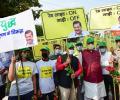
According to the Central Pollution Control Board's mobile application SAMEER, the city recorded an air quality index of 168, which falls in the 'moderate' category, much better than Monday's AQI of 221, which falls in the 'poor' category.

A CPCB official said a number of factors were responsible for the deteriorating air quality, including vehicular pollution, construction activities and meteorological factors.

The nationwide 'Janta Curfew' followed by the 21-day lockdown to combat the coronavirus outbreak have led to a significant reduction in pollution in the country, with 91 cities recording air quality in the 'good' and 'satisfactory' category on March 29, a Central Pollution Control Board report has stated. Travel restrictions and the closure of industries have helped reduce the pollution level, it said.

Stating that 'we cannot...infuse creativity in your bureaucracy', the apex court warned it will have to do something extraordinary if the authorities failed to control pollution.
