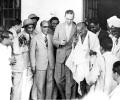
The Bombay High Court has requested a response from the Maharashtra Home Department and Nagpur police regarding a petition seeking action against a journalist and event organiser for allegedly making derogatory statements about Mahatma Gandhi.
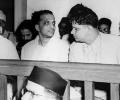
A Gujarati play about Nathuram Godse, Mahatma Gandhi's assassin, was cancelled in Ahmedabad after protests by Youth Congress and NSUI activists who claimed it glorified Godse. The play had previously faced disruptions in other Gujarat cities.
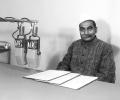
'The largest listenership for Vividh Bharati outside the country is in Spain.' 'The labourers who go there for the tomato-picking season feel cut off from their country and listen to Vividh Bharati to overcome their loneliness.'

Government was watching Gandhiji's mood to know if he had cooled down. They found out from his letters and utterances that he was the same old firebrand and even more determined than before.
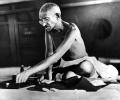
Gandhiji asked me if I had sufficient warm clothes in view of the coming cold season. I said yes. But he verified my statement by asking Miraben to search my bag to make sure. Such was Gandhiji.
'Modi will do himself a favour if he starts studying about Mahatma Gandhi.' 'I feel pity that we have a PM who has no idea of our own history.'

Some rare photographs of the Father of the Nation on his birth anniversary
'Even though Gandhiji did not know me well, Sardar knew and remembered me working with him till the Congress was banned.' Glimpses from the fascinating memoirs of Chakkedath Sankarankutty Menon, the stenographer who worked for Mahatma Gandhi and Sardar Vallabhbhai Patel during the freedom struggle.

'The sudden arrests and detentions of all Working Committee members led to mass satyagraha.' 'I found myself helpless as the source of my income, from which I sent a portion to my parents in the village, had suddenly stopped.'

Economist Gandhi: The Roots and the Relevance of the Political Economy of the Mahatma by retired entrepreneur Jerry Rao provides insights into a hidden facet of Gandhi's personality -- his thoughts on economics and capitalism -- and also highlights some of his views on religion, ethics, human nature, education and society.
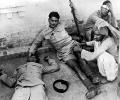
Have we been allowed to forget Partition? Isn't Partition the reason many Hindus cannot bring themselves to trust Muslims? So many Muslims born after 1947 have told me with anguish: "How long will we be blamed for Partition?" notes Jyoti Punwani.

Godse's choice fitted with the Hindutva world view in which the assertion of masculinity, power and virility -- both discursively and institutionally -- occupied the central position. His close association with Savarkar seems only to have sharpened his uncompromising views on women.
'During my nearly three decades of military service, both in war and peace, I have usefully drawn upon Gandhiji's storehouse of wisdom.' 'When military intelligence jobs require tightrope walking on the edge of moral and ethical dilemmas, I have looked up to Gandhiji,' notes Colonel R Hariharan (retd).

'Absolute non-violence is not only sinful, but immoral.' 'This doctrine of non-violence benumbed the revolutionary fervor, softened the limbs and hearts of the Hindus, and stiffened the bones of enemies.' A revealing excerpt from Vikram Sampath's Savarkar (Part 2): A Contested Legacy, 1924-1966.

'Where children are told soothing bedtime tales, our daily fare were stories of the bloodshed my family had witnessed, scenes, my father said, of the sewers turning red and the overpowering stench of corpses,' remembers Sunil Sethi.

'Gandhi turned his life into a counter-intuitive experiment in old ideas like non-violence and swadeshi.' 'He offered numerous universal ideas that talk to the human condition.' 'His ability to take risks was outstanding,' says Sopan Joshi, explaining why the Mahatma's ideas are as relevant as ever.

'There she was, standing before me, burning with fever but ready to dance. She was like that. When it came to her dancing it didn't matter to her whether she was well or unwell,' says the legendary Birju Maharaj.
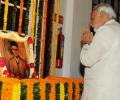
'There was the indisputable fact that Savarkar knew Godse, Apte and Karkare well, he had corresponded with them closely, and funded their extremely provocative newspaper, and they looked up to him as their icon.'

The British administration ignored the mounting evidence of violence between Hindus and Muslims... Military historian Barney White-Spunner traces the countdown to the tragedy in his book, Partition.

Photographer S Paul, who died this month, was furiously protective about his independence and intensely sure about his work. So much so that he once walked away from a shoot with a prime minister.

On the occasion of Gandhiji's birthday, Rediff.com presents an excerpt from the book that shows how Gandhi changed the face of cricket as it was played then.

'This book is really the story of the woman whose destiny takes her onto the path of an inordinately iconic man whom the world reveres as God!' 'It is the day-to-day demolition of her dreams that are at stark variance with those who view him as a trail blazer on the holy path to redemption, while he wrecks the peace of those whom he loves the most; his family.'
 © 2026 Rediff.com - Advertise with us - Disclaimer - Privacy Policy - Sitemap - Feedback - About us - Terms of use - Grievances