
Public sector banks have raked in more profits in the three months ended June on the back of a persistent decline in bad loans and the trend may have a positive bearing on their balance sheets in the coming quarters. In the June quarter, Bank of Maharashtra (BoM) and State Bank of India (SBI) were in the lowest quartile as far as Gross Non Performing Assets (NPAs) and net NPAs were concerned, according to an analysis of the quarterly financial numbers published by the public sector lenders. Cumulatively, all the 12 public sector banks reported a profit of about Rs 15,306 crore in the three months ended June, registering an annual growth of 9.2 per cent. However, leading public sector lenders -- SBI and PNB -- posted lower profits in the June quarter.

Most of those punished were managers across different scales, from Scale 7 (general managers) to Scale 1 (officers). However, at least one bank - Oriental Bank of Commerce - revealed that 17 single-window operators (SWOs), five head cashiers, two clerks, one clerk-cum-cashier, and one peon-cum-housekeeper were among those penalised for staff delinquency. Punishments against these employees included withholding of increment, demotion for one year, and censure under provisions of the bipartite settlement.

Public sector banks have lost nearly Rs 2.85 lakh crore on account of loan dues of 13 corporates even as the banks are used to bail out ailing financial institutions such as Yes Bank and IL&FS, United Forum of Bank Unions alleged on Monday. In a press release, UFBU's convener B Rambabu said the organisation calls for a two-day all India bank strike on December 16 and 17 protesting against Banking Laws (Amendment) Bill 2021 and opposing the Centre's alleged move to privatise PSBs. According to the statistics given by the UFBU, the 13 corporates' outstanding dues were at Rs 486,800 crore and it was resolved at Rs 161,820 crore resulting in a loss of Rs 284,980 crore.

The government can issue recapitalisation bonds, or the RBI's huge reserves of over $127 can also be dipped into to help the state-owned bank's recapitalisation needs.

The FM he said non-performing assets of PSBs have come down by Rs 1 lakh crore.

"This is a budget to deceive the masses. It's an anti-farmer, anti-people and anti-country budget," Banerjee said while addressing the inaugural ceremony of Uttar Banga Utsav.

Eminent economist Arvind Panagariya has said India is on the cusp of returning to a high growth trajectory and voiced confidence that the country will become the world's third-largest economy by 2027-28. Currently, India is the fifth largest economy "so it's another five years.We are already in (the year) 2023. "So 2027-28, India should be the third-largest economy," Panagariya, Columbia University Professor and former Vice Chairman of NITI Aayog, told PTI in an interview in New York.

Prime Minister Narendra Modi on Thursday said his government is using all channels including diplomatic to bring back high-profile economic offenders, leaving them with no option but to return to the country. Speaking at a symposium on credit flow and economic growth, he asked banks to support wealth and job creators with proactive lending while promising to stand by any loans given in right earnest. "In our attempt to bring back fugitive (economic offenders), we relied on policies and law and also used diplomatic channels.
The PCA plan covers various suggestions or measures to recover non-performing assets (NPAs), reduce costs, boost capital, downsize risk-weighted assets, and improve profitability, among others. The LVB management is in the process of implementing all of these, said sources.

The government in the Budget 2021-22 has made an allocation of Rs 20,000 crore for the capital infusion in the state-owned banks. The capital position of banks would be reviewed in the next quarter, and depending on the requirement, the infusion will be made to meet the regulatory needs. In the current fiscal so far, all 12 public sector banks have posted a profit, which is being ploughed back to bolster the balance sheet of the banks, sources said.

Indeed, there were frauds, and the politician-banker-industrialist nexus played a role in the rise of NPAs, but governance issues in Indian banking are far more nuanced and complex, reveals Tamal Bandyopadhyay.
The total quantum of non-performing assets in the Indian banking system increased to Rs 7.33 trillion as of June 2017, from Rs 2.75 trillion in March 2015.

Besides financials, shares of telecom, IT, auto and pharma were in demand.
He said the impact of the second wave of COVID-19 has waned by August,and economic growth will be better from the second quarter onward on a sequential basis. Speaking at an event organised by The Indian Express and Financial Times, Das said the RBI has decided to give more emphasis on growth because of the pandemic and operate in the 2-6 per cent inflation band set by the government for it. The central bank will seek to gradually move towards achieving the 4 per cent target over a period of time, he said, adding that the possibility of a sustained increase in inflation is unlikely.

Income of the bank during March quarter of the last financial year rose to Rs 76,027.51 crore from Rs 75,670.5 crore in the same period of 2018-19.

Although such alerts are not compulsory for the banks, this may become the norm now if payments are missed even for a day.

India is poised to be the fastest-growing major economy in the world and an engine of global growth despite global headwinds, says leading industrialist and Aditya Birla Group Chairman Kumar Mangalam Birla. The economic activity in India has witnessed a sharp recovery to pre-pandemic levels on the back of a rapid and widespread rollout of the vaccination programme, Birla said in the latest annual report of UltraTech Cement Ltd. "A strong digital ecosystem, fiscal and monetary policy and various government schemes helped small and medium enterprises and the worst affected sections of the population to survive while reviving demand and bringing the economy back on track," said Birla while addressing UltraTech's shareholders.

Paving the way for takeover of crisis-ridden Punjab and Maharashtra Cooperative Bank (PMC), the Reserve Bank of India on Friday granted in-principle approval to the Centrum Financial Services to set up a small finance bank. Centrum Financial Services was one of the applicants for takeover of the PMC Bank. "This 'in-principle' approval has been accorded in specific pursuance to the Centrum Financial Services Limited's offer dated February 1, 2021, in response to the expression of interest notification (November 3, 2020) published by the PMC Bank Ltd," the RBI said in a statement.

Only NIIF has stayed the course as a viable infrastructure financing institution.

The bank's gross non-performing assets rose to 10.69 per cent of total advances at the end of June, against 9.97 per cent a year ago.

The meeting will review annual financial performance of public sector banks, credit offtake in the economy, priority sector lending and progress made under various social sector schemes, including Atal Pension Yojana (APY) and Pradhan Mantri Jan Dhan Yojana.

Finance minister Nirmala Sitharaman on Wednesday exuded confidence that inflation would further decline and the government is on track to meet its budgetary target for deficit and said that there is no fear of stagflation in India. Replying to the debate on first batch of Supplementary Demands for Grants 2022-23 in Lok Sabha, the finance minister said inflation has come down and it is now in the tolerable band of the RBI. Inflation has been declining since April 2022 and it is declining further, she said.

The country's largest lender SBI on Friday reported an 80 per cent surge in standalone net profit at Rs 6.450.75 crore for the fourth quarter ended March 2021, aided by decline in bad loans. State Bank of India (SBI) had registered a profit of Rs 3,580.81 crore during January-March period of 2019-20, the lender said in a regulatory filing. Total income of the bank during the March quarter of the last financial year rose to Rs 81,326.96 crore, from Rs 76,027.51 crore in the same period of 2019-20.

The country's largest lender State Bank of India on Monday said it has reduced interest rates on home loans by up to 10 basis points (bps) and is offering loans starting from 6.70 per cent rate. The new rates are based on loan amount and CIBIL score of the borrower, and are available till March 31, 2021, according to a statement. The bank said the home loan interest rates will start from 6.70 per cent for loans up to Rs 75 lakh and 6.75 per cent for loans in the range of Rs 75 lakh-Rs 5 crore.

The drop in net interest margin will separate the men from the boys, explains Tamal Bandyopadhyay.

Rs 2.06 trillion, is the gross non-performing assets of Indian banks.

They also warned that banks will start reporting higher non-performing assets after September, once the six-month moratorium on loan repayment ends.

HDFC and HDFC Bank were the biggest losers in the Sensex pack, plunging 5.09 per cent and 3.32 per cent, respectively, after the private bank reported a rise in non-performing assets.

The CBI has filed a fresh case against absconding diamantaire Mehul Choksi, wanted along with his nephew Nirav Modi in a loan fraud case of Rs 13,500 crore, for allegedly inflating the value of diamonds and jewellery pledged to get Rs 25 crore loan from IFCI, officials said on Monday. The CBI has booked Mehul Choksi, his company Gitanjali Gems and valuers Surajmal Lallu Bhai and Co, Narendra Jhaveri, Pradip C Shah and Shrenik Shah, they said. The central agency has acted on a complaint from Industrial Finance Corporation of India (IFCI) Ltd alleging that Choksi had approached it in 2016 seeking Rs 25 crore working capital loan for which he had pledged shares and gold and diamond jewellery.
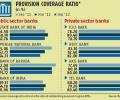
Amid a rise in non-performing assets, most public sector banks have seen a substantial drop in their provision coverage ratio in the year since the reserve Bank of India (RBI) withdrew the 70 per cent provision coverage ratio norm.

The asset quality of non-banking financial companies (NBFCs) deteriorated in April-September 2021 (H1FY22) owing to the second wave of the pandemic. Their gross non-performing assets (NPAs) rose to 6.8 per cent in September 2021 from 6 per cent in March 2021. The Reserve Bank of India's (RBI's) annual Trend and Progress report (FY21) said the sector might have to grapple with higher delinquencies as and when policy measures unwound. The pandemic posed significant challenges to NBFCs during the first wave (2020) also.

'There will be a series of rate hikes, but the pace and quantum will depend on how the economy in the US and the rest of the world behave.'

RBL Bank's interim chief executive officer (CEO) and managing director (MD) Rajeev Ahuja on Sunday tried to allay concerns around the health of the bank. He said events during the weekend are not linked to RBL's asset quality. The bank said Vishwavir Ahuja, its managing director (MD) and chief executive officer (CEO), had on Saturday proceeded on leave with immediate effect on medical grounds.

A strong performance by sectors including banking raised the profits of Indian companies by 28 per cent in the three months ended March 2022. The rate of growth is, however, lower than the 30 per cent seen in December. Growth in net sales was also lower than what was seen in the December quarter for the sample under consideration.

Life Insurance Corporation (LIC) has received the insurance regulator's nod for time till January-end 2023 to dispose of investments in pension, group and life annuity funds, which do not fall in the "approved investment" category. Had the Insurance Regulatory and Development Authority (Irdai) denied more time to transfer the investments to shareholders' fund at amortised cost, the loss that would have accrued in the profit and loss account (shareholders account) would have been Rs 5,365.83 crore as of September 2021, LIC said in its draft red herring prospectus (DRHP).
Banks' bad loans might cross Rs 10 lakh crore by the end of this fiscal, mainly on account of slippages in retail and MSME sectors, a study said on Tuesday. "NPAs are expected to rise to 8.5-9 per cent by March 2022, driven by slippages in retail, Micro, Small and Medium Enterprise (MSME) accounts, besides some restructured assets," the study by industry body Assocham and ratings firm Crisil said. The study titled 'Reinforcing the Code' said the Gross Non-Performing Assets (GNPAs) of banks are expected to cross Rs 10 lakh crore by March 2022.

Transiting from "survival mode", which took most of the management time in FY21, the bank has been able to take a long-term view in terms of growth and preparing technology in the past 12 months.
SBI Chairman Pratip Chaudhuri told reporters in New Delhi on Thursday the Kingfisher Airlines (KFA) account had turned into a non-performing asset (NPA). "The account became an NPA on December 31, 2011. They are in default," Chaudhuri said.

Non-performing assets of banks have increased from Rs 2.75 lakh crore in March 2015 to Rs 7.33 lakh crore as on June 2017.
The Centre should privatise all public sector banks (PSBs), except the State Bank of India (SBI). This is because private banks have emerged as a credible alternative to PSBs with substantial market share. Also, government ownership hinders the ability of the Reserve Bank of India (RBI) to regulate the sector, according to a report by the National Council of Applied Economic Research (NCAER).
 © 2026 Rediff.com - Investor Information - Advertise with us - Disclaimer - Privacy Policy - Sitemap - Feedback - About us - Terms of use - Grievances