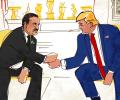
'Trump has personally weighed in to overcome doubts and reservations about Pakistan among his top advisors.'

'We should watch -- in the near term -- for signs that the two have totally fallen out at a personal, political level.' 'Trump and Modi know how to be dealmakers, but they also know how to hold a grudge.'

'Every decision India makes along the LoC, it must also consider implications along the LAC.'

'Unfortunately, India and Pakistan could learn a 'lesson' from this conflict that will make them more likely to use these weapons against each other in the future.' 'Rounds of missile and drone attacks could be more routine features of their hostility, just like artillery fire has become a familiar fact of life along the Line of Control.'

US senators have alleged that TikTok, owned by the Chinese Communist Party, has interfered in elections of various countries, including India, and called for extending the deadline for a ban on the platform in the US. They applauded India's ban on the social media platform, citing concerns about Chinese propaganda and data harvesting. Lawmakers, including Democrats and Republicans, introduced legislation to delay the ban by 270 days, arguing it would allow for a more thorough review of the implications and potential alternatives to a ban. They also criticized the rushed nature of the ban and its potential impact on free speech and the livelihoods of American users.
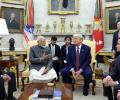
'By his words, actions, and body language during their joint press appearance wanted to convey his personal respect and, more broadly, his desire to work closely with India.'

Biden is not risking his reputation in a crucial election year, argues Ambassador M K Bhadrakumar.

'India's specific concerns about whether Russia will be a reliable defense supplier and diplomatic partner in the event of heightened hostilities with China has undoubtedly accelerated the process of US-India defense and intelligence cooperation intended to support Indian military positions along the Line of Actual Control.'

'The United States should not, by this logic, expect India to create military distractions along the Line of Actual Control, hold up Chinese shipping in the Indian Ocean, or even openly provide intelligence or basing for US forces transiting the region.'

'This incident offers ammunition to those inside the US government and elsewhere who question the wisdom of trusting India, so it will have a lasting consequence no matter how it is managed.'

'The general perspective -- certainly on Capitol Hill and Congress -- the love for India, the positive feeling for India still focuses on India as a democracy.' 'The more that Indian democracy and its pluralistic features is called into question by Indians, the more that same debate will replay back here.'

Making nuclear exemptions for India, says Senator Edward Markey, 'only infuriates Pakistan and leads them to further increase their own nuclear capacities.'

The US has realised that China is cutting lucrative deals in South America as more nations are joining Beijing's Belt and Road Initiative.

Former vice president Hamid Ansari and four US lawmakers have expressed concern over the current human rights situation in India. They were speaking at a virtual panel discussion organised by the Indian American Muslim Council on Wednesday.

The fundamental challenge to United States-India strategic cooperation is China, says Daniel Markey, senior fellow for India, Pakistan, and South Asia at the Council on Foreign Relations, where he specialises in security and governance issues in the subcontinent.

Much sophistication is needed by US policymakers if the US-India relationship is to be on a par with Washington's most durable strategic partners
The foreign secretary should delegate policy execution

Council on Foreign Relations Senior Fellow Daniel Markey Tuesday said that the raising of the issue of American intervention in Jammu and Kashmir by visiting Pakistani Prime Minister Nawaz Sharif at the United States Institute of Peace in Washington was not 'especially constructive' and was motivated by political expediency.
South Asia expert Daniel Markey believes India will not go to war with Pakistan. His reading of comments made by the external affairs minister leads him to believe that India does not consider a short-term military solution.

US Secretary of State Antony Blinken on Saturday (local time) said the US is working closely with its partners in the Indian government to deploy more supplies and additional support amid the record upsurge in Covid-19 infections in the country.

According to CBS Boston, the 40-year-old actor is on a list of possible successors to Massachusetts Senator John Kerry, the Politico reported.
Noting that Pakistan's Prime Minister-elect Nawaz Sharif appears to be sincere in his effort to improve relationship with India, a former top American diplomat has said he might not be able to do much unless he brings on board the powerful military.
Former senior Administration policy expert on South Asia, Daniel Markey, just back from Pakistan after meeting senior political and security officials in Islamabad, has said that for all of the internal terrorist attacks and continuing existential threats from extremist elements in Pakistan, India is still perceived as the primary security threat.
The illegal modifications in the anti-ship Harpoon missiles is a provocative and destabilising action by Islamabad and threatens the "delicate" India-Pakistan ties, an influential US lawmaker has said.
Charging that Islamabad has not taken any concrete action against the group, Daniel Markey, Senior Fellow for India, Pakistan and South Asia, Council on Foreign Relations (CFR), said US President Barack Obama should focus on LeT and other extremist organisation which are of enormous concern.
Facing the 'undeniable' threat of another Mumbai-type attack by Pakistan-based terror groups, which may act under Al Qaeda's direction, India is most likely to retaliate militarily in such a scenario, according to a prominent American think tank.
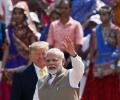
'Flattering press, nice photos, no major gaffes.' 'Both sides will be very happy as they are clearly measuring 'success' by a different yardstick than the world used in the past.'
When she served in the United States Congress, Democrat Ellen Tauscher was one of the most vehement critics of the Indo-United States civilian nuclear deal.
Expressing concern over the nuclear arms race in South Asia, a senior Democratic lawmaker, who opposed the Indo-US civilian nuclear deal, has asked the Obama administration to "encourage" India and Pakistan to sign Comprehensive Nuclear Test Ban and halt production of nuclear-weapon fissile material.
Though Pakistan fears that a repeat of the Mumbai attacks could be "very dangerous" to it, there is relatively little shift in its attitude towards India which it views as a "threat", a noted US scholar has said.
With the Bush administration pushing hard for a quick Congressional nod for the landmark India-United States civil nuclear agreement, a small group of senior Democratic lawmakers have demanded the detailed examination of the pact.The three-person group led by Massachussetts Congressman Edward Markey has said that there are many lingering questions about the deal that require further examination and hence the Congress should rule out any rush for an expedited vote.
The United States House of Representatives on Friday postponed the formal vote on the approval legislation for the India-US civilian nuclear agreement, following a 40-minute debate.House Foreign Affairs Committee Chairman Howard Berman, a known opponent of the deal, supported the Senate version of the Bill saying the deal is a positive step as it will bring India into the non-proliferation regime.Fellow Democrat Edward Markey demanded a recorded vote.
Daniel Markey, a senior fellow at the Council for Relations, is a long-standing expert on India, Pakistan, and South Asia, specialising in security and governance, international conflict, theories of international relations, and the US foreign policy in the region.
Acceptance of the draft waiver in its current form could fuel a nuclear arms race in the Asian subcontinent, Edward J Markey, a critic of the Indo-US civilian nuclear deal said, as the 45-member grouping yesterday held discussions over the matter as part of a two-day meet in Vienna.

The US Senate Foreign Relations Committee held a hearing on US-Pakistan relations and had a lively debate on the issue whose transcript was released on Sunday.
The high-powered US Congressional delegation led by US House of Representatives Speaker Nancy Pelosi that visited India last month and met Prime Minister Manmohan Singh and other senior Indian officials, has made it clear that it is the Hyde Act and not the 123 Agreement that is binding on the Indo-US civilian nuclear agreement that now remains stalled in New Delhi.

Pai is the fourth Indian-American to become part of Trump's administration.
 © 2026 Rediff.com - Investor Information - Advertise with us - Disclaimer - Privacy Policy - Sitemap - Feedback - About us - Terms of use - Grievances