
ISRO stated that the disengagement of at least one contact -- in both the main and redundant paths -- of a connector led to the failure of NVS-02.
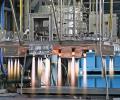
With these successful tests, ISRO has moved a step closer to India's first human spaceflight mission, Gaganyaan.

'The satellite's condition is healthy.'
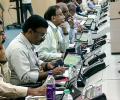
'The work is already on with various data being studied.'
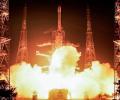
ISRO's vendor policy and quality control processes are under scanner.
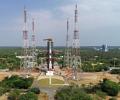
Days after landing on the Moon, India will aim for the Sun on Saturday with its maiden solar expedition, as ISRO's trusted PSLV will carry the Aditya L1 mission on a 125-day voyage to the Sun.

Space scientists began the exercise at 8:17 am by commanding the satellite from Master Control Facility at Hassan in Karnataka
INSAT-4A, India's most advanced and powerful communication satellite, has been successfully placed in near geo-synchronous orbit and its solar panels and two antennae have been deployed.
All systems on board the satellite were functioning normally.
The apogee [farthest point] is 36,000km and the inclination of the orbit with respect to the equatorial plane has been reduced from 7.37 degrees to the present 0.32 degrees,

Weighing about 5,854 kg, GSAT-11 would play a vital role in providing broadband services across the country, and also provide a platform to demonstrate new generation applications.

"First orbit raising operation of GSAT-6 was successfully completed by firing the Apogee Motor for 3385 seconds at 8:35 pm IST on August 28," the ISRO said.

In a crucial manoeuvre ahead of India's Mars orbiter's entry into the final destination on September 24, the main liquid engine on the spacecraft was on Monday successfully test fired and its trajectory corrected.

"Efforts are underway to establish the link with the satellite," it added.

Ahead of India's Mars orbiter's scheduled rendezvous with the red planet on September 24, ISRO is all set for the crucial fourth trajectory correction manoeuvre and test fire of the main liquid engine on the spacecraft on Monday.
The feat is the second one for the Indian Space Research Organisation scientists in using the indigenously made cryogenic stage after the January 5, 2014 launch of GSLV-D5.

The ISRO lost communication with the satellite when it attempted to ignite the engine in a third and final move to its desired location.

Nail-biting moments gave way to celebratory mood at the command centre of Indian Space Research Organisation in Bangalore on Wednesday, as its Mars Orbiter Mission or Mangalyaan entered the red planet's orbit.

India successfully placed its spacecraft in orbit around Mars, becoming the first country in the world to succeed in such an inter-planetary mission in the maiden attempt itself.
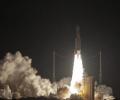
Boosting India's communication services, its latest satellite GSAT-16 was successfully launched on board Arianespace rocket from the spaceport of Kourou in French Guiana in the early hours of Sunday, after a delay of two days due to bad weather.
 © 2026 Rediff.com - Investor Information - Advertise with us - Disclaimer - Privacy Policy - Sitemap - Feedback - About us - Terms of use - Grievances