
Unhappy over Pakistan's repeated claim about lack of evidence to prosecute Jamaat-ud Dawa chief Hafiz Saeed, India on Wednesday said it should not ask any more questions as enough proof has been provided in the dossiers on Mumbai attacks. "They should not ask any more questions. Everything is contained in the dossier," Home Minister P Chidambaram told reporters in New Delhi when asked to comment on Pakistan's claim that it does not have evidence to prosecute Saeed.
Pakistan's interior minister Rehman Malik has said the government would not allow banned outfits and parties to take out any rallies or advertise themselves.
The trial court hearing the 26/11 terror attack cases issued non-bailable warrants on Tuesday against 22 absconding accused, including Jamaat-ud-Dawa chief Hafeez Saeed and head of operations of Lashkar-e-Toiba Zaki-ur-Rehman Laqvi.

Syed Firdaus Ashraf/Rediff.com presents the names of 10 global terrorists who, according to United Nations Security Council, are operating against India from Pakistan.
India has said that it is disappointed with the verdict passed by the Pakistan Supreme Court on 26/11 mastermind Hafiz Saeed.
Pakistani authorities are keeping a close watch on Jamaat-ud-Dawa chief Hafiz Mohammad Saeed, who is allegedly the mastermind behind the terror attack on Mumbai, after a court ordered his release from detention three days ago. Personnel from the Prison Department were withdrawn from Saeed's residence in Johar Town in Lahore soon after the Lahore High Court released him from house arrest on Tuesday.However, the government of Punjab province has deployed policemen at his home.
"We are unhappy," said Home Minister P Chidambaram, reacting to Jamaat-ud-Dawa chief Hafiz Mohd Saeed's release by a court in Pakistan.
The United Nations Security Council's sanctions committee has not received any petition from Pakistan-based Jamaat-ud-Dawa, a front for Lashkar-e-Tayiba, to reconsider the decision declaring it as a terrorist group, a top official said on Thursday. Reports from Pakistan had said that the JUD is appealing the decision but Coordinator of Al Qaeda and Taliban Sanctions Monitoring Committee Richard Barrett said no such petition has been received.

Pakistan should review its stand on India as its "restrained" policy is being taken as "weakness", believes Jamaat-ud-Dawa chief Hafiz Saeed.
The Pakistan government today banned Jamaat-ud-Dawa, the front organisation for the outlawed LeT blamed for the Mumbai attacks, after the UN Security Council declared it a terrorist outfit and sealed its nine offices in Sindh apart from rounding up over 20 of its activists.
This residential school boasts of a sprawling campus, dotted with trees, where students go about their regular classes. The school campus includes a farm, a swimming pool and a hospital. It is hard to believe that this is allegedly the breeding ground of Fidayeen terrorists, including those who unleashed terror in Mumbai last week, according to a report in the Gaurdian.
The Bharatiya Janata Party on Monday said a Pakistan court order quashing cases against Mumbai terror attack mastermind and Jamaat-ud-Dawa chief Hafiz Saeed was a "big setback" to India's efforts to bring him to justice and "proof" that Pakistan does not want to act against those behind the attack.
India on Monday reacted strongly to the Lahore High Court's order to dispose of the anti-terror case against Jamaat-ud-Dawa chief Hafiz Saeed, the alleged mastermind behind the November 26, 2008 Mumbai terror attacks.

Saeed was booked by the Pakistani authorities for allegedly inciting people to wage 'jihad' (holy war) against 'infidels'.

Banned Jamaat-ud-Dawa chief Hafiz Mohd Saeed has joined the debate over conditions attached to US aid to be provided to Pakistan, charging that clauses asking the country to take action against militant groups had been included due to "Indian pressure".

Special public prosecutor in the 26/11-terror attacks case, Ujjwal Nikam, on Friday demanded that the Pakistani court should conduct an open trial in the case, slated to begin there on Saturday.
Pakistani Prime Minister Yousuf Raza Gilani on Tuesday confirmed the arrest of Hafiz Saeed, chief of the banned organisation Jamaat-ud-Dawa.
Amid global concerns that terrorists may take advantage of the devastating floods in Pakistan, the Jamaat-ud-Dawa (JuD), blamed by India for the Mumbai attacks, has claimed that it has received donations for the deluge-hit people from "hundreds" of British-Muslims. The JuD, which acts as a front for the Lashkar-e-Tayiba that carried out the 2008 strikes in Mumbai leaving 166 people dead, is said to have significant support in the UK, The Sunday Times reported.

Pakistan President Asif Ali Zardari does not believe that India's demand to take action against Jamaat-ud-Dawa chief Hafiz Mohammad Saeed, the mastermind of the terror attacks on Mumbai, is a 'major hurdle' and was hopeful that relations would be normalised soon between the two neighbours."I don't think the issue of Hafiz Saeed is a major hurdle in the normalisation of our relations. I am hopeful that ties between the two countries will be restored very soon," Zardari said.

Mahmood Ali Durrani, who was sacked as the Pakistan's National Security Advisor after he acknowledged Ajmal Kasab's Pakistani nationality, has insisted that Jamaat-ud-Dawa chief Hafiz Saeed had no role in the 26/11 terror strike and has asked New Delhi not to "push" Islamabad.
Even as Pakistan continues to claim that India has not provided enough evidence in the Mumbai terror attack case, Interpol has suggested otherwise by issuing an arrest warrant against Jamaat-ud-Dawa chief Hafiz Saeed.
The two boys were brainwashed into believing that there was no need for educational qualification as they were destined to go to paradise.
India has said it would talk to Pakistan if it takes "credible steps" to demonstrate its willingness to fight terror both "within and without". External Affairs Minister S M Krishna, however, suggested that Pakistan had not done enough to bring to justice the perpetrators of Mumbai attacks and highlighted the release of Jamaat-ud-Dawa chief Hafiz Saeed as a case in point.
A meeting organised by the Jamaat-ud-Dawah in Lahore on Saturday demanded that the government should either stop India from building dams on rivers flowing into Pakistan or give a 'free hand' to the 'Kashmiri mujahideen' to deal with the issue. A joint declaration issued by the Jamaat-ud-Dawa after the meeting asked the Pakistan government to keep open the option of using force to protect its water resources if India does not stop work on projects.
On the eve of the Indo-Pak foreign secretary-level talks, Pakistan on Wednesday said that India's demand for handing over of Jamaat-ud-Dawa chief Hafiz Saeed, the mastermind of the 26/11 Mumbai attacks, should not be bracketed with the parleys as it would be 'counter-productive.'
India is expected to convey its unhappiness over Pakistan's equivocation on Jamaat-ud Dawa chief Hafiz Saeed to US Under Secretary of State William Burns, who arrived in New Delhi on a two-day visit.
Terrorist groups, which were banned during the tenure of former President Pervez Musharraf, have again become active and reopened their offices in the southern Pakistani port city of Karachi.
The outlawed Jamaat-ud-Dawa said on Wednesday that it would frame an "appropriate response" to the Red Corner Notice issued against its chief Hafiz Mohammad Saeed by Interpol, even as it emerged that the prime accused in 26/11 attacks was not on government's exit control list. "Our legal team is looking into the matter that has come to our notice and we will come out with an appropriate response," JuD spokesman Yahya Mujahid told PTI.
International pressure made Pakistan act against Saeed and Nazir Ahmed as well as the five involved in the Mumbai attack. Now, Pakistan calculates that international pressure will be less because of its strong action against the Taliban. It hopes to take advantage of this for once again ensuring that the LeT and its capabalities to attack India remain.
The UN on Friday, said it is yet to receive any appeal from Jamaat-ud-Dawa or four of its top leaders to review the sanctions imposed on them by the Security Council in the wake of the Mumbai terror attacks. If received, the request would need to be considered by the Security Council, with the letter for review being sent through a member state.
The Lashkar-e-Taiyba and the Jamaat-ud-Dawa might have disowned him, but the father of the lone Pakistani gunman arrested for the Mumbai terror attacks has admitted that the young man whose photograph was beamed by media across the world, is his son.Amir Kasab, the father of Ajmal Amir Iman alias Ajmal Kasab, broke down as he made the admission to the influential Dawn newspaper in the courtyard of his house in Faridkot.
The JUD has been banned by the United States for its role in terrorist activities and India has criticised the Pakistani government for permitting to let it work in PoK in the aftermath of the October 2005 earthquake there.
Saeed called Geelani in Jammu and Kashmir and "expressed his concern" over the health of the Hurriyat leader, the Jamaat-ud-Dawa, an organisation founded by Saeed and seen as the parent of the LeT, said in a release from Lahore.
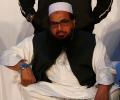
At a media briefing, ministry of external affairs spokesperson Arindam Bagchi asked Pakistan to focus on setting its own house in order in containing terror networks and said that the international community is well aware of that country's credentials when it comes to terrorism.

As per the charges, these proscribed outfits were operating under the guise of charities and were involved in funnelling funds to terror suspects.
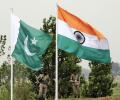
The govt said the onus is on Pakistan to create such a conducive atmosphere, including by taking "credible, verifiable and irreversible" action to not allow any territory under its control to be used for cross-border terrorism against India.
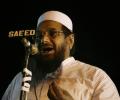
"We are going to wage jihad (war) against India to get our rivers freed," Saeed said while addressing a gathering of JuD workers in Sialokot district of Punjab Province on Friday.

Pakistan has quietly banned Tehreek-e-Azaadi Jammu and Kashmir, a new front for Hafiz Saeed's Jamaat-ud-Dawa, as international pressure on the country grew, including from a global watchdog, to combat terror and its funding.
 © 2026 Rediff.com - Investor Information - Advertise with us - Disclaimer - Privacy Policy - Sitemap - Feedback - About us - Terms of use - Grievances